
Rib Fracture Non-Union: Clicking Pain, Secondary Plating, and Rehabilitation
In short
Clinical identification of rib fracture non-union, pseudarthrosis, audible clicking, and rehabilitation protocols following secondary plating.
In this guide (2 sections)
While the vast majority of rib fractures achieve solid bony union within eight to twelve weeks, an estimated five to ten percent fail to heal, progressing to chronic rib fracture non-union (pseudarthrosis). Characterized by persistent localized pain lasting beyond three to six months, painful clicking or popping during torso rotation, and progressive functional disability, non-union represents a failure of mechanical stabilization or biological osteogenesis. When conservative therapies fail, secondary surgical stabilization of rib fractures (SSRF) with titanium plating and bone grafting provides definitive relief, requiring a specialized postoperative rehabilitation pathway.
Pathobiology of Pseudarthrosis and Friction-Induced Clicking
Rib non-union typically develops from excessive continuous motion at the fracture site (interfragmentary strain exceeding 10 percent), wide initial displacement, poor regional vascularity, or severe underlying tissue disruption. Rather than forming continuous trabecular bone, the body lines the persistent fracture gap with dense fibrous scar tissue and a synovial-like pseudo-capsule (pseudarthrosis). Every respiratory excursion, cough, or trunk twist causes the unanchored bone ends to rub and slide against one another, producing an audible or palpable 'click.' This continuous micro-motion chronically irritates adjacent intercostal nerves, generating disabling mechanical pain.
| Diagnostic Feature | Normal Delayed Union (Weeks 8 to 12) | Established Non-Union (> 3 to 6 Months) | Management Strategy | |
|---|---|---|---|---|
| Pain Characteristics | Gradually diminishing aching pain | Persistent sharp, localized pain with torso movement | Requires formal orthopedic/thoracic surgical review | |
| Mechanical Sensation | Stable chest wall, zero clicking | Audible or palpable clicking, popping, or shifting | Surgical candidate for non-union resection & plating | |
| CT Imaging Findings | Progressive bridging callus | Sclerotic rounded bone margins, persistent radiolucent gap | Secondary SSRF with autologous/demineralized bone graft |
Postoperative Rehabilitation Following Secondary Plating for Non-Union
Rehabilitation following secondary plating for non-union differs from primary trauma repair. Because chronic non-union is characterized by surrounding muscle atrophy, scar tissue contracture, and osteopenic bone edges, early loading must be more conservative. Day one begins with breathing exercises and gentle active scapular movement. Heavy lifting and torsional sports are strictly restricted for eight to twelve weeks to allow the bone graft to fully incorporate and bridge the revised fracture site.
Serratus Anterior and Core Isometric Wall Stabilization
Objective: Stabilize the lateral chest wall and activate serratus anterior without generating torsional torque.
- 1Stand upright facing a wall with forearms resting flat against the surface in a parallel position.
- 2Gently press your forearms into the wall, feeling your shoulder blades wrap slightly forward around your ribs.
- 3Take a slow, deep nasal breath into the lower rib cage without letting your chest sink toward the wall.
- 4Maintain the gentle forearm press for 5 seconds while exhaling smoothly through the mouth.
- 5Step back slightly to release arm tension, resting for 10 seconds before repeating the drill.
Ergonomic Adaptations for Indian Housewives and Workers
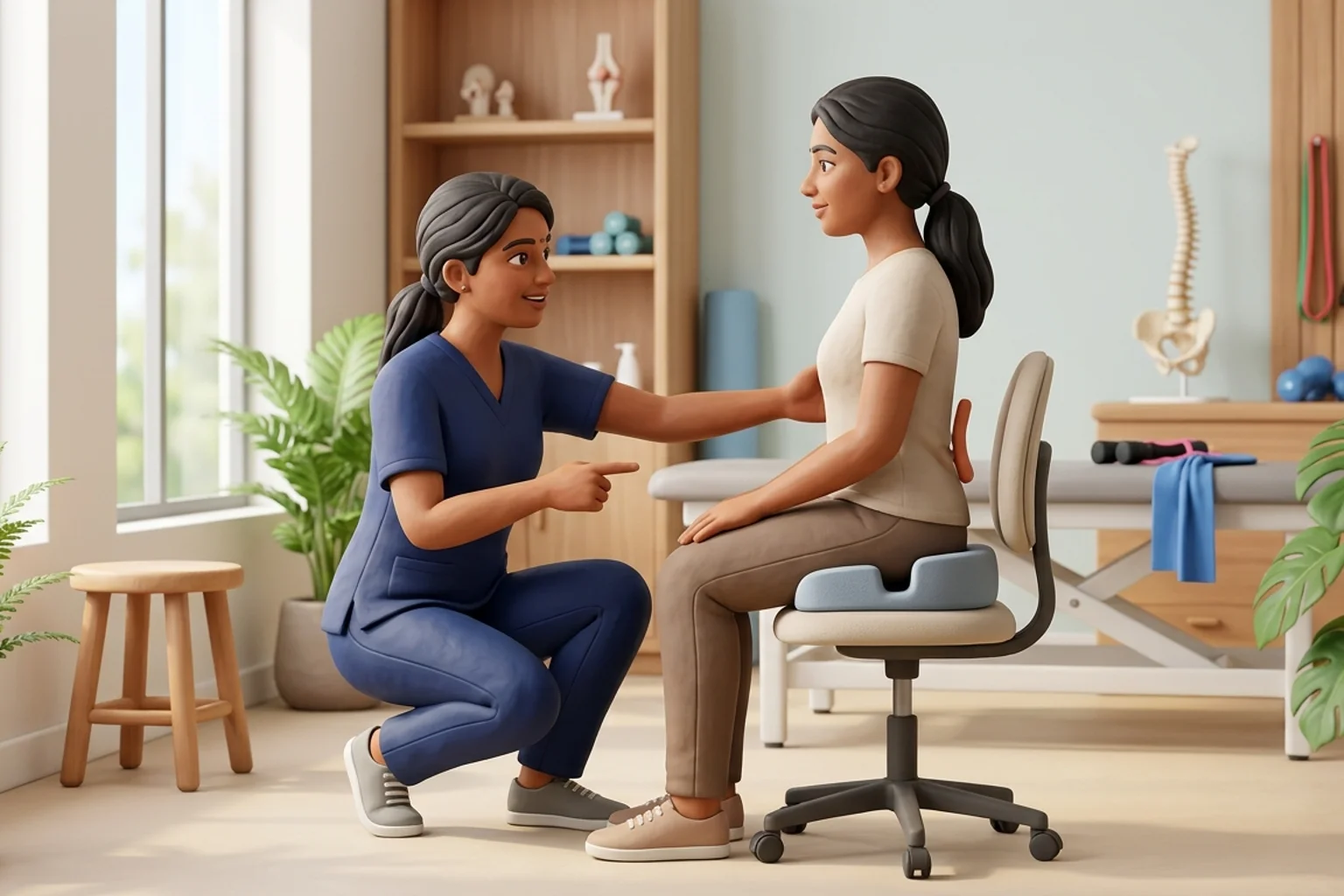
In India, individuals recovering from secondary rib non-union surgery must adapt daily occupational and domestic routines. Homemakers must delegate floor sweeping (jhadu-pocha), hand-washing heavy clothes, and kneading stiff dough (atta) during the first two months, as these activities produce sustained rotational torque on the ribs. Office workers should set up ergonomic desk chairs with firm armrests, avoiding prolonged slumped sitting over laptops.
Long-Term Rehabilitation Trajectory and Clinical Follow-Up
Following secondary plating and bone grafting, osseous consolidation is verified on computed tomography at three and six months. Once solid cortical bridging is confirmed, therapy advances to unrestricted multi-planar core strengthening, manual work clearance, and recreational sporting activities.
Palpable clicking accompanied by sharp pain in a patient with previously plated ribs suggests hardware loosening, screw pullout, or plate fatigue fracture, mandating immediate radiographic evaluation before proceeding with exercise.
What does it mean if my broken rib makes a clicking noise when I bend over?
A clicking or popping sound means the broken bone ends have not fused together solidly and are rubbing against each other as you move. This condition, called non-union, should be evaluated by a thoracic specialist to see if surgical plating is needed to lock the bones firmly in place.
Do I need a doctor referral to consult a home physiotherapist in India?
Under the National Commission for Allied and Healthcare Professions (NCAHP) Act 2021, patients in India have direct access to registered physiotherapists without requiring a physician referral. At BookPhysio.in, you connect with verified physiotherapists and pay directly per session, with zero advance fees, zero package lock-ins, and no platform commissions.
Related condition guides



Related recovery guides & articles
BookPhysio.in Editorial Team
The BookPhysio.in editorial team writes and maintains this content, checking it against reliable clinical sources. Content follows our medical review policy: general information only, and no page claims a clinical review until a named registered physiotherapist has signed it off.
Read our medical review policy