
Osteopenia and Cementless Tibial Fixation: Weight-Bearing Cautions in Knee Arthroplasty
In short
Understand the biological bone ingrowth requirements, protected weight-bearing protocols, and osteopenia safeguards essential for cementless knee implants.
In this guide (4 sections)
While polymethylmethacrylate (PMMA) bone cement remains the traditional gold standard for implant fixation in total knee arthroplasty, cementless (press-fit or biological) knee replacement has experienced a dramatic resurgence. Cementless implants feature highly porous titanium or trabecular metal surfaces designed to achieve long-term biological fixation through direct bone ingrowth (osseointegration). However, the biological mechanics of cementless fixation differ fundamentally from cemented implants. Cemented components achieve immediate, maximum mechanical stability upon cement polymerization within ten minutes of application, permitting immediate full weight-bearing. In sharp contrast, cementless implants rely initially on mechanical press-fit friction alone; permanent stability requires six to twelve weeks of biological osteoblast migration and trabecular remodeling. In patients with underlying osteopenia or osteoporosis, premature excessive weight-bearing can induce interfacial micromotion, causing biological non-union, painful tibial subsidence, and early implant loosening.
Nutritional Osteopenia, Vegetarian Diets, and Sun Exposure in India
In India, subclinical osteopenia and severe vitamin D deficiency represent an epidemiological epidemic, particularly among postmenopausal women and vegetarian older adults. Traditional vegetarian diets, while culturally vital, often lack adequate bioavailability of high-quality protein, calcium, and vitamin D unless carefully supplemented. Furthermore, social customs and intense summer heat keep many older adults indoors during peak sunlight hours, impairing cutaneous synthesis of active cholecalciferol. In such patients receiving cementless knee arthroplasty, the host cancellous bone is structurally fragile, with thin, widely spaced trabeculae. Home physiotherapists must emphasize strict compliance with protected weight-bearing aids: using a walker or bilateral crutches prevents excessive focal shear forces that could crush fragile trabeculae before biological bone ingrowth consolidates.
Interfacial Micromotion Limits, Osseointegration Biology, and Trabecular Crushing
The biology of cementless fixation is governed by a strict mechanical threshold: the 150-micrometre rule. Histological studies demonstrate that for osteoblasts to successfully bridge the gap between host bone and porous implant surfaces, relative interfacial micromotion must remain strictly below 40 to 50 micrometres, with absolute failure occurring if micromotion exceeds 150 micrometres. If excessive axial shear or rotational torque is applied to a cementless tibial tray in early recovery, continuous interfacial grinding shears fragile capillary buds and neo-trabeculae. Instead of healthy osteointegration, the host tissue forms a layer of fibrous scar tissue, encapsulating the implant in a loose fibrous membrane. In osteopenic bone (T-score between -1.0 and -2.5), the compressive yield strength of proximal tibial cancellous bone is diminished by up to 60 percent, making it susceptible to micro-trabecular microfractures and vertical component subsidence under unassisted body-weight loading.
Protected Loading Protocols, Walker Weaning Restrictions, and Pacing
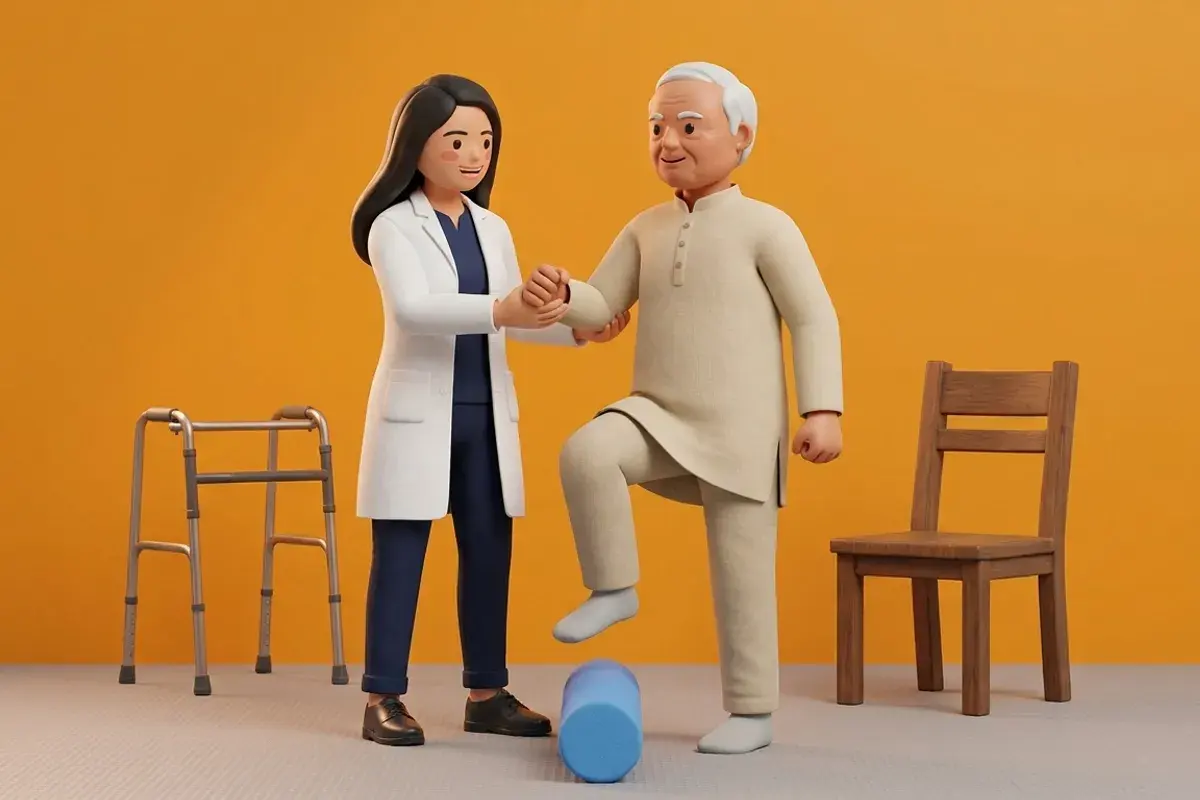
Rehabilitation protocols for cementless knee arthroplasty in osteopenic patients enforce a protected weight-bearing schedule. During weeks zero to six, the patient ambulates strictly using a reciprocal walker or bilateral elbow crutches, maintaining flat-foot partial weight-bearing (bearing 50 percent of body weight) to stimulate bone remodeling without exceeding micromotion thresholds. Weaning to a single stick or unassisted walking is strictly delayed until week eight to ten, following radiographic confirmation of stable component seating and absence of radiolucent lines. Therapy focuses on non-shearing open-chain active-assisted exercises, gentle isometric quadriceps setting, and seated closed-chain drills, avoiding aggressive single-leg impact loading until biological consolidation is secure.
Low-Shear Isometric Quadriceps and Gluteal Co-Activation Drill
Objective: Stimulate osteoblast mechanotransduction and maintain muscle tone without interfacial shearing
- 1Lie flat on your back on a firm bed with your operative leg extended straight and a small towel roll under your ankle.
- 2Simultaneously tighten your quadriceps on the front of your thigh and squeeze your buttock muscles firmly together.
- 3Focus on pulling your kneecap upward toward your hip while pressing your heel lightly into the towel roll.
- 4Maintain this firm, static muscular co-contraction for 6 seconds without moving your knee joint.
- 5Relax completely for 4 seconds, allowing microvascular circulation to wash through the tissue before repeating.
| Fixation Domain | Cemented Total Knee Arthroplasty | Cementless (Biological Press-Fit) Arthroplasty |
|---|---|---|
| Primary Fixation Mechanism | Immediate mechanical interdigitation of PMMA cement into cancellous bone pores | Initial press-fit frictional wedge; secondary biological bone ingrowth (osseointegration) |
| Time to Full Stability | Complete and permanent within 10 to 15 minutes of cement polymerization | Requires 6 to 12 weeks of progressive osteoblast proliferation and matrix remodeling |
| Early Weight-Bearing Rule | Immediate weight-bearing as tolerated on Day 0 or Day 1 with walker | Protected partial weight-bearing (50%) for 4 to 6 weeks in osteopenic patients |
| Risk in Severe Osteopenia | Low fixation failure risk; cement provides stable mantle even in porous bone | High risk of component subsidence, fibrous non-union, or interfacial micromotion |
If you have a cementless knee replacement, do not discard your walker or crutches prematurely, even if you feel completely pain-free. Walking unassisted before biological bone ingrowth is complete can crush fragile microscopic bone bridges, causing the metal component to tilt or sink into the bone. Always wait for your surgeon's explicit radiographic clearance before unassisted walking.
Frequently Asked Questions
How do I know whether my knee replacement was performed with bone cement or press-fit?
Your hospital discharge card will clearly indicate whether your procedure was 'Cemented TKA' or 'Cementless / Uncemented TKA'. In India, over 90 percent of knee replacements are cemented, but cementless technology is increasingly utilized. Check with your surgeon or physiotherapist so your weight-bearing progression is matched perfectly to your implant fixation type.
Do I need a doctor referral for post-knee replacement physiotherapy on BookPhysio.in?
BookPhysio.in does not require a doctor referral. Under the National Commission for Allied and Healthcare Professions (NCAHP) Act 2021, patients across India enjoy direct access to autonomous registered physiotherapists. Through BookPhysio.in, you connect directly with verified clinicians and pay per session with transparent fees, completely free from advance package commitments, commission markups, or platform subscription charges.
Related condition guides



Related recovery guides & articles
BookPhysio.in Editorial Team
The BookPhysio.in editorial team writes and maintains this content, checking it against reliable clinical sources. Content follows our medical review policy: general information only, and no page claims a clinical review until a named registered physiotherapist has signed it off.
Read our medical review policy