
Periprosthetic Patellar and Tibial Fracture Prevention Rules in Knee Arthroplasty
In short
Safeguard your knee replacement against periprosthetic patellar and tibial fractures with proven bone protection rules, transfer modifications, and fall prevention.
In this guide (4 sections)
Periprosthetic fractures around the knee joint, involving the patella, proximal tibia, or distal femur, represent catastrophic complications following total knee arthroplasty that carry high morbidity, prolonged hospitalization, and complex revision requirements. While intraoperative fracture risks are managed by surgical technique, postoperative periprosthetic fractures typically occur between months three and twenty-four, triggered by low-energy domestic falls in patients with underlying osteopenia or chronic mechanical stress concentrations. The interface between rigid metallic prosthetic stems and native cancellous bone creates a natural stiffness mismatch, concentrating bending and torsional moments at specific anatomic weak points. Preventing periprosthetic fractures requires a multi-faceted clinical strategy: aggressive domestic fall risk mitigation, bone mineral density optimization, adherence to safe movement mechanics, and avoiding premature high-impact torsional activities.
Loose Rugs, Nighttime Lighting, and Saree Hemline Hazards in Indian Homes
Preventing periprosthetic fractures in an Indian domestic setting requires addressing everyday environmental tripping hazards. Traditional Indian homes frequently feature decorative throw rugs, daris, or loose doormats placed over smooth vitrified tiles, which slip easily under a patient's foot. In multi-generational homes, grandchildren's toys, loose electrical charging cords, and cluttered hallways create dangerous obstacle courses. For female patients, wearing long traditional sarees or loose salwars presents a subtle hazard: stepping on an unpinned pleat or loose hemline while negotiating steps can trigger an immediate forward trip. Families must conduct a home safety audit: removing all loose floor coverings, taping down cords, installing continuous low-wattage nightlights along bathroom corridors, and encouraging patients to pin saree hemlines securely above ankle level.
Stiffness Mismatch, Stress Shielding, and Fracture Classification Pathways
The mechanical vulnerability of bone surrounding an arthroplasty implant stems from the substantial difference in elastic modulus between prosthetic materials and human bone. Cobalt-chromium alloys possess an elastic modulus of approximately 210 GPa, and titanium alloys measure around 110 GPa, whereas cortical bone possesses an elastic modulus of only 12 to 18 GPa. This dramatic stiffness mismatch prevents normal physiological strain distribution, concentrating stress along the tips of metallic stems and around the margins of bone resection. In the tibia, periprosthetic fractures (classified by Felix et al.) frequently occur through the tibial plateau (Type I) or immediately below the prosthetic stem tip (Type II) following rotational torsion. In the patella, aggressive resection leaving a bone remnant thinner than 12 millimetres or thermal necrosis during cement polymerization creates an ischemic bone bed susceptible to transverse tensile fractures (Goldberg classification) during violent eccentric quadriceps contractions.
Reactive Stepping Drills, Dual-Task Balance, and Bone Density Pacing
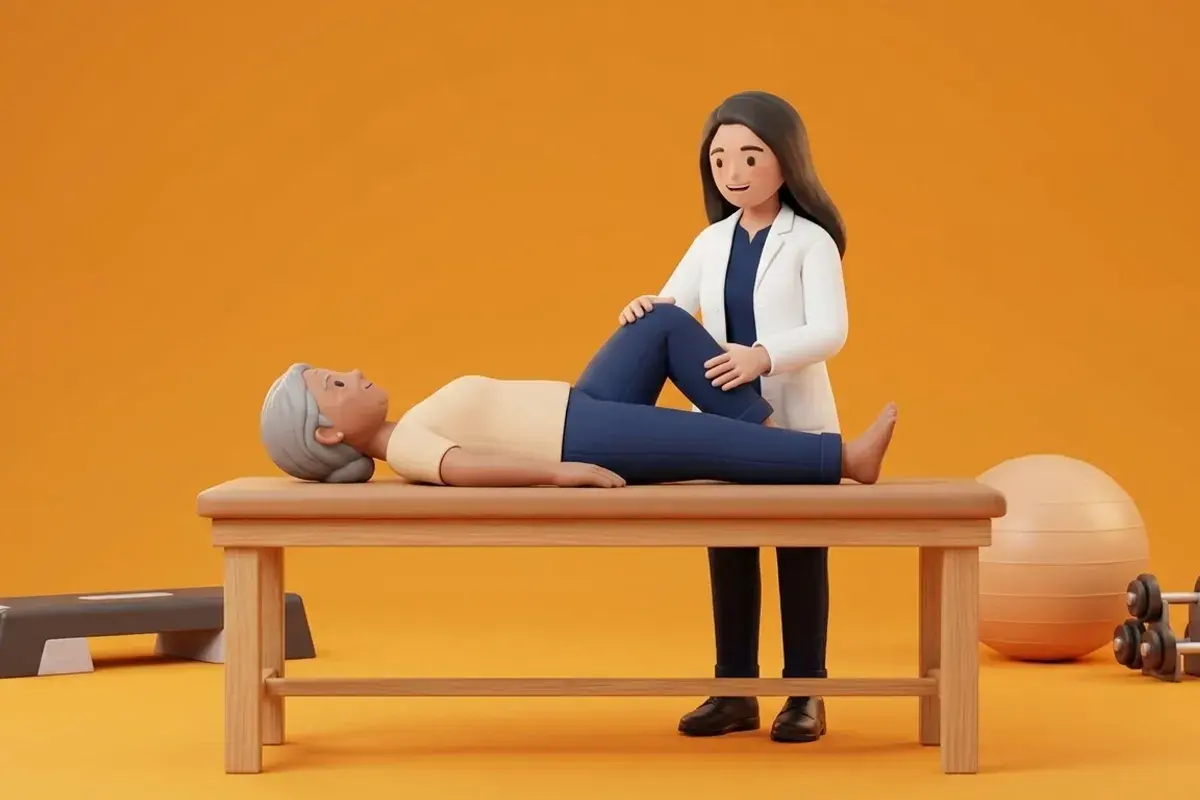
Physiotherapy plays a vital protective role through neuromotor balance conditioning and fall-prevention training. Therapy incorporates reactive stepping drills, where the clinician introduces gentle, controlled perturbations, training the patient to rapidly deploy the non-operative foot to catch their balance rather than taking the full fall impact onto the surgical knee. Dual-task cognitive balance exercises simulate real-world distractions (such as carrying a conversation while negotiating an obstacle path). In parallel, clinicians coordinate with medical physicians to manage underlying systemic osteoporosis, ensuring adequate calcium, active vitamin D3, and antiresorptive pharmacotherapy to maintain supportive bone trabecular architecture.
Reactive Multi-Directional Stepping Balance Drill
Objective: Train rapid compensatory stepping reactions to arrest balance loss and prevent catastrophic domestic falls
- 1Stand upright in an open area with a sturdy kitchen counter or heavy table within arm's reach for safety.
- 2Have a family member or clinician stand behind you and provide a gentle, light nudge forward at your hips.
- 3Instead of freezing, immediately take a rapid, firm step forward with your non-operative leg, arresting your forward momentum.
- 4Push back to the starting position, then repeat the drill with a gentle nudge backward, stepping backward with a wide base.
- 5Practice taking a rapid lateral step sideways to either side upon unpredictable verbal direction cues.
- 6Ensure every landing step is firm, flat-footed, and confident.
| Fracture Anatomic Site | Classification System & Mechanism | Primary Clinical Risk Factors | Targeted Prevention Rule |
|---|---|---|---|
| Periprosthetic Patellar Fracture | Goldberg Classification (Type I to IV); eccentric extensor mechanism overload | Patellar bone remnant <12 mm; thermal necrosis from cement; direct impact fall | Avoid deep squats beyond 60°; never drop forcefully onto knees; maintain quadriceps flexibility |
| Periprosthetic Proximal Tibial Fracture | Felix Classification (Type I: plateau; Type II: stem tip; Type III: distal) | Severe nutritional osteopenia; rotational torque while foot is planted; loose components | Avoid pivoting on planted foot; eliminate domestic trip hazards; ensure adequate vitamin D3 |
| Periprosthetic Distal Femoral Fracture | Lewis and Rorabeck Classification (Type I to III); low-energy fall on flexed knee | Anterior femoral cortical notching during surgery; severe osteoporosis; advanced age | Mandatory handrail use on stairs; nightlights in hallways; reactive stepping balance training |
If you experience a slip or fall and immediately notice a visible deformity around your knee, severe focal bone tenderness, rapid tense swelling, or an absolute inability to bear weight on the leg, do not attempt to stand or walk. Keep the limb completely still and call for emergency ambulance transit to an orthopedic hospital for immediate radiological evaluation.
Frequently Asked Questions
Can taking calcium and vitamin D supplements really help prevent fractures around my artificial knee?
Yes, absolutely. Your metal knee implants rely entirely on the strength and density of your surrounding native bone for stability. In India, vitamin D deficiency and osteopenia are widespread among older adults. Taking prescribed calcium, active vitamin D3, and bone-strengthening medications keeps your host bone dense and resilient, drastically reducing the risk of a bone fracture around the metal components.
Do I need a doctor referral for post-knee replacement physiotherapy on BookPhysio.in?
BookPhysio.in does not require a doctor referral. Under the National Commission for Allied and Healthcare Professions (NCAHP) Act 2021, patients across India enjoy direct access to autonomous registered physiotherapists. Through BookPhysio.in, you connect directly with verified clinicians and pay per session with transparent fees, completely free from advance package commitments, commission markups, or platform subscription charges.
Related condition guides



Related recovery guides & articles
BookPhysio.in Editorial Team
The BookPhysio.in editorial team writes and maintains this content, checking it against reliable clinical sources. Content follows our medical review policy: general information only, and no page claims a clinical review until a named registered physiotherapist has signed it off.
Read our medical review policy