
Post-ICU Home Physiotherapy: Transfer Safety and Fall Risk Assessment
In short
Conduct home physiotherapy evaluations for ICU survivors. Assess bed, chair, and toilet transfers, fall risk factors, and home hazards in India.
In this guide (2 sections)
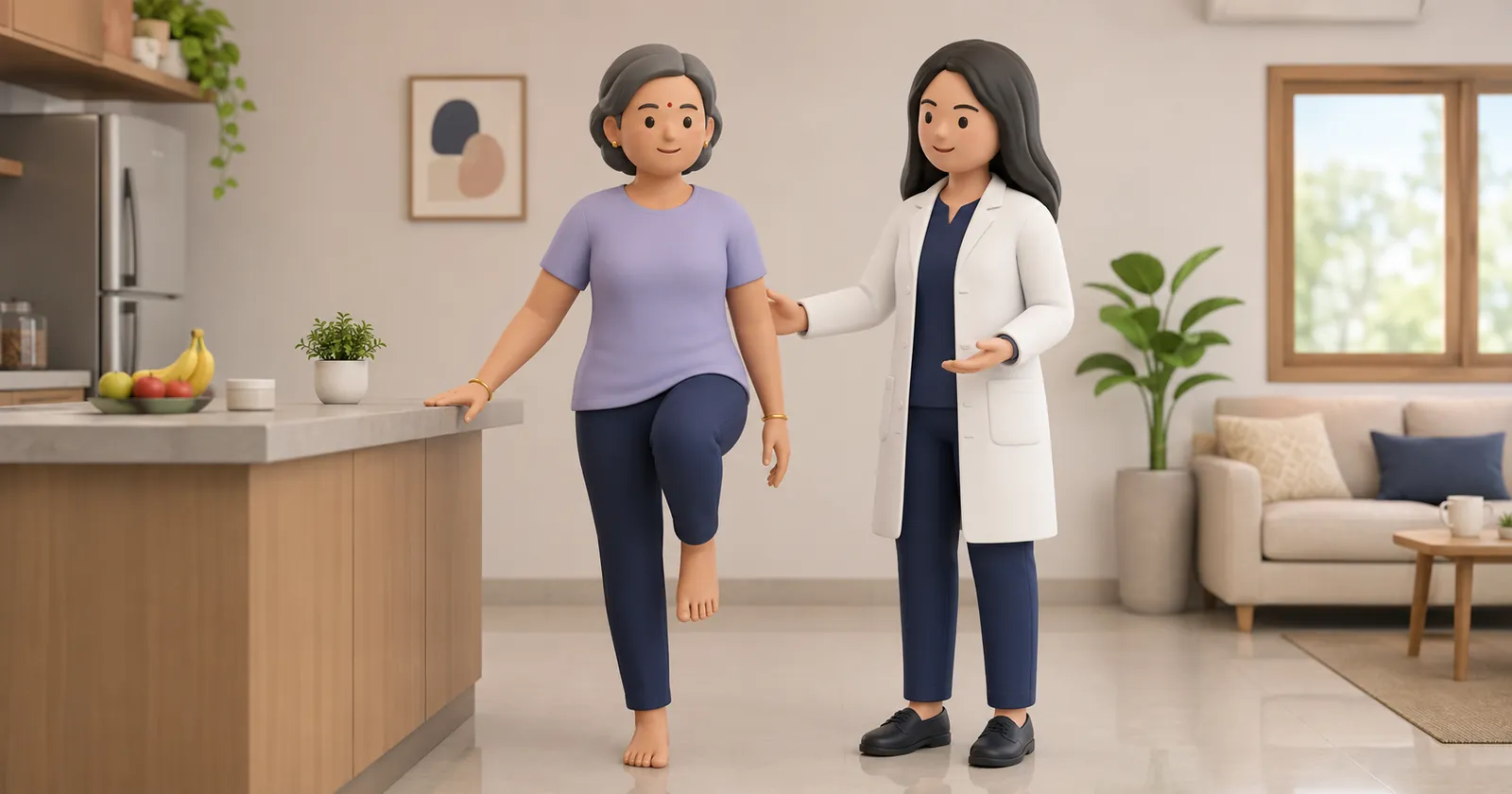
Returning home after weeks of intensive care hospitalization is a monumental achievement, yet the domestic setting introduces immediate physical challenges that were entirely absent in the hospital. Without hospital beds with electric side rails, grab bars, and level linoleum floors, recovering ICU survivors face substantial fall risks. Comprehensive in-home physiotherapy assessments identify environmental hazards, evaluate functional transfer safety, and establish personalized restorative exercise regimes.
Multifactorial Etiology of Post-ICU Domestic Falls
Post-ICU falls stem from a convergence of profound physical debility: severe quadriceps and hip extensor weakness, impaired proprioceptive feedback from critical illness polyneuropathy, persistent orthostatic hypotension, and cognitive slowing from lingering delirium. When these physiological impairments encounter common domestic obstacles, such as throw rugs, cluttered pathways, slick polished stone flooring, and low furniture, the risk of catastrophic fall-related fractures and hospital readmission escalates dramatically.
| Domestic Domain | Specific Environmental Hazard | Observed Functional Deficit | Physiotherapy Mitigation Solution | |
|---|---|---|---|---|
| Bedroom | Low wooden cot (takhat), soft mattress, unstable bedside tables | Inability to rise from low bed without pulling on unsteady furniture | Install bed risers, place firm wooden board under mattress, add bed rail | |
| Bathroom | Slippery wet tiles, traditional Indian squat latrine, absence of grab bars | Loss of balance during toileting, inability to squat or rise safely | Install raised western toilet chair with armrests, non-slip rubber mats | |
| Living Area | Loose cotton dhurries / rugs, electrical cords, low coffee tables | Tripping over curled carpet edges due to foot drop | Remove all loose rugs, clear wide walking pathways, secure cables | |
| Entrances & Stairs | Unrailed thresholds, steep exterior steps, inadequate illumination | Inability to negotiate steps without severe loss of balance | Install sturdy bilateral wall handrails, improve LED lighting |
Standardized Bedside and Bathroom Transfer Protocols
The visiting home physiotherapist systematically evaluates three vital functional transfers during the initial home visit: bed-to-standing, chair-to-standing, and toilet transfers. Transfer mechanics are analyzed for safe weight-shifting, foot placement, and momentum control. Caregivers are instructed on how to position their bodies, utilize transfer belts, and provide contact guarding on the patient's weaker side without pulling on hemiparetic or painful arms.
Home Sit-to-Stand with Armrest Pushing and Controlled Lowering
Objective: Re-educate functional sit-to-stand mechanics and build eccentric quadriceps control in the home environment.
- 1Select a firm armchair in the living room with sturdy armrests and a seat height of at least 45 centimeters.
- 2Instruct the patient to scoot forward toward the front edge of the seat.
- 3Position feet flat on the floor, slightly wider than shoulder-width, with heels drawn back beneath knees.
- 4Cue the patient to lean the upper torso forward while pushing through both armrests to stand smoothly.
- 5Stand fully upright, pause for three seconds to ensure hemodynamic stability, then slowly reach back for armrests to sit.
Domestic Recovery in India and Multigenerational Support
In multi-generational Indian homes, elder care is deeply valued, but family members often provide excessive physical assistance, lifting the patient entirely instead of allowing them to practice active weight-bearing. The visiting physiotherapist coaches the family on the distinction between assisting and enabling, guiding sons, daughters, and domestic helpers on how to provide minimal support so the elder can rebuild authentic muscular independence.
Long-Term Trajectory and Community Mobility Restoration
Mastering home transfers within the first four weeks post-discharge significantly reduces fall incidence and builds the foundation for community ambulation. As quadriceps strength and balance confidence improve, patients advance to walking in neighborhood parks and attending social gatherings independently.
Never allow a patient with bilateral foot drop or severe neuropathy to walk in socks or bare feet on polished marble tiles. Mandate supportive indoor footwear with textured rubber non-slip outsoles at all times.
What clinical test best predicts fall risk in a post-ICU patient at home?
The Timed Up and Go (TUG) test is the most reliable predictor. A patient who takes longer than 14 seconds to rise from an armchair, walk 3 meters, turn, and sit back down is at high risk for falls and requires ongoing home physiotherapy and walking aids.
Do I need a doctor referral to consult a home physiotherapist in India?
Under the National Commission for Allied and Healthcare Professions (NCAHP) Act 2021, patients in India enjoy direct access to registered physiotherapists without requiring a mandatory doctor referral. At BookPhysio.in, you consult verified physiotherapists and pay directly per session without hidden fees or platform commissions.
Related condition guides



Related recovery guides & articles
BookPhysio.in Editorial Team
The BookPhysio.in editorial team writes and maintains this content, checking it against reliable clinical sources. Content follows our medical review policy: general information only, and no page claims a clinical review until a named registered physiotherapist has signed it off.
Read our medical review policy