
Post-Operative Shoulder Stiffness Versus Re-Tear: Balancing Rehabilitation Safety
In short
Too much early motion risks tearing the delicate surgical repair, while too little motion causes debilitating joint stiffness. Discover how clinicians balance this tightrope.
In this guide (4 sections)
Following arthroscopic rotator cuff repair, orthopaedic surgeons and physiotherapists face an intrinsic clinical dilemma: balancing the prevention of post-operative joint stiffness against the protection of the healing tendon repair. If rehabilitation progresses too aggressively with early vigorous stretching, the mechanical anchors may pull out from soft osteoporotic bone or sutures may cut through fragile tendon substance, causing structural repair failure (re-tear). Conversely, if the limb is immobilized too rigidly for too long out of fear of re-injury, the glenohumeral capsule undergoes dense fibrotic contracture, resulting in severe post-operative stiffness (secondary frozen shoulder). Successfully navigating this therapeutic tightrope requires an intimate understanding of patient-specific risk factors, biological healing timelines, and calibrated manual therapy techniques.
Fear of Stiffness Versus Re-Injury Anxiety in Indian Households
In Indian clinical practice, patients recovering from rotator cuff repair often swing between two dangerous emotional extremes. Some patients, deeply anxious about re-tearing the surgical repair, keep their arm rigidly strapped to their chest for months, refusing even permitted passive exercises; they eventually present with frozen, severely contracted shoulders that require months of painful mobilization. Other patients, panicked by early joint stiffness, forcefully crank the arm upward using door edges or allow well-meaning relatives to pull the arm aggressively, risking acute anchor pull-out. In Indian domestic life, where tasks like washing clothes, bathing with water buckets, and dressing in sarees demand wide range of motion, clear professional guidance provides the reassurance required to progress safely.
Biological Competition: Capsular Fibrosis Versus Suture-Tendon Micro-Motion
The pathophysiology of post-operative stiffness involves exaggerated capsular inflammation and fibroblast proliferation. High levels of transforming growth factor-beta (TGF-beta) and matrix metalloproteinases in the post-surgical joint fluid drive dense collagen cross-linking within the coracohumeral ligament and rotator interval, severely restricting external rotation. Conversely, the structural re-tear mechanism is governed by interfacial micro-motion. Biomechanical studies indicate that cyclical gap formation exceeding one to two millimetres at the tendon-bone interface prevents vascular ingrowth and fibrocartilage scar formation. Large and massive tears, older patient age (> 65 years), advanced Goutallier fatty infiltration, and diabetes mellitus significantly heighten re-tear vulnerability, whereas younger age, single-tendon tears, and pre-existing capsular tightness tilt the clinical risk profile toward stiffness.
Calibrated Mobilization Algorithms: Risk-Stratified Rehabilitation Pacing
Modern post-operative protocols resolve this dilemma through individualized risk stratification. Patients classified as high re-tear risk (large tears, older age, poor tissue quality) follow a conservative pathway: strict sling immobilization for six weeks, with passive motion delayed until week four and restricted strictly to safe scaption planes. Conversely, patients identified as high stiffness risk (younger active individuals, partial or small tears, concurrent labral repair or adhesive capsulitis history) follow an early passive mobilization pathway starting within the first post-operative week. In both cohorts, end-range forceful stretching is strictly deferred until week twelve, when biological tendon-to-bone consolidation is mature.
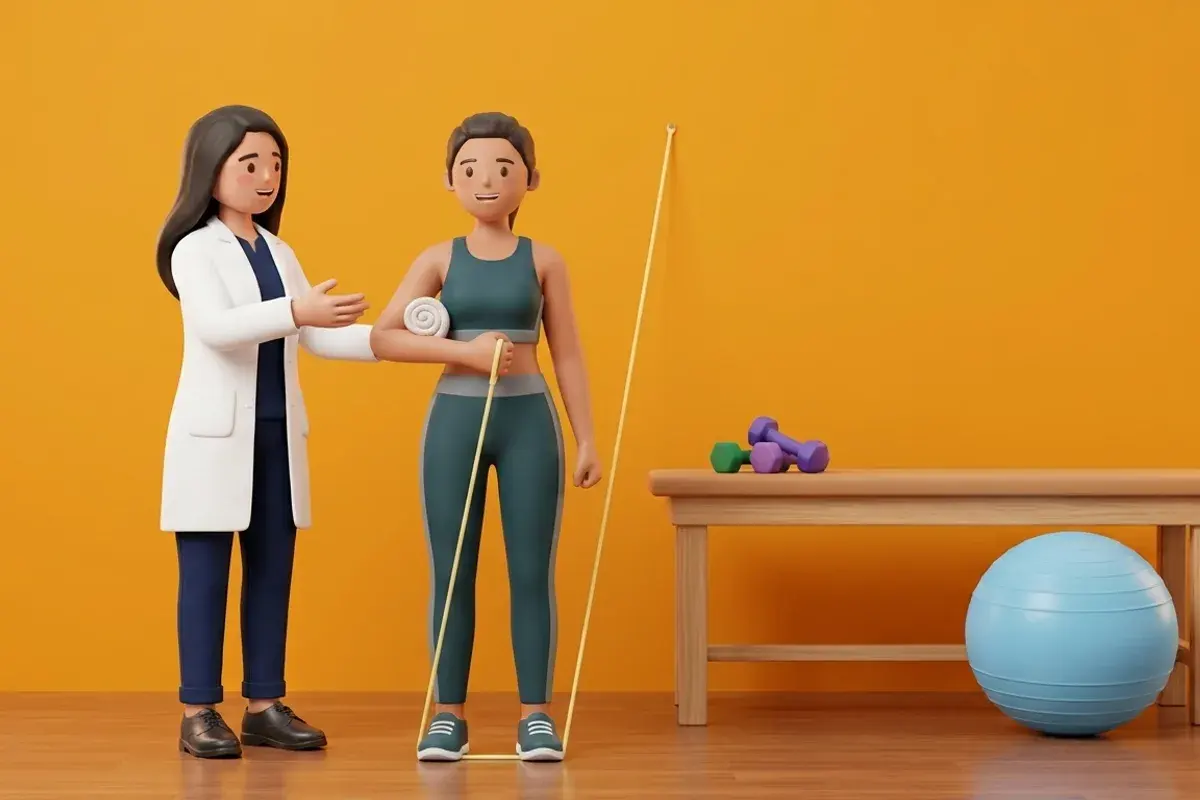
Scapular Plane Passive Table Slides with Torso Rock
Objective: Mobilize the inferior glenohumeral capsule within safe parameters using body weight rather than shoulder muscle force
- 1Sit upright on a stable dining chair positioned comfortably close to a smooth dining table.
- 2Rest your operative forearm and palm flat on a soft hand towel placed on the tabletop.
- 3Place your healthy hand lightly over the operative wrist to guide the direction of movement.
- 4Gently rock your upper torso forward from your hips, allowing your hands to slide smoothly across the table surface.
- 5Stop when you feel gentle capsular tension (never sharp pain), hold for 5 seconds, and use your torso to rock back upright.
| Clinical Risk Domain | High Stiffness-Prone Profile (Early Motion Pathway) | High Re-Tear-Prone Profile (Protected Pathway) |
|---|---|---|
| Patient Demographics & Health | Age < 55 years; non-diabetic; high anxiety regarding joint freezing; active occupational background. | Age > 65 years; chronic diabetes mellitus; smoker; osteopenic bone density; low tissue elasticity. |
| Surgical Tear Characteristics | Small or medium tear (< 2 cm); single tendon (supraspinatus); robust tissue quality; zero retraction. | Large or massive tear (> 3-5 cm); multi-tendon involvement; Patte Stage 2-3 retraction; Goutallier Grade 2-3. |
| Sling Immobilization Duration | Abduction sling worn for 3 to 4 weeks; early supervised weaning initiated during daytime rest. | Strict abduction sling worn for full 6 weeks day and night; removed only for personal hygiene. |
| Passive Range Initiation | Initiated during week 1 or 2; early gentle external rotation to 20 degrees; scapular plane elevation. | Delayed to weeks 3 or 4; restricted strictly to 90 degrees scaption; zero external rotation past neutral. |
Gradual loss of motion accompanied by firm end-feel resistance represents typical capsular stiffness, which responds reliably to patient manual therapy after week twelve. In contrast, sudden effortless loss of active elevation accompanied by an audible pop or sharp tearing sensation signifies acute construct failure requiring immediate surgical review.
Frequently Asked Questions
Is it better to have a slightly stiff shoulder or a loose shoulder after rotator cuff repair?
Orthopaedic surgeons and sports physiotherapists universally agree that mild temporary stiffness is preferable to early looseness. Stiffness indicates that the surgical repair construct is securely attached and healing without gap formation. Capsular stiffness can be stretched out safely between three and six months, whereas a re-torn tendon cannot be easily fixed without revision surgery.
Do I need a doctor referral to see a rotator cuff physiotherapist on BookPhysio.in?
BookPhysio.in does not require a physician prescription. Under the National Commission for Allied and Healthcare Professions (NCAHP) Act 2021, patients across India enjoy direct access to autonomous registered physiotherapists. Through BookPhysio.in, you connect directly with verified clinicians and pay per session with transparent fees, completely free from advance package commitments, commission markups, or platform subscription charges.
Related condition guides



Related recovery guides & articles
BookPhysio.in Editorial Team
The BookPhysio.in editorial team writes and maintains this content, checking it against reliable clinical sources. Content follows our medical review policy: general information only, and no page claims a clinical review until a named registered physiotherapist has signed it off.
Read our medical review policy