
Postural Kyphosis and Rounded Shoulders in TOS: Reversing Upper Crossed Syndrome
In short
Discover how thoracic kyphosis and rounded shoulder syndrome collapse the thoracic outlet, and master evidence-based corrective exercise protocols.
In this guide (4 sections)
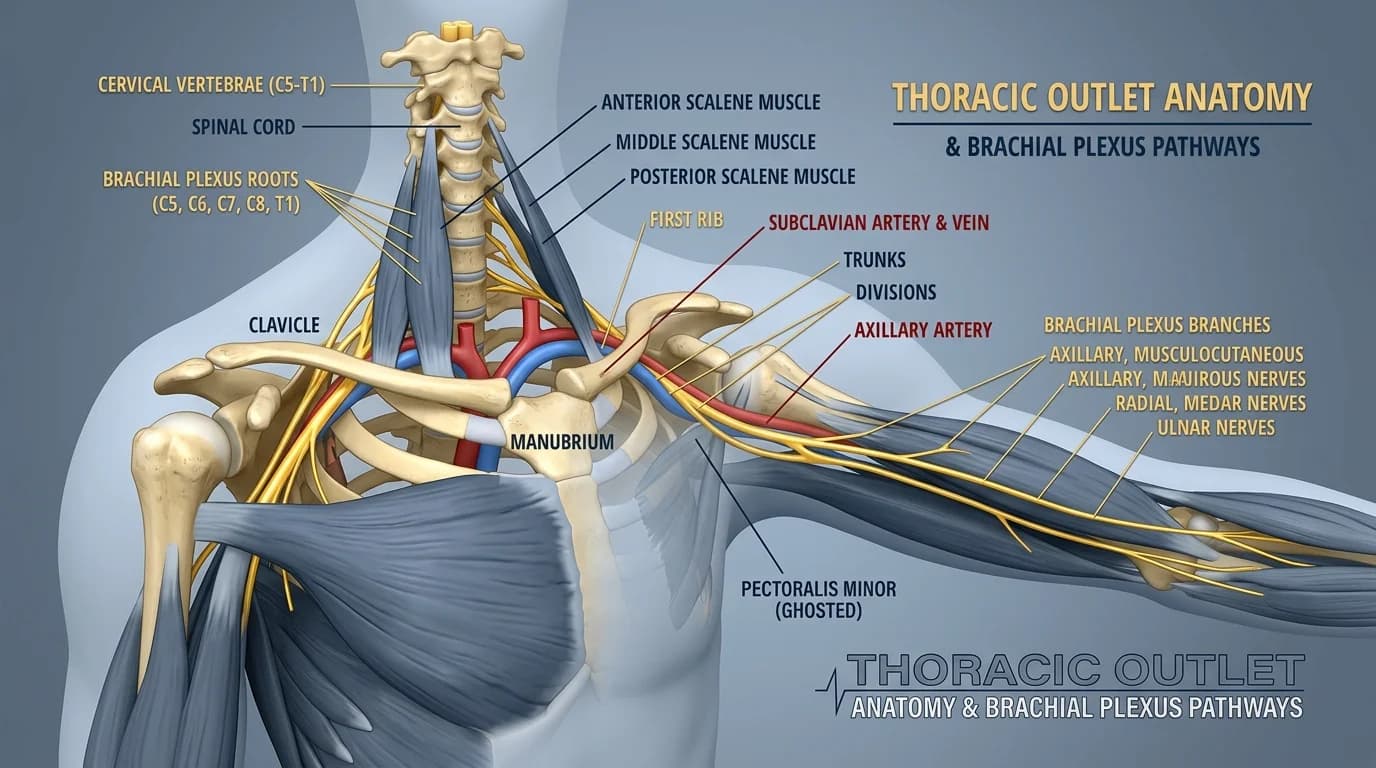
Postural thoracic kyphosis and rounded shoulder syndrome represent the predominant structural matrix within which neurogenic thoracic outlet syndrome develops. Described classically by Vladimir Janda as Upper Crossed Syndrome, this pervasive postural distortion is characterized by a predictable pattern of muscular imbalances across the upper quadrant: hypertonicity and adaptive shortening of the anterior chest musculature (pectoralis major and minor) and posterior cervical extensors (upper trapezius and levator scapulae), paired with reciprocal weakness and inhibition of the deep cervical flexors and lower scapular stabilizers (serratus anterior, rhomboids, and lower trapezius). When the thoracic spine curves into excessive kyphosis, the ribs are depressed anteriorly, while the scapulae drift into protraction, downward rotation, and anterior tilt. This structural collapse dramatically reduces the dimensions of all three thoracic outlet tunnels, locking the brachial plexus in continuous mechanical impingement.
Laptop Slouching, Sofa Binging, and Kitchen Counter Fatigue
Sedentary lifestyle patterns and domestic relaxation habits across Indian households heavily reinforce Upper Crossed Syndrome. In modern urban apartments, individuals routinely spend entire evenings lounging on deep, soft sofas or sitting propped up in bed while watching streaming entertainment on televisions or tablets. These soft surfaces offer zero thoracic support, encouraging the spine to sink into maximal C-shaped kyphosis. In kitchen environments, women spend hours leaning over counters that are positioned too low for their height, maintaining rounded shoulders while rolling rotis or washing dishes. Concurrently, office professionals spend ten to twelve hours seated before computer monitors without ergonomic lumbar rolls. Over years of daily reinforcement, the anterior spinal ligaments and chest fascial tissues adaptively shorten, making it physically difficult and fatiguing for the individual to stand or sit upright without conscious effort. The inability to maintain an upright posture without rapid exhaustion leads many individuals to resign themselves to poor posture, believing it is an inevitable consequence of modern desk employment.
Structural Kinematics: Anterior Rib Depression and Clavicular Descent
The structural kinematics of rounded shoulder posture exert devastating mechanical effects upon the thoracic outlet compartments. An increased thoracic kyphotic curve pushes the manubrium sterni and the anterior ends of the first and second ribs downward and posteriorly, reducing the vertical clearance of the superior thoracic aperture. Concurrently, the scapula rotates internally and tilts anteriorly, driving the coracoid process forward and downward. This orientation shortens the distance between the coracoid and the chest wall by up to twenty-five percent, directly clamping the cords of the brachial plexus beneath the pectoralis minor tendon. Furthermore, as the head protrudes forward into cervical hyperextension, the anterior and middle scalenes must contract continuously against gravity, pulling the first rib upward into the descending clavicle and crushing the costoclavicular space from both sides simultaneously. Reversing this structural kyphotic distortion permanently widens the vertical height of the superior thoracic aperture, taking direct compressive pressure off the subclavian vessels and brachial plexus.
Corrective Protocols: Thoracic Foam Rolling, Chin Tucks, and Wall Angels
Reversing Upper Crossed Syndrome requires a coordinated approach that mobilizes rigid thoracic spinal segments before retraining postural endurance. Physiotherapists utilize foam roller thoracic extension mobilizations and seated thoracic extension drills over a chair back to restore segmental spinal extension and rib cage mobility. Soft tissue release and targeted doorway stretches lengthen the shortened pectoralis minor and subclavius muscles. Rehabilitation then focuses on neuromuscular re-education of the inhibited postural stabilizers: deep cervical flexor training (cranio-cervical flexion with pressure biofeedback), prone cobra exercises, and wall angels with scapular retraction and posterior tilt. Patients are prescribed regular hourly posture resets to break the cycle of prolonged slouching, permanently restoring structural patency across the thoracic outlet. Long-term adherence to thoracic extension exercises and hourly postural resets empowers patients to maintain an open, decompressing spinal alignment throughout demanding modern professional careers and active domestic responsibilities, preventing recurrent postural collapse and maintaining continuous decompression across the thoracic outlet spaces.
Wall Angel with Scapular Retraction and Chin Retraction
Objective: Activate the lower trapezius and deep neck flexors while opening the anterior chest wall to reverse rounded shoulders
- 1Stand with your back flat against a smooth wall, placing your heels approximately 4 to 6 inches away from the baseboard.
- 2Ensure your tailbone, upper back, and the back of your head rest flat against the wall, gently tucking your chin to flatten your neck curve.
- 3Place the backs of your upper arms, forearms, and hands against the wall with your elbows bent at ninety degrees in a 'goalpost' shape.
- 4Slowly slide your arms upward along the wall over a count of 3 seconds as far as you can while keeping your forearms and lower back in contact with the wall.
- 5Slowly slide your elbows downward toward your rib cage, squeezing your shoulder blades together and downward, holding for 2 seconds.
| Muscle Group | Postural Dysfunction | Clinical Impact on Outlet | Targeted Physiotherapy Strategy |
|---|---|---|---|
| Pectoralis Minor & Major | Hypertonic, adaptively shortened, dense fascial adhesions | Pulls coracoid into anterior tilt; collapses subpectoral tunnel | Manual myofascial release, dry needling, corner stretching |
| Upper Trapezius & Levator | Chronically hyperactive, shortened, active trigger points | Elevates clavicle abnormally; co-contracts with scalenes | Down-train with biofeedback; reciprocal inhibition |
| Lower Trapezius & Serratus | Inhibited, lengthened, profound neuromuscular amnesia | Fails to provide upward rotation and posterior tilt during reach | Prone Y-raises, wall slides with foam roller, push-up plus |
While most thoracic kyphosis is flexible and postural, adolescent patients presenting with severe, rigid thoracic kyphosis that cannot be actively corrected may have Scheuermann disease (juvenile kyphosis), characterized by anterior wedging of vertebral bodies and Schmorl nodes. In elderly patients, sudden-onset kyphosis accompanied by acute midline thoracic pain suggests an osteoporotic vertebral compression fracture. In such presentations, arrange diagnostic thoracic radiographs before initiating mobilization.
Frequently Asked Questions
Can fixing my rounded shoulders really cure the numbness in my fingers?
Yes. When your shoulders are rounded forward, your chest muscles shorten and your collarbone drops down, physically crushing the nerves traveling from your neck to your fingers like a heavy door closing on a cable. When you reverse that rounded posture by stretching your tight chest muscles and strengthening your upper back, your shoulder blades swing back into their natural position. This lifts your collarbone off your nerves, instantly opening up the space and allowing normal sensation to return to your hands. Correcting rounded shoulders swings your collarbone up and back into its natural position, permanently taking the pressure off your nerves and restoring pain-free hand function.
Do I need a doctor referral to treat thoracic outlet syndrome on BookPhysio.in?
BookPhysio.in does not require a doctor referral. Under the National Commission for Allied and Healthcare Professions (NCAHP) Act 2021, patients across India enjoy direct access to autonomous registered physiotherapists. Through BookPhysio.in, you connect directly with verified clinicians and pay per session with transparent fees, completely free from advance package commitments, commission markups, or platform subscription charges.
Related condition guides



Related recovery guides & articles
BookPhysio.in Editorial Team
The BookPhysio.in editorial team writes and maintains this content, checking it against reliable clinical sources. Content follows our medical review policy: general information only, and no page claims a clinical review until a named registered physiotherapist has signed it off.
Read our medical review policy