
Proprioceptive Joint Position Sense Retraining in the Cuff-Deficient Shoulder
In short
Tearing a rotator cuff damages sensory mechanoreceptors, leaving the brain blind to joint position. Discover how proprioceptive retraining restores stability.
In this guide (4 sections)
The rotator cuff is universally recognized as a powerhouse of dynamic joint stabilization. However, its equally critical role as a sensory organ is frequently overlooked in clinical rehabilitation. Rotator cuff tendons, the glenohumeral joint capsule, and the glenoid labrum are densely populated with specialised neurosensory mechanoreceptors, including Ruffini endings, Pacinian corpuscles, and Golgi tendon organ-like structures. When a rotator cuff tendon tears or undergoes surgical repair, these delicate neural receptors are severed or denervated, resulting in a profound loss of Joint Position Sense (JPS), kinesthetic awareness, and neuromuscular feedforward control. Without targeted proprioceptive retraining, the brain remains blind to subtle humeral head translations, predisposing the joint to recurrent micro-trauma, movement incoordination, and chronic re-injury.
Sensory Loss and Incoordination in Everyday Indian Tasks
In Indian daily life, proprioceptive deficits manifest not as severe muscle weakness, but as subtle spatial clumsiness and coordination failures. A homemaker may consistently misjudge the distance when placing a glass tumbler onto a crowded kitchen table, knocking it over, or struggle to guide the hand smoothly through a tight kurta sleeve without looking directly at the arm. When riding a scooter through bumpy city traffic, an uncoordinated rotator cuff fails to anticipate road shocks, causing the joint to sublux slightly and producing sudden sharp aches. In dark bedrooms at night, reaching for a bedside water bottle or light switch becomes hesitant and inaccurate. Physiotherapists implement sensory re-education drills that retrain joint position awareness and restore spatial precision.
Mechanoreceptor De-Afferentation, Cortical Smudging, and JPS Errors
The neurophysiological consequence of rotator cuff disruption is de-afferentation. The loss of afferent mechanoreceptive feedback to the somatosensory cortex alters the brain's internal spatial representation of the shoulder, a phenomenon known as cortical smudging. On formal testing, patients with rotator cuff tears exhibit significantly higher Joint Position Sense (JPS) absolute angular errors, often missing target angles by eight to twelve degrees compared to healthy controls (normal error is under three degrees). Furthermore, the reflexive feedforward activation of the rotator cuff (wherein the subscapularis and infraspinatus fire milliseconds before the deltoid to compress the joint) is delayed or abolished. This timing latency permits unchecked humeral head translation before stabilizing muscles can engage.
Sensory Biofeedback: Laser Targeting, Closed-Eye Repositioning, and Perturbations
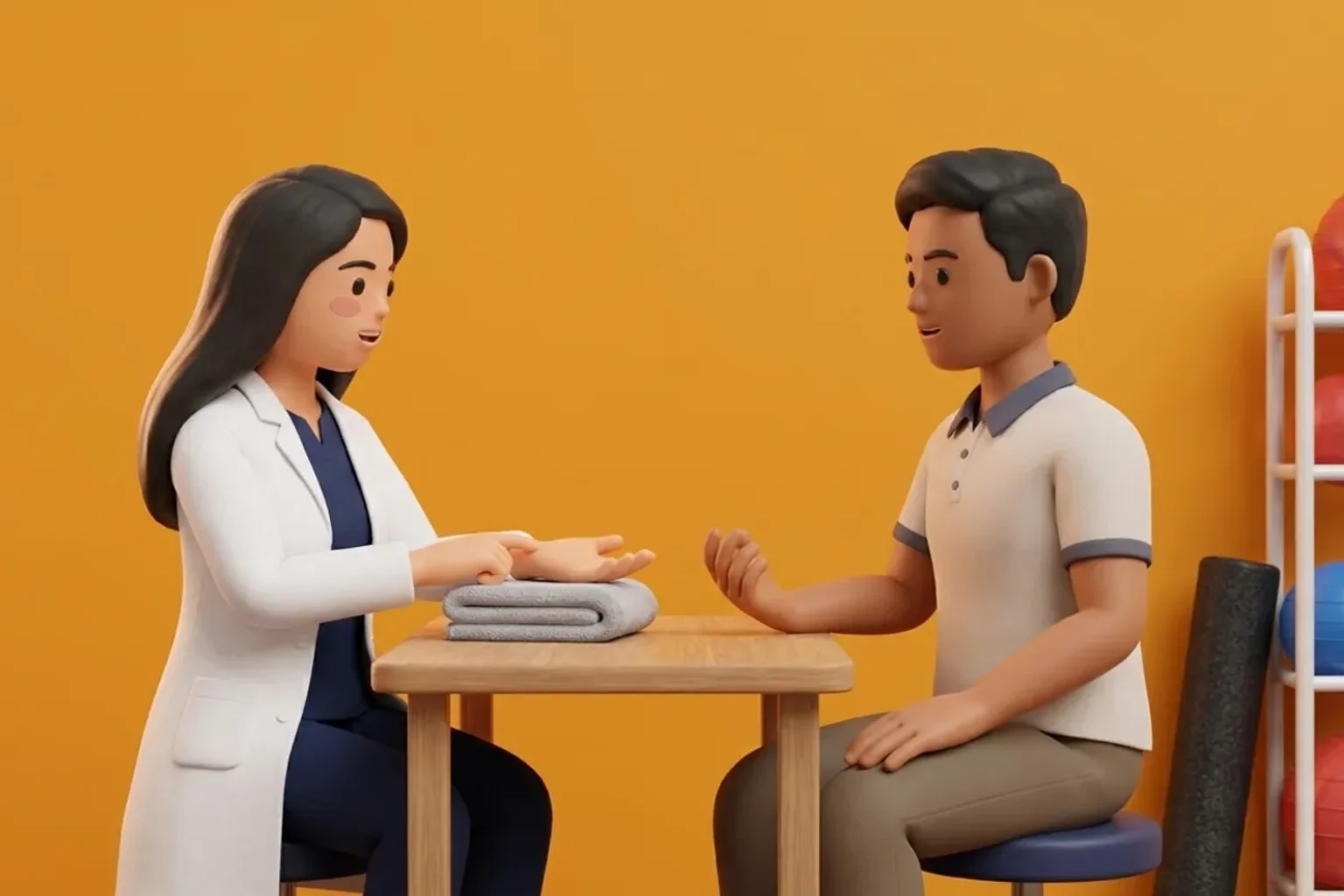
Clinical rehabilitation of proprioceptive deficits follows a graduated sensory hierarchy. Phase 1 introduces Joint Position Sense Training with visual feedback. The clinician straps a small laser pointer to the patient's wrist; the patient elevates the arm to project the laser dot onto a target grid on a wall, establishing a precise visual-proprioceptive link. Phase 2 removes vision: the patient performs Active Joint Repositioning drills with eyes closed, attempting to recreate specific angles (forty-five, ninety, and one hundred and twenty degrees) before opening their eyes to verify accuracy. Phase 3 incorporates Rhythmic Perturbations: the therapist applies unexpected, multidirectional manual taps to the forearm while the patient maintains a steady arm position, stimulating reflexive feedforward co-contraction.
Eyes-Closed Active Joint Repositioning with Wall Marker Touch
Objective: Retrain capsular and muscular proprioceptive awareness to reduce absolute joint position angle errors
- 1Stand comfortably upright facing a clear wall, placing a small piece of colored tape at shoulder height.
- 2Look at the tape target, raise your operative index finger to touch it cleanly, and memorize that exact arm position.
- 3Lower your arm back down to your side, close your eyes firmly, and take a deep breath.
- 4With your eyes closed, raise your arm and attempt to place your index finger directly onto the tape target.
- 5Open your eyes to observe any positional error; adjust your finger to the target, then repeat the drill.
| Mechanoreceptor Type | Histological Morphology & Tissue Location | Neurophysiological Function & Rehabilitation Drill |
|---|---|---|
| Ruffini Endings (Type I) | Slowly adapting dendritic receptors located primarily in the superficial fibrous joint capsule. | Detect static joint position, capsular stretch, and intra-articular pressure; trained via slow, sustained holds. |
| Pacinian Corpuscles (Type II) | Rapidly adapting lamellated receptors situated in deep capsular layers and subacromial bursa. | Detect joint acceleration, sudden deceleration, and high-frequency vibration; trained via plyometric rebounds. |
| Golgi Tendon Organ-Like (Type III) | High-threshold fusiform receptors embedded at the myotendinous junction and tendon enthesis. | Detect active tensile muscle tension; protect against overload; trained via progressive isometric loading. |
| Free Nerve Endings (Type IV) | Unmyelinated nociceptors distributed abundantly throughout the subacromial bursa and synovium. | Transmit tissue damage and chemical inflammatory signals; downregulated by rhythmic joint mobilization. |
Proprioceptive and feedforward motor retraining requires a high degree of central nervous system concentration. When muscles become physically fatigued, mechanoreceptor signaling degrades rapidly, leading to erratic joint movements that can stress healing tissues. Keep sensory training sessions short, focused, and performed prior to fatiguing strength exercises.
Frequently Asked Questions
Why do I feel so clumsy and inaccurate with my arm after shoulder surgery?
When your tendon was torn and surgically repaired, the microscopic position sensors (mechanoreceptors) inside the joint were temporarily disrupted. Your brain has lost its accurate internal map of where your arm is in space. Simple eyes-closed balance and pointing exercises quickly retrain these sensors, restoring your natural accuracy and coordination.
Do I need a doctor referral to see a rotator cuff physiotherapist on BookPhysio.in?
BookPhysio.in does not require a physician prescription. Under the National Commission for Allied and Healthcare Professions (NCAHP) Act 2021, patients across India enjoy direct access to autonomous registered physiotherapists. Through BookPhysio.in, you connect directly with verified clinicians and pay per session with transparent fees, completely free from advance package commitments, commission markups, or platform subscription charges.
Related condition guides



Related recovery guides & articles
BookPhysio.in Editorial Team
The BookPhysio.in editorial team writes and maintains this content, checking it against reliable clinical sources. Content follows our medical review policy: general information only, and no page claims a clinical review until a named registered physiotherapist has signed it off.
Read our medical review policy