
Return to Cricket Batting and Fast Bowling After Cervical Disc Herniation: Biomechanical Progression
In short
Cricket batting and fast bowling place immense impact and rotational demands on the cervical spine. Learn structured return-to-play criteria and bowling progressions.
In this guide (4 sections)
Cricket is the undisputed sporting passion of India, played by millions of amateur, club, and elite athletes across every state. However, the modern game demands extraordinary physical resilience from the cervical spine. Fast bowlers generate ground reaction forces exceeding five to eight times their body weight at front-foot delivery stride, transmitting explosive axial shock up through the spine. Batters must track bouncers traveling at over 140 km/h while wearing heavy protective helmets, executing rapid craniocervical rotation and extension. When a cricketer suffers a cervical disc herniation with radiculopathy, returning to the pitch requires a structured, multi-phase sports rehabilitation program that rebuilds kinetic chain power while protecting healing spinal structures.
Club Cricket, Turf Grounds, and Street Gulli Matches in India
Across India, cricket is played on widely varying playing surfaces, from manicured international stadiums to hard concrete gullies, uneven dirt maidans, and synthetic matting pitches. Fast bowlers bowling on hard, unyielding surfaces absorb massive impact shock through their joints with every delivery stride. When young athletes experience neck stiffness and arm tingling, they often play through the pain, fearing loss of their team selection spot or club contract. Many athletes receive non-specific shoulder massages or take pain-relieving injections that mask worsening nerve root compression. Sports physiotherapy provides an objective, criteria-based return-to-cricket roadmap that restores competitive performance safely.
Delivery Stride Biomechanics, Front-Foot Ground Reaction, and Helmet Dynamics
The biomechanical stress experienced by a fast bowler cervical spine is immense. During the delivery stride, front-foot plant creates an abrupt deceleration shock. As the bowling arm windmills overhead into release, the trunk undergoes violent lateral flexion, rotation, and extension. The lower cervical spine (C5-C7) experiences simultaneous axial compression, rotational torque, and contralateral shear. If an intervertebral disc has suffered an annular tear or extrusion, these combined forces can re-herniate nuclear material directly into the exiting nerve root. For batters, wearing a protective cricket helmet adds 800 to 1,000 grams of mass. Hooking or pulling short-pitched bouncers requires rapid cervical extension and rotation within fractions of a second, exerting high eccentric strain on the posterior cervical extensors and facet capsules.
Staged Return-to-Play Criteria, Kinetic Chain Training, and Bowling Load Spikes
Returning to cricket follows an objective, five-stage progression. Stage 1 focuses on symptom resolution, achieving full pain-free cervical range of motion, normal deep tendon reflexes, and a negative Spurling test. Stage 2 builds cervical and scapular strength: the athlete must demonstrate cervical extensor isometric endurance exceeding 90 seconds and complete deep neck flexor holds at 30 mmHg. Stage 3 initiates cricket-specific gym training: medicine ball throws, thoracic rotational power drills, and kinetic chain core transfers. Stage 4 begins non-competitive cricket skills: batters face gentle throw-downs in the nets with lightweight helmets; bowlers begin static arm action drills without a run-up. Stage 5 introduces progressive bowling workloads, monitoring delivery counts to prevent acute-to-chronic workload spikes before clearing the athlete for full match play.
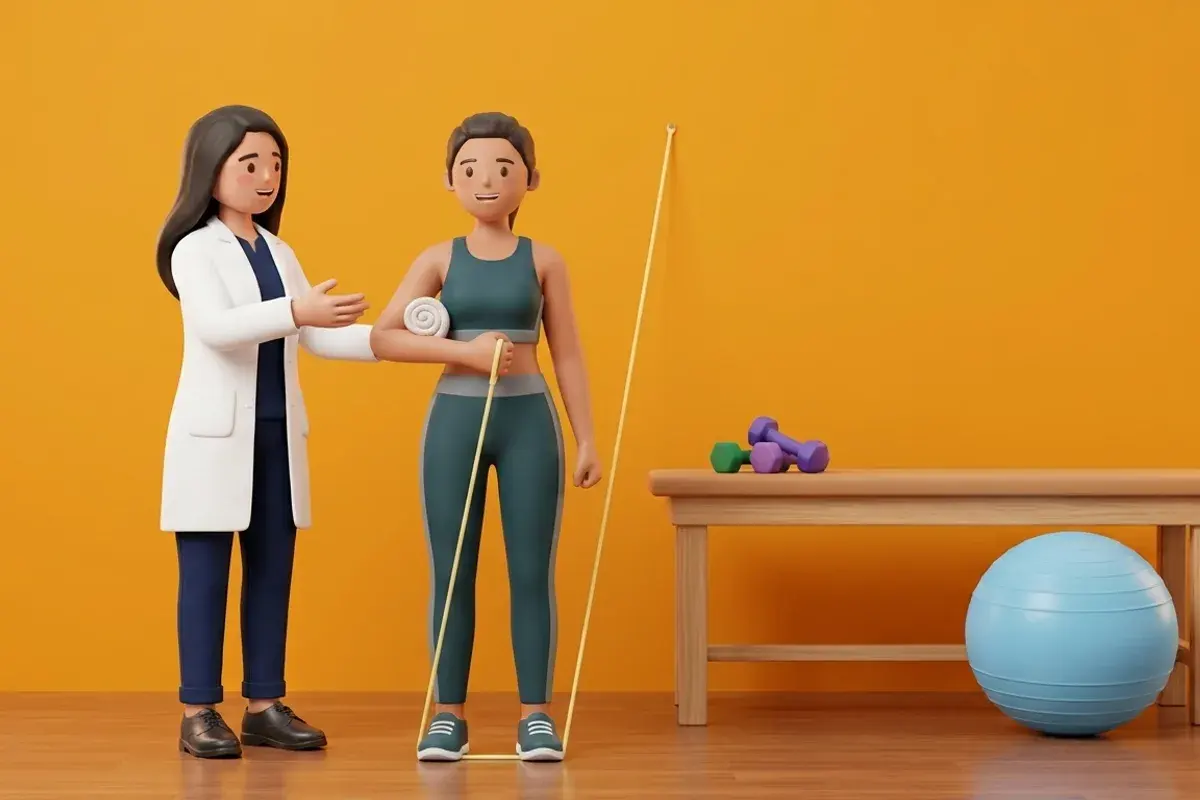
Rotational Elastic Band Diagonal Pull with Neutral Cervical Control
Objective: Condition kinetic chain rotational power from hips through torso while maintaining stable craniocervical alignment
- 1Secure an elastic resistance band at chest height to a sturdy post or door anchor.
- 2Stand sideways to the anchor in an athletic cricket batting stance, knees slightly bent and feet wider than shoulder-width.
- 3Hold the band handle with both hands across your chest, keeping your chin lightly tucked and gaze fixed forward on an imaginary bowler.
- 4Rotate your hips and torso smoothly across your body as if executing a powerful drive, pulling the band diagonally.
- 5Keep your head completely steady and neck long, ensuring your eyes stay level without tilting your head backward.
| Return-to-Play Stage | Physical and Neurological Entry Criteria | Allowed Cricket Activities & Bowling Progression |
|---|---|---|
| Stage 1: Clinical Clearance | Zero resting radicular pain; full active cervical ROM; negative Spurling and ULNT tests | Cardiovascular fitness (stationary cycling, treadmill); gentle walking. |
| Stage 2: Muscular Endurance | Cervical extensor endurance > 90 sec; CCFT 30 mmHg hold; symmetric shoulder strength | Gym-based kinetic chain conditioning; core rotation drills; medicine ball throws. |
| Stage 3: Cricket Skills Drills | Passes all gym strength tests; zero post-exercise cervical ache or paresthesia | Batters: light throw-downs in nets; Bowlers: standing deliveries from 3 paces; no run-up. |
| Stage 4: Workload Building | Tolerates 4 net sessions without symptoms; acute-to-chronic workload ratio 0.8-1.2 | Bowlers: progress from half run-up (18 balls) to full run-up (30-36 balls per session). |
| Stage 5: Full Match Clearance | Bows full spell at match intensity in practice match; zero neurological symptoms | Cleared for competitive league and club matches; ongoing maintenance conditioning. |
If a cricket batter is struck on the helmet by a fast delivery, or if a fielder collides violently while diving, immediately conduct sideline concussion screening (SCAT6) and evaluate the cervical spine using the Canadian C-Spine Rule. Never allow an athlete to continue playing if they report neck pain, midline bony tenderness, visual blurring, or confusion.
Frequently Asked Questions
When can a fast bowler start bowling again after a slipped disc in the neck?
A fast bowler typically requires 12 to 16 weeks of structured rehabilitation before bowling off a full run-up. You must first be completely free of nerve pain, have full neck movement, and demonstrate excellent neck and core strength. Bowling resumes gradually: first standing at the crease, then bowling from a few paces, and finally building up your full run-up over several weeks to avoid re-injuring the disc.
Do I need a doctor referral to see a cervical spine physiotherapist on BookPhysio.in?
BookPhysio.in does not require a physician prescription. Under the National Commission for Allied and Healthcare Professions (NCAHP) Act 2021, patients across India enjoy direct access to autonomous registered physiotherapists. Through BookPhysio.in, you connect directly with verified clinicians and pay per session with transparent fees, completely free from advance package commitments, commission markups, or platform subscription charges.
Related condition guides



Related recovery guides & articles
BookPhysio.in Editorial Team
The BookPhysio.in editorial team writes and maintains this content, checking it against reliable clinical sources. Content follows our medical review policy: general information only, and no page claims a clinical review until a named registered physiotherapist has signed it off.
Read our medical review policy