
Return to Work After Prolonged ICU Stay: Ergonomics and Pacing
In short
Guide vocational return after prolonged ICU admission. Physical ergonomics, cognitive pacing, phased return-to-work plans, and occupational rehab in India.
In this guide (2 sections)
Returning to professional employment after prolonged intensive care is one of the most meaningful milestones of recovery, symbolizing a complete restoration of identity, financial independence, and social participation. However, international registries show that nearly 50 percent of previously employed ICU survivors remain unemployed or experience significant job changes one year after discharge. A structured vocational physiotherapy program bridges the gap between home recovery and workplace demands.
The Triad of Workplace Barriers: Physical, Cognitive, and Psychological
Successful employment demands complex physical and mental endurance that heavily strains a recovering body. Sarcopenic physical weakness causes postural back and neck pain during prolonged sitting or standing. Concurrently, post-ICU cognitive deficits (such as impaired working memory, slow information processing speed, and mental fatigue) make multi-tasking and meeting deadlines exhausting. Compounded by travel stress and fear of failure, returning to work too quickly can trigger profound exhaustion and job abandonment.
| Vocational Phase | Working Hours Schedule | Target Occupational Tasks | Physiotherapy Ergonomic Intervention | |
|---|---|---|---|---|
| Phase 1: Pre-Vocational Reconditioning | Zero workplace hours (Home preparation) | Simulating workplace tasks at home (computer work 2-3 hours) | Ergonomic desk setup, posture endurance exercises, energy budgeting | |
| Phase 2: Graduated Return (Part-Time) | 2 to 4 hours/day, 2 to 3 days/week | Low-stress tasks, zero urgent deadlines, frequent rest breaks | Commute pacing, seated ergonomic adjustments, micro-break stretching | |
| Phase 3: Workload Consolidation | 6 hours/day, 4 to 5 days/week | Standard job responsibilities with built-in pacing intervals | Advanced dynamic core strengthening, postural endurance drills | |
| Phase 4: Full Vocational Re-Integration | Full-time regular employment | Full unrestricted professional duties and commuting | Long-term physical fitness maintenance, stress management |
Ergonomic Workspace Assessment and Adaptation Protocols
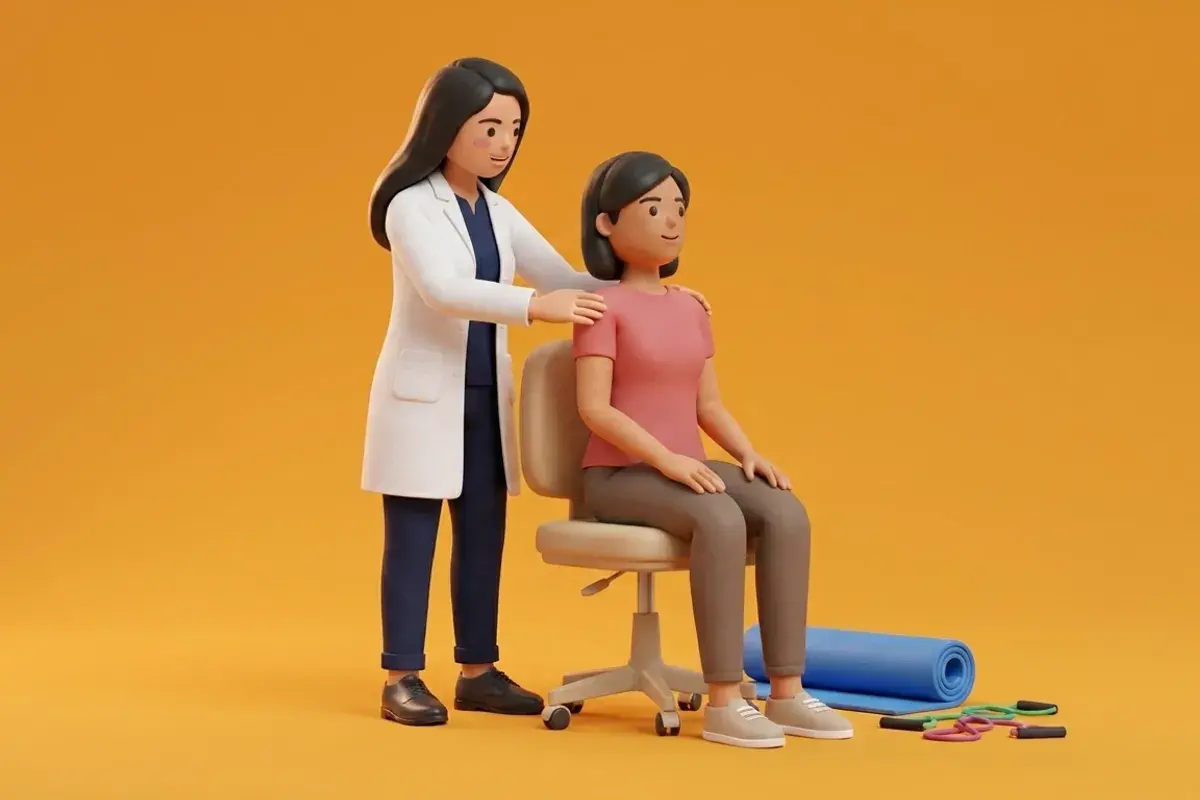
The physiotherapist conducts an ergonomic job demands analysis, evaluating physical requirements such as sitting tolerance, typing duration, lifting weights, and commuting distances. Recommendations include ergonomic task seating with lumbar support, adjustable desk heights for alternating sit-stand postures, monitor height adjustments to eliminate cervical flexion, and scheduled micro-breaks every 45 minutes.
Desk-Based Scapular Retraction and Thoracic Extension Drill
Objective: Relieve postural fatigue and prevent neck and upper back strain during workplace computer use.
- 1Sit tall in your office chair with feet flat on the floor and back unsupported by the chair back.
- 2Rest both hands on your thighs and gently nod the chin to align the cervical spine.
- 3Inhale deeply while drawing both shoulder blades backward and downward toward the spine.
- 4Open the chest and gently extend the upper thoracic spine, holding the posture for five seconds.
- 5Exhale smoothly while relaxing back to neutral posture, releasing shoulder tension.
Domestic Recovery in India and Multigenerational Support
In India, returning to work involves navigating crowded public transit, local trains, or auto-rickshaw commutes in heavy traffic, which can exhaust a recovering survivor before the workday even begins. Multi-generational families assist by arranging private carpools or car services during early phases, ensuring the patient carries nutritious home-cooked meals, and encouraging flexible work-from-home arrangements where possible.
Long-Term Trajectory and Career Longevity
Survivors who follow a phased, ergonomically supported return-to-work program achieve higher rates of sustained employment and report greater job satisfaction. Gradual physical reconditioning protects vulnerable tissues while rebuilding professional confidence and career longevity.
Do not attempt a sudden full-time return to high-stress employment. Rushing back to 40-plus hour workweeks within the first three months post-ICU frequently triggers physical burnout, severe cognitive fatigue, and medical relapse.
How many months after ICU discharge should a patient wait before returning to work?
Most critical illness survivors require at least three to six months of dedicated physical and cognitive rehabilitation before initiating a phased, part-time return to work. Highly physical jobs may require six to nine months of reconditioning.
Do I need a doctor referral to consult a home physiotherapist in India?
Under the National Commission for Allied and Healthcare Professions (NCAHP) Act 2021, patients in India enjoy direct access to registered physiotherapists without requiring a mandatory doctor referral. At BookPhysio.in, you consult verified physiotherapists and pay directly per session without hidden fees or platform commissions.
Related condition guides


Related recovery guides & articles
BookPhysio.in Editorial Team
The BookPhysio.in editorial team writes and maintains this content, checking it against reliable clinical sources. Content follows our medical review policy: general information only, and no page claims a clinical review until a named registered physiotherapist has signed it off.
Read our medical review policy