
Scar Mobilization and Patellar Tendon Mobility Following Knee Arthroplasty
In short
Restore normal patellar tracking and prevent restrictive adhesions with targeted surgical scar mobilization and multi-directional patellar glides after knee surgery.
In this guide (4 sections)
Following total knee arthroplasty, the development of dense surgical scar tissue and restrictive adhesions around the extensor mechanism represents a leading cause of persistent stiffness and anterior knee pain. The standard anterior longitudinal surgical incision and underlying medial parapatellar arthrotomy cut through cutaneous dermis, superficial fascia, the prepatellar bursa, and the medial retinaculum. During the proliferative and remodeling phases of wound healing, fibroblasts deposit a dense, disorganized matrix of Type III collagen. If these collagen fibrils are not subjected to guided mechanical tension, they cross-link into unyielding fibrous bands that tether the skin to the patellar tendon and anchor the patella into the femoral trochlea. Systematic scar mobilization and multi-directional passive patellar glides are vital clinical interventions to preserve joint arthrokinematics and prevent arthrofibrotic entrapment.
Traditional Oil Application Habits, Staple Clearance, and Sterile Skin Care
In Indian households, traditional cultural practices strongly advocate massaging healing wounds with mustard oil, sesame oil, or turmeric pastes to accelerate recovery. Applying oils or herbal concoctions over a surgical incision before staples are removed and before the epidermal barrier has fully epithelialized carries an extreme risk of bacterial colonization and deep periprosthetic infection. Home physiotherapists must establish clear, non-negotiable boundaries: zero topical substances should contact the wound until the operating surgeon removes all metal staples (typically on day 12 to 14) and confirms complete, dry epithelial closure. Only after full epithelialization, typically by week three, should patients use a small drop of sterile vitamin E oil or pure medical-grade coconut oil to facilitate gentle scar mobilization.
Collagen Realignment, Infrapatellar Fat Pad Fibrosis, and Arthrokinematics
The mechanical excursion of the patella is fundamental to both knee flexion and extension. In full extension, the patella sits loosely above the trochlea; as the knee flexes to 90 degrees, it must glide inferiorly by approximately 1.5 to 2 centimetres while tracking smoothly within the femoral groove. During surgical exposure, the infrapatellar fat pad (Hoffa fat pad) is frequently resected or coagulated, predisposing the anterior compartment to dense fibrotic obliteration. If the patellar tendon becomes tethered to the underlying anterior proximal tibia, patella baja (inferior tethering) ensues, creating an immovable mechanical block that halts flexion at 70 to 80 degrees and causes severe anterior impingement pain. Manual cross-friction scar massage stimulates collagenase activity, reorganizing random collagen strands into parallel bundles aligned with physiologic lines of stress.
Multi-Directional Patellar Glides, Skin Rolling, and Retinacular Release
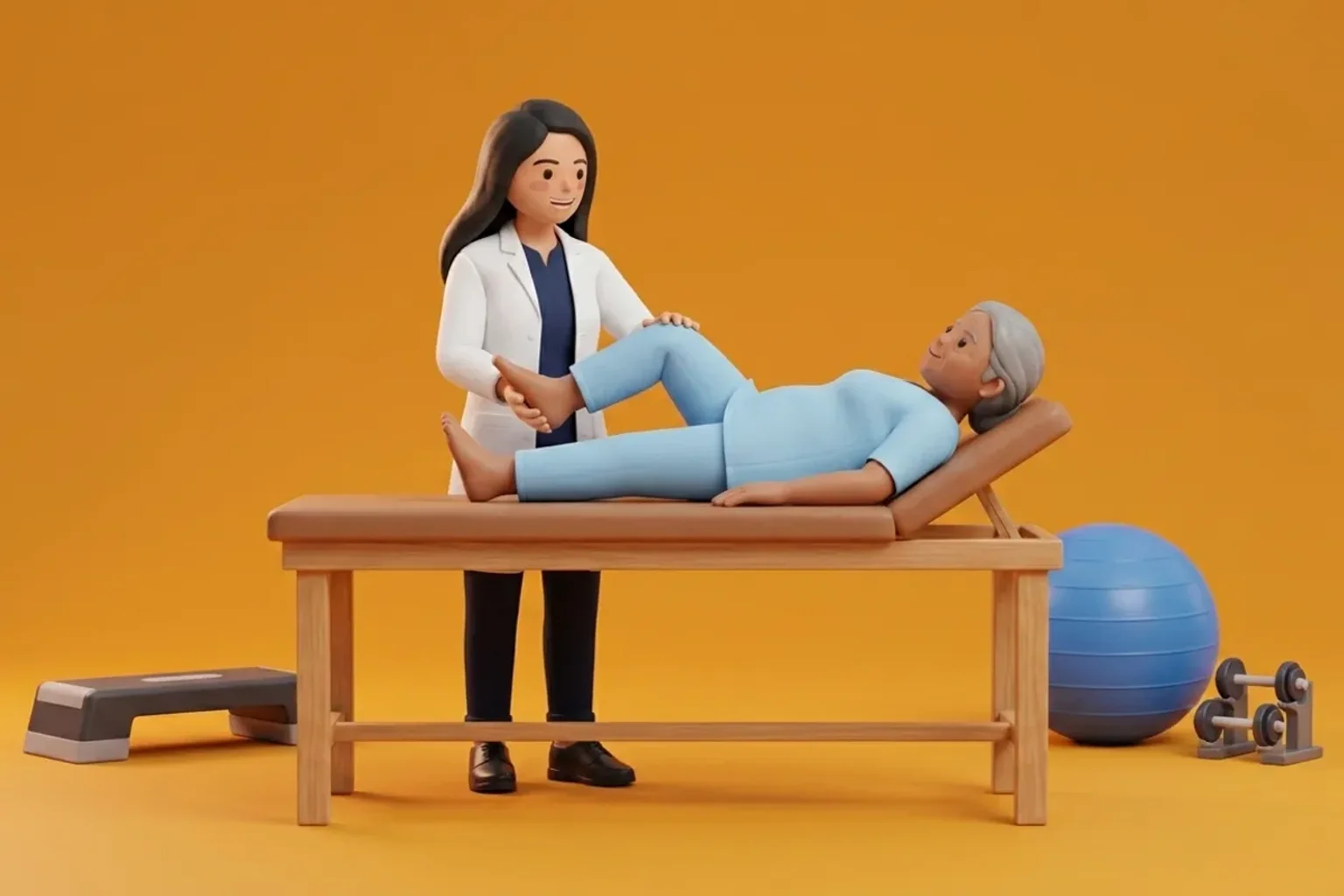
Patellar mobilization commences once postoperative hemarthrosis subsides, performed with the patient supine and the quadriceps completely relaxed. The clinician or trained patient uses the web spaces of both thumbs to apply sustained, oscillatory glides in four distinct directions: superior glides to restore extension lockout, inferior glides to facilitate deep flexion, and medial/lateral glides to stretch the retinacular tissues. Once the surgical incision has matured past week three, gentle skin rolling and cross-friction massage are applied directly over the scar line, lifting the cutaneous tissue away from the underlying patellar tendon to ensure free, unrestricted tissue gliding.
Four-Directional Passive Patellar Mobilization in Complete Relaxation
Objective: Restore physiological superior, inferior, medial, and lateral patellar glide to facilitate full flexion and extension
- 1Sit upright on a bed with your operative leg extended straight out in front of you, supported completely by the mattress.
- 2Ensure your thigh and hamstring muscles are entirely limp and relaxed; if your thigh is tense, the kneecap cannot move.
- 3Place the fleshy pads of both thumbs against the outer edge of your kneecap and apply a gentle, steady push inward (medial glide), holding for 5 seconds.
- 4Repeat the technique in reverse, using your index fingers on the inner edge to gently glide the kneecap outward (lateral glide).
- 5Place your index fingers and thumbs along the top and bottom borders of the kneecap, gently gliding it upward toward your hip and downward toward your foot.
| Patellar Glide Direction | Targeted Arthrokinematic Motion | Primary Functional Movement Restored | Consequence of Restricted Mobility |
|---|---|---|---|
| Superior Glide (Upward) | Translates patella proximally into suprapatellar pouch | Terminal active knee extension (zero degrees lockout) | Persistent quadriceps extensor lag; inability to lock knee during stance |
| Inferior Glide (Downward) | Translates patella distally into intercondylar groove | Deep knee flexion beyond 90 degrees | Mechanical flexion block at 75-80 degrees; patellar impingement pain |
| Medial Glide (Inward) | Stretches tight lateral retinaculum and iliotibial band attachments | Balanced patellofemoral tracking during active quadriceps contraction | Lateral patellar tilt; increased lateral facet wear; anterior crepitus |
| Lateral Glide (Outward) | Stretches medial retinacular surgical repair line gently | Prevents medial adhesion formation in gutters | Medial joint line tightness; asymmetric tension on trochlear component |
Never perform scar massage or vigorous patellar mobilization if the surgical incision shows areas of open scabbing, active fluid oozing, or localized redness and warmth. Manipulating an unhealed incision can cause wound dehiscence or introduce surface bacteria into the deep periprosthetic space. If the incision opens or drains clear or yellow fluid, cover it with a dry sterile dressing and contact your surgical team immediately.
Frequently Asked Questions
The skin on the outer side of my surgical scar feels completely numb and strange to touch. Is this permanent?
Numbness over the outer side of the scar is entirely normal and expected. The standard surgical cut inevitably divides the tiny infrapatellar branch of the saphenous nerve that provides sensation to that patch of skin. Over several months, the numb area will gradually shrink as surrounding microscopic nerves sprout, although a small patch of altered sensation may remain permanently. It does not affect joint strength or function.
Do I need a doctor referral for post-knee replacement physiotherapy on BookPhysio.in?
BookPhysio.in does not require a doctor referral. Under the National Commission for Allied and Healthcare Professions (NCAHP) Act 2021, patients across India enjoy direct access to autonomous registered physiotherapists. Through BookPhysio.in, you connect directly with verified clinicians and pay per session with transparent fees, completely free from advance package commitments, commission markups, or platform subscription charges.
Related condition guides



Related recovery guides & articles
BookPhysio.in Editorial Team
The BookPhysio.in editorial team writes and maintains this content, checking it against reliable clinical sources. Content follows our medical review policy: general information only, and no page claims a clinical review until a named registered physiotherapist has signed it off.
Read our medical review policy