
Sinding-Larsen-Johansson Syndrome: Inferior Patellar Pole Traction Apophysitis
In short
Sinding-Larsen-Johansson syndrome involves traction apophysitis at the inferior patellar pole in active adolescents. Learn how targeted physiotherapy resolves pain.
In this guide (6 sections)
Sinding-Larsen-Johansson (SLJ) syndrome is an osteochondrosis affecting the distal cartilaginous pole of the patella at the proximal origin of the patellar tendon. Typically presenting in young athletes aged 10 to 14 years who participate in running and jumping sports, this condition represents the proximal counterpart to Osgood-Schlatter disease. Repetitive traction by the extensor mechanism during skeletal growth produces micro-avulsions of the unossified patellar apex, accompanied by localized tendinopathy and calcification.
Domestic and Cultural Indian Realities
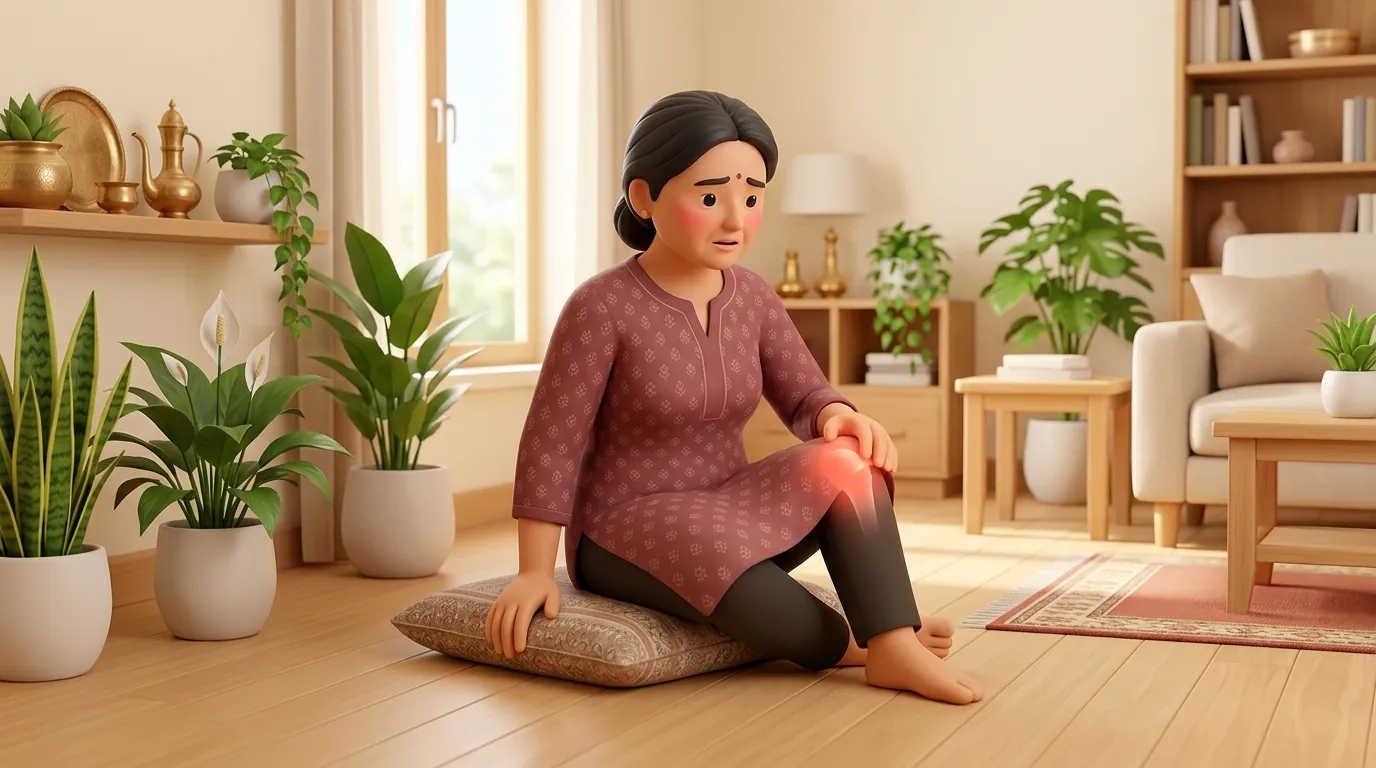
Young Indian athletes engaged in basketball, track athletics, and badminton frequently jump and land on unforgiving indoor concrete surfaces without shock-absorbing wooden suspension floors. Training routines often emphasise repetitive squatting, rope skipping, and bounding drills without adequate recovery intervals. In school routines, prolonged kneeling on hard floors during assembly punishments or traditional prayers places direct compressive contact pressure on the inferior pole of the patella, worsening the traction-induced inflammatory cascade.
Clinical Biomechanics and Physeal Physiology
During the adolescent growth spurt, rapid femoral lengthening increases passive tension throughout the rectus femoris and vasti musculature. The inferior pole of the patella consists of secondary ossification cartilage embedded in fibrocartilage, which possesses lower tensile stiffness than mature cortical bone. Eccentric quadriceps contractions during jump take-offs and landings transmit concentrated tensile stress across this junction, initiating micro-fractures, localized ischaemia, and delayed osteogenesis.
Clinical Assessment and Diagnostic Differentiation
Physical examination demonstrates exquisite pinpoint tenderness precisely localized to the inferior patellar pole, aggravated by passive full knee flexion and resisted knee extension. Clinicians must differentiate SLJ syndrome from Osgood-Schlatter disease (located 3 to 5 centimetres more distally over the tibial tuberosity), adult-type patellar tendinopathy (jumper knee), and bipartite patella. Lateral plain knee radiographs may reveal fragmentation or elongation of the inferior patellar pole in chronic presentations.
Targeted Rehabilitation and Loading Protocols
Rehabilitation focuses on modulating patellofemoral loading while actively conditioning the extensor apparatus. Temporary modification of jumping volume is paired with isometric quadriceps loading, which provides immediate analgesic relief through local tendon mechanotransduction. As resting discomfort subsides, patients progress to heavy slow resistance training (including leg presses and split squats), paired with dynamic hip abductor and gluteal strengthening to control dynamic knee valgus.
Wall Sit with Hip Adductor Isometric Squeeze
Objective: Load the proximal patellar extensor mechanism isometrically while stabilizing the patellar tracking vector
- 1Lean your back flat against a smooth wall with feet placed shoulder-width apart and approximately two feet forward from the wall.
- 2Place a soft foam block or small football securely between your inner knees.
- 3Slide down the wall until knees are bent to approximately 45 to 60 degrees, ensuring your kneecaps track over your middle toes.
- 4Gently squeeze the block between your knees while maintaining the static wall sit position for 40 seconds, breathing evenly throughout.
| Diagnostic Parameter | Sinding-Larsen-Johansson (SLJ) | Osgood-Schlatter Disease (OSD) |
|---|---|---|
| Anatomical Site | Inferior pole of patella at proximal patellar tendon origin | Tibial tuberosity at distal patellar tendon insertion |
| Typical Age Group | 10 to 13 years (slightly younger presentation) | 12 to 15 years (peak pubertal growth spurt) |
| Radiographic Sign | Fragmentation or calcification at patellar apex | Irregularity and bony prominence of tibial tuberosity |
Red Flags and Specialist Escalation
Red flag indicators warranting immediate orthopaedic escalation include a palpable defect within the patellar tendon, high-riding patella (patella alta) following sudden trauma indicating complete tendon avulsion, persistent joint effusion, or unremitting nocturnal pain. These clinical features require urgent plain radiographs and magnetic resonance imaging to exclude macroscopic extensor mechanism rupture, infection, or bony malignancy.
Frequently Asked Questions
How long does it take for Sinding-Larsen-Johansson syndrome to improve with physiotherapy?
With structured activity modification and isometric physiotherapy, acute knee pain typically improves within 4 to 8 weeks. Complete resolution occurs as the inferior patellar pole ossifies, allowing a safe and full return to competitive sports.
Do young athletes in India need a doctor referral to see a physiotherapist for patellar pole pain?
BookPhysio.in does not ask for a doctor referral. Under the National Commission for Allied and Healthcare Professions (NCAHP) Act 2021, registered physiotherapists are recognized as primary contact practitioners. You can book directly with sports physiotherapists and pay directly per session.
Related condition guides


Related recovery guides & articles
BookPhysio.in Editorial Team
The BookPhysio.in editorial team writes and maintains this content, checking it against reliable clinical sources. Content follows our medical review policy: general information only, and no page claims a clinical review until a named registered physiotherapist has signed it off.
Read our medical review policy