
Sitting Cross-Legged in Sukhasana: Meniscal Horn Impingement Mechanics and Protection
In short
Analyze the combined flexion, external rotation, and varus strain placed on meniscal horns during cross-legged sitting, with safe modifications.
In this guide (4 sections)
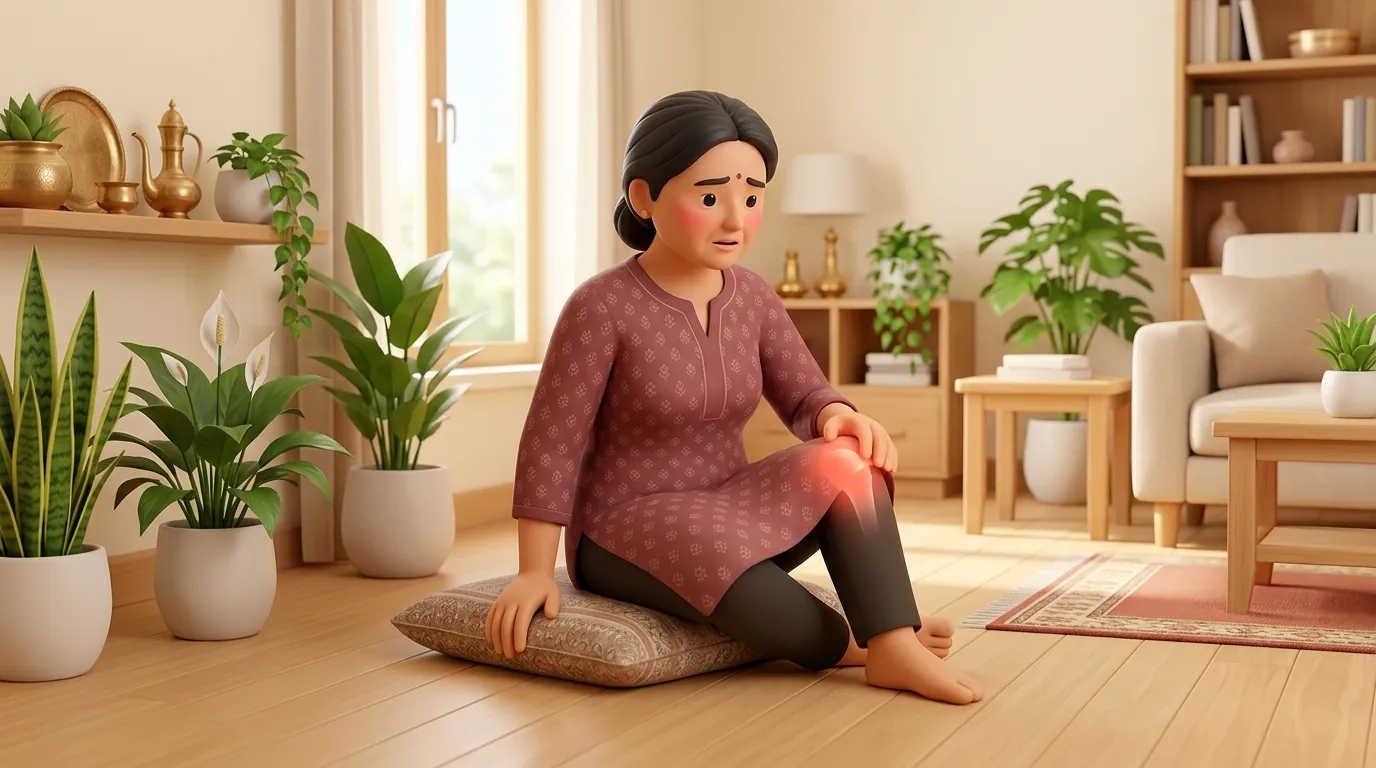
Sitting cross-legged on the floor, traditionally known in yoga as Sukhasana (easy pose) or Swastikasana, is an ancient and deeply ingrained postural posture across the Indian subcontinent. It is employed daily during family meals, religious ceremonies, meditation, social interactions, and domestic chores. Biomechanically, sitting cross-legged is far from an easy pose for the knee joint. It demands a complex triad of multiplanar joint motions: near-terminal knee flexion (typically 120 to 135 degrees), accompanied by external tibial rotation and a substantial varus angulation. In a healthy knee with flexible hip rotators, much of the rotational excursion originates from the ball-and-socket hip joint. However, when hip external rotation is restricted, compensatory torsional shear is transferred directly onto the knee, driving the medial meniscal posterior horn into a mechanical impingement zone.
Cultural Floor Living: Puja Rituals, Dining Mats, and Family Expectations
In Indian households, the expectation to sit on the floor is laden with social and cultural significance. Declining to sit cross-legged during a family religious pooja, festive feast, or wedding gathering is often perceived as disrespectful or socially awkward, especially for middle-aged and older family members. Many patients with diagnosed meniscal tears endure excruciating knee pinch simply to avoid appearing uncooperative in front of relatives. Furthermore, rising from the floor after 45 minutes of cross-legged sitting imposes a sudden torsional burst across a joint that has experienced prolonged fluid stasis. Clinicians must educate patients and families alike, framing posture modifications not as physical weakness, but as prescribed medical joint protection that safeguards long-term mobility.
Multiplanar Varus-Rotational Shear and Medial Meniscal Wedge Traps
The patho-mechanics of cross-legged sitting involve a destructive combination of compressive and torsional forces. As the knee flexes past 120 degrees with the shin resting against the floor or opposite thigh, the medial joint space undergoes significant varus narrowing. The medial femoral condyle shifts posteriorly and rotates externally relative to the tibial plateau. This motion wedges the posterior horn of the medial meniscus into the narrow posterior recess between the femoral condyle and the posterior tibial margin. If the patient has an existing horizontal cleavage tear, the superior and inferior leaves of the meniscus are subjected to opposing shearing vectors, provoking synovial irritation and parameniscal cyst formation. In radial or complex tears, the compressive pinch drives fragment fraying, accelerates tissue degeneration, and generates localized inflammatory effusion.
Hip-Centred Mobility Conditioning and Adaptive Floor Seating Strategies
Protecting the menisci during floor living requires addressing the primary anatomical driver of knee torque: restricted hip external rotation. Physiotherapists implement targeted hip mobility exercises, including seated figure-four stretches, gentle piriformis mobilizations, and active hip abduction drills. When hip mobility improves, the knee is spared from compensatory twisting. For domestic floor sitting, practical adaptive ergonomics are introduced. Placing a firm yoga block or folded meditation cushion (zafu) under the sit bones elevates the pelvis 10 to 15 centimetres above the floor. This pelvic elevation opens the hip angle, reduces required knee flexion from 135 degrees down to 95 degrees, and significantly diminishes varus torque. Supporting both knees with rolled towels or cushions eliminates hanging tension on the collateral ligaments and meniscal margins.
Seated Figure-Four Hip External Rotation Stretch with Neutral Spine
Objective: Expand hip external rotation mobility to reduce compensatory rotational torque on the knee during cross-legged sitting
- 1Sit upright on a firm dining chair with your feet flat on the floor and your spine in neutral alignment.
- 2Lift your affected leg and gently rest your ankle across the opposite thigh, just above the kneecap.
- 3Allow your elevated knee to rest downward toward the floor, keeping your foot flexed at 90 degrees to protect the ankle.
- 4Place a gentle, relaxed hand on your inner knee without pushing aggressively downward.
- 5Hinge forward slightly from your hips with a straight chest until you feel a comfortable stretch in your outer hip and buttock, holding for 30 seconds.
| Sitting Posture | Knee Flexion Angle | Rotational Torque Source | Meniscal Horn Risk | Ergonomic Adaptation Strategy |
|---|---|---|---|---|
| Unmodified Floor Sukhasana | 120 to 135 degrees | High compensatory knee torsion if hips are stiff | Severe medial posterior horn impingement | Avoid during acute tears and early repair healing |
| Elevated Pelvis on Cushion (Zafu) | 90 to 105 degrees | Significantly reduced; hips absorb rotation | Low; preserves open joint space margins | Permits safe participation in prayer and family dining |
| Kneeling on Heels (Virasana) | 140 to 155 degrees | Minimal rotation, but extreme compressive squeeze | Severe posterior horn wedge pressure | Contraindicated for posterior root and repair patients |
| Straight-Leg Floor Seating (Dandasana) | 0 degrees (neutral extension) | Zero rotational shear | Virtually zero meniscal compression | Excellent alternative when floor sitting is unavoidable |
If a patient experiences an acute catching sensation or is unable to straighten their leg when attempting to uncross their legs after floor sitting, an unstable posterior horn or flap tear may have caught in the joint line. Patients should be instructed never to force the knee straight with sudden violent kicks. Instead, they should gently support the thigh with their hands, gently rock the knee in small arcs, and seek immediate physiotherapy or medical assessment if locking persists.
Frequently Asked Questions
Will I ever be allowed to sit cross-legged on the floor again after meniscal surgery?
For patients who undergo partial meniscectomy, modified cross-legged sitting with cushion support can often be resumed after 8 to 12 weeks once swelling settles and quad control returns. However, following a meniscal repair, sitting cross-legged is strictly restricted for at least 4 to 6 months to protect the delicate suture line, and should only be resumed under the direct guidance of your treating physiotherapist.
Do I need a doctor referral to treat a meniscal tear on BookPhysio.in?
BookPhysio.in does not require a doctor referral. Under the National Commission for Allied and Healthcare Professions (NCAHP) Act 2021, patients across India enjoy direct access to autonomous registered physiotherapists. Through BookPhysio.in, you connect directly with verified clinicians and pay per session with transparent fees, completely free from advance package commitments, commission markups, or platform subscription charges.
Related condition guides



Related recovery guides & articles
BookPhysio.in Editorial Team
The BookPhysio.in editorial team writes and maintains this content, checking it against reliable clinical sources. Content follows our medical review policy: general information only, and no page claims a clinical review until a named registered physiotherapist has signed it off.
Read our medical review policy