
Stage 3 Rigid Flatfoot: Subtalar Stiffness, Accommodative Bracing Strategies, and Surgical Triage
In short
Understand the complex management of Stage 3 rigid flatfoot, exploring subtalar joint arthrosis, custom accommodative bracing, and surgical fusion indications.
In this guide (4 sections)
Stage 3 posterior tibial tendon dysfunction represents an advanced, fixed musculoskeletal deformity characterized by complete loss of flexibility across the hindfoot and midtarsal joints. Unlike the flexible presentation observed in Stage 2, the collapsed arch, severe calcaneal valgus, and forefoot abduction in Stage 3 cannot be passively reduced to neutral alignment, even when examined non-weight-bearing under complete muscle relaxation. Chronic joint subluxation, extensive periarticular soft-tissue fibrosis, and secondary degenerative arthrosis across the subtalar, talonavicular, and calcaneocuboid articulations permanently lock the foot in a rigid, deformed configuration. Patients present not only with medial tendon failure but also with incapacitating lateral hindfoot pain caused by subfibular impingement in the sinus tarsi. At this stage, corrective biomechanical orthotics are strictly contraindicated, shifting the clinical focus toward custom accommodative bracing and surgical evaluation.
Navigating Stairs, Uneven Roads, and Severe Functional Limitation
In Indian urban and semi-urban settings, living with Stage 3 rigid flatfoot severely curtails personal independence. Simple daily requirements such as walking across broken pedestrian footpaths, stepping over roadside curbs, or navigating wet, muddy streets during the monsoon season become extraordinarily hazardous. Because the subtalar joint cannot adapt to ground irregularities, the entire shock of impact transfers unattenuated into the ankle, knee, and lumbar spine. In the home, climbing internal staircases without handrails or standing to cook becomes an excruciating trial, as rigid lateral bone impingement generates deep, unrelenting pain. Finding commercial footwear that accommodates the widened, splayed midfoot and severe bony prominences is nearly impossible, often resulting in painful blisters and calluses.
Subtalar Arthrosis, Fibrous Ankylosis, and Sinus Tarsi Impingement
The pathomechanics of Stage 3 disease involve irreversible osseous and soft-tissue remodeling. Longstanding calcaneal valgus and peritalar subluxation cause complete denudation of articular cartilage within the posterior and middle subtalar facets. Subchondral sclerosis, extensive osteophyte formation, and fibrous ankylosis subsequently lock the joint. Simultaneously, the lateral calcaneal wall tilts upward, directly abutting the distal tip of the lateral malleolus and crushing the sensitive soft tissues within the sinus tarsi, including the cervical ligament and fat pad. On the medial side, the tibialis posterior tendon is frequently completely ruptured, leaving a scarred, non-functional fibrous cord. Any attempt by a clinician to forcibly invert the rigid hindfoot produces intense joint pain without achieving corrective movement.
Accommodative Gauntlet Bracing, Rocker-Bottom Soles, and Surgical Triage
Therapeutic strategy in Stage 3 shifts decisively from deformity correction to deformity accommodation and joint protection. Attempting to force a rigid valgus foot over a stiff medial arch support generates unbearable pressure over the collapsed navicular bone and accelerates skin breakdown. Instead, conservative management employs custom leather Arizona-style gauntlet braces or solid molded ankle-foot orthoses that cradle the foot in its fixed alignment, immobilize painful arthritic joints, and absorb ground impact. Footwear modifications featuring wide toe boxes, soft leather uppers, and rigid rocker-bottom soles facilitate smooth forward progression during gait without requiring painful midfoot motion. When comprehensive bracing fails to alleviate debilitating pain, prompt orthopaedic consultation is required for surgical triple arthrodesis.
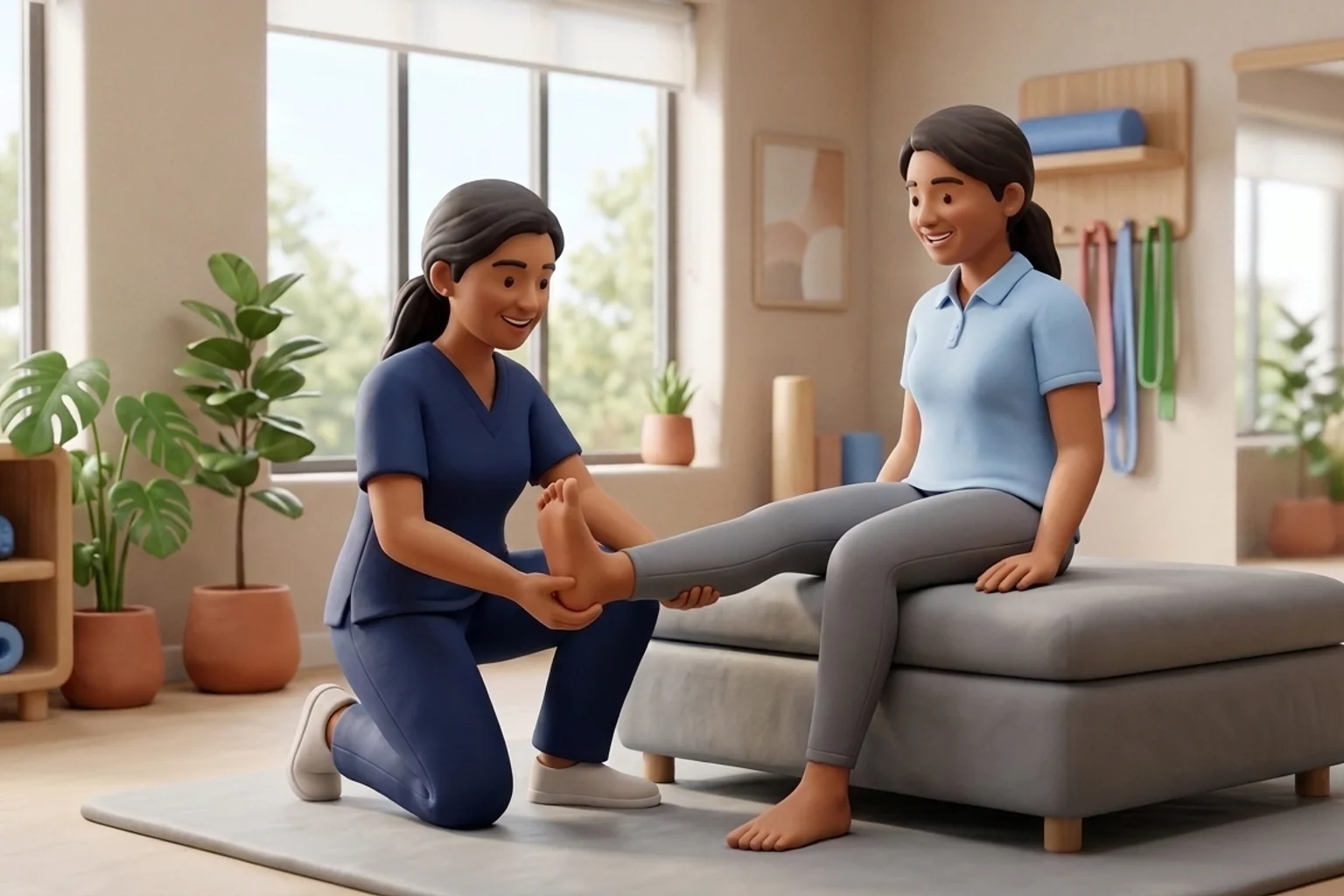
Non-Weight-Bearing Ankle Dorsiflexion and Plantarflexion Mobility Drill
Objective: Maintain sagittal plane ankle mortise mobility while avoiding painful subtalar inversion and eversion shear
- 1Sit comfortably on a supportive chair with your affected leg extended forward, elevating your foot slightly off the floor.
- 2Keep your leg stationary and relaxed, ensuring no twisting or rolling motions occur at your knee or hip.
- 3Slowly pull your foot upward toward your shin in pure dorsiflexion, moving strictly within a pain-free range.
- 4Hold the upward stretch for three seconds, then smoothly point your toes downward into gentle plantarflexion.
- 5Repeat this smooth, purely sagittal pumping motion, consciously avoiding any sideways twisting of the ankle.
| Clinical Domain | Accommodative Conservative Pathway | Surgical Arthrodesis Pathway | Clinical Decision Factor |
|---|---|---|---|
| Primary Goal | Symptom mitigation, joint immobilization, skin preservation | Permanent osseous realignment, joint fusion, pain elimination | Patient age, systemic comorbidities, functional mobility demands |
| Orthotic / Surgical Tool | Custom leather Arizona gauntlet, rigid rocker-bottom footwear | Subtalar or triple arthrodesis (talonavicular, subtalar, calcaneocuboid) | Tolerance of heavy bracing versus surgical recovery willingness |
| Expected Outcome | Pain reduction during limited walking, stable brace dependence | Solid osseous fusion, durable pain-free gait, permanent joint stiffness | Presence of severe lateral sinus tarsi bone-on-bone impingement |
Clinicians must never prescribe rigid, corrective medial arch wedges or aggressive UCBL orthotics for a Stage 3 flatfoot. Because the hindfoot is structurally fused in valgus, a rigid medial wedge cannot realign the bone; instead, it acts as a fulcrum that dramatically amplifies lateral calcaneofibular bone crushing, provoking excruciating pain and risking severe skin ulceration over the medial navicular.
Frequently Asked Questions
Is surgery inevitable once my flatfoot becomes rigid in Stage 3?
Surgery is not universally mandatory. Many elderly or lower-demand patients achieve substantial pain relief and maintain independent daily mobility through custom leather gauntlet braces (such as the Arizona brace) combined with rocker-bottom shoes. However, if unremitting pain persists despite optimal bracing, surgical arthrodesis represents the definitive reconstructive solution.
Do I need a doctor referral to treat flatfoot or PTTD on BookPhysio.in?
BookPhysio.in does not require a doctor referral. Under the National Commission for Allied and Healthcare Professions (NCAHP) Act 2021, patients across India enjoy direct access to autonomous registered physiotherapists. Through BookPhysio.in, you connect directly with verified clinicians and pay per session with transparent fees, completely free from advance package commitments, commission markups, or platform subscription charges.
Related condition guides



Related recovery guides & articles
BookPhysio.in Editorial Team
The BookPhysio.in editorial team writes and maintains this content, checking it against reliable clinical sources. Content follows our medical review policy: general information only, and no page claims a clinical review until a named registered physiotherapist has signed it off.
Read our medical review policy