
Stair Climbing Training: Unoperated Foot First Ascending Technique After Hip Surgery
In short
Master safe stair climbing after total hip replacement using the unoperated foot first technique, handrail mechanics, and practical adaptations for multi-floor homes.
In this guide (4 sections)
Negotiating stairs represents one of the most physically demanding activities of daily living required for true functional independence following total hip arthroplasty. Unlike level-ground walking, stair climbing generates substantial joint reaction forces, exceeding two to three times body weight during ascent and more than four times body weight during descent. Furthermore, stair negotiation requires deep hip and knee flexion combined with eccentric muscular control, which can provoke joint impingement or destabilize healing soft tissues if performed incorrectly. Clinicians rely on a time-tested biomechanical mnemonic, 'Up with the good, down with the bad,' to teach patients how to sequence lower limb movements safely, protect the newly implanted prosthesis, and build movement confidence.
Navigating Multi-Storey Indian Independent Houses and Narrow Staircases
In Indian cities and towns, independent multi-storey houses, row houses, and older walk-up apartment complexes rarely feature elevators. Bedrooms and living areas are often situated on the first or second floor, with kitchen and prayer spaces on the ground floor. In many traditional homes, staircases are steep, constructed with polished granite or smooth kota stone, feature irregular riser heights, and may lack continuous handrails. Descending these stairs during the monsoon season or when wet from daily cleaning poses a severe slip hazard. Families must install sturdy, securely bolted round wooden or metallic handrails along both sides of the staircase and apply non-skid textured adhesive strips to stair treads before the patient returns home from the hospital.
Kinematics of Stair Ascent and Descent, Eccentric Loading, and Impingement Risks
The biomechanics of stair climbing differ fundamentally between the ascending and descending phases. Stair ascent demands explosive concentric power from the lead limb's quadriceps, gluteus maximus, and calf musculature to elevate the body's entire mass against gravity. By leading with the unoperated, healthy leg, the patient utilizes their intact muscular strength to hoist their weight upward, allowing the operative leg to be drawn up passively without excessive tensile stress across the surgical incision. Conversely, stair descent demands controlled eccentric deceleration. As the lead leg steps down, the trailing stance leg must absorb massive eccentric quadriceps and abductor loads while flexing deeply. Stepping down with the operative leg and walking aid first preserves the unoperated limb's strength for controlled lowering, minimizing peak contact stresses across the prosthetic acetabular cup.
Standardized Step-by-Step Stair Negotiation Training Protocol
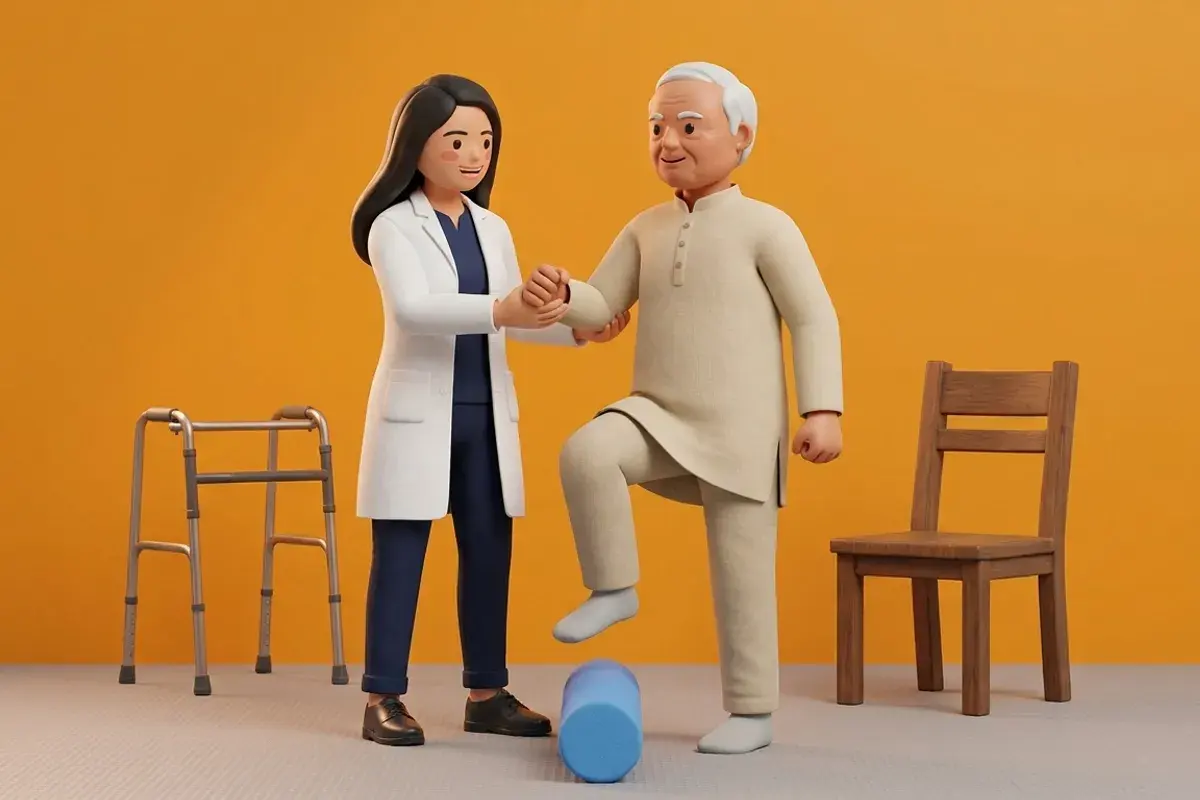
Stair climbing training begins in the hospital ward once the patient demonstrates independent level ambulation and safe sit-to-stand control. To ascend stairs, the patient approaches the base of the staircase holding the handrail with one hand and a walking stick or crutch in the opposite hand. The sequence is executed precisely: step up first with the unoperated leg, transfer weight onto that foot, step up with the operative leg onto the same step, and finally bring the walking stick up onto the step. To descend stairs, the sequence is reversed: place the walking stick down onto the lower step first, step down with the operative leg, and then step down with the unoperated leg onto the same step. Reciprocal step-over-step stair climbing is strictly avoided until late subacute recovery.
Low Platform Step-Up and Step-Down Training Drill
Objective: Practice coordinated lower limb sequencing and eccentric knee control on a safe, low-height platform
- 1Stand facing a sturdy exercise step or wooden block measuring three to four inches high, with a secure wall rail beside you.
- 2Hold onto the handrail firmly with your unoperated side hand, keeping your posture completely upright.
- 3Step your unoperated foot up onto the center of the step, planting your entire sole flat.
- 4Press through that heel to lift your body upward, bringing your operative foot up to rest beside it on the platform.
- 5To step down, lower your operative foot backward to the floor first, then bring your unoperated foot down smoothly.
| Movement Phase | Step-by-Step Movement Sequence | Biomechanical Objective and Clinical Rationale |
|---|---|---|
| Stair Ascent (Going Up) | 1. Unoperated leg steps up first 2. Operative leg steps up onto same step 3. Crutch/stick steps up onto same step | Utilizes strong unoperated quadriceps for concentric lift; protects operative hip from heavy upward shear |
| Stair Descent (Going Down) | 1. Crutch/stick moves down first 2. Operative leg steps down onto lower step 3. Unoperated leg steps down beside it | Uses strong unoperated leg for eccentric lowering; crutch absorbs impact shock before operative foot contacts |
| Handrail Utilization | Grasp wall handrail firmly with one hand; hold both crutches or stick in opposite hand | Creates three-point stability, broadens base of support, and offloads lower extremity forces by up to 30% |
| Turning on Landings | Take small shuffling steps to turn on flat intermediate landings; never pivot on operative leg | Eliminates dangerous torsional torque across the femoral stem and prevents acute prosthetic subluxation |
Attempting to climb stairs using an alternating foot-over-foot pattern during the first six to eight weeks post-surgery places severe eccentric overload on the healing abductors and forces deep hip flexion that can cause sudden joint dislocation. Maintain the 'step-to' pattern (bringing both feet onto the same step) until your physiotherapist explicitly clears reciprocal climbing.
Frequently Asked Questions
What is the easy way to remember how to climb stairs after hip replacement?
Remember the simple rule: 'Up with the good leg, down with the bad leg.' When going upstairs, lead with your healthy unoperated leg first. When going downstairs, lead with your walking stick and your operated surgical leg first, letting your strong leg do the lowering work.
Do I need a doctor referral for post-hip replacement physiotherapy on BookPhysio.in?
BookPhysio.in does not require a doctor referral. Under the National Commission for Allied and Healthcare Professions (NCAHP) Act 2021, patients across India enjoy direct access to autonomous registered physiotherapists. Through BookPhysio.in, you connect directly with verified clinicians and pay per session with transparent fees, completely free from advance package commitments, commission markups, or platform subscription charges.
Related condition guides



Related recovery guides & articles
BookPhysio.in Editorial Team
The BookPhysio.in editorial team writes and maintains this content, checking it against reliable clinical sources. Content follows our medical review policy: general information only, and no page claims a clinical review until a named registered physiotherapist has signed it off.
Read our medical review policy