
Step-by-Step TFCC Tear Rehabilitation: From Conservative Care to Sports Return
In short
Triangular fibrocartilage tears demand precise rotational staging. Discover the 5-stage rehabilitation protocol from acute protection to full athletic return.
In this guide (4 sections)
Rehabilitation of Triangular Fibrocartilage Complex (TFCC) tears in athletes, racquet sport players, and active individuals presents a unique biomechanical challenge. Situated at the crossroads of axial load transmission and forearm rotation, the TFCC is subjected to extreme torsional shear and compressive forces during sports such as badminton, tennis, cricket, and golf. A successful return to competition requires far more than passive symptom relief; it necessitates a structured, multi-phase rehabilitation protocol. Moving systematically from acute DRUJ protection and splinting, through non-shear mobility, isometric stabilization of dynamic muscular couples, and progressive rotational loading, athletes rebuild the high-velocity shock-absorbing capacity needed to withstand ball impact and racquet torque.
Monsoon Wet Floor Falls, Two-Wheeler Skids, and Traditional Indian Cooking Rebuilding
In Indian sporting and daily life, TFCC tears occur frequently in recreational and competitive athletes who play badminton, cricket, and tennis, as well as in commuters who suffer sudden handlebar twists during road skids. A cricketer executing a forceful bottom-hand wrist flick on a drive, or a badminton player executing a rapid overhead smash with extreme pronation-pronation torque, suddenly experiences sharp ulnar-sided wrist pain and a sickening mechanical click. In domestic life, the injured athlete struggles to perform basic rotational tasks: twisting doorknobs, lifting filled steel cooking pots, or turning scooter throttles. If the athlete attempts to return to sports prematurely before dynamic stabilizers are conditioned, partial tears rapidly progress to full avulsions with chronic joint instability.
Colles Malunion Mechanics, Palmer TFCC Classification, and DRUJ Instability
The functional stability of the ulnocarpal joint depends on the harmonious interaction between passive ligamentous restraints and dynamic muscular stabilizers. When the peripheral radioulnar ligaments or articular disc of the TFCC are torn (Palmer Class 1B or 1A), passive stability is compromised, allowing the distal radius and ulna to separate under load. To compensate, rehabilitation recruits the dynamic muscular stabilizers: specifically the pronator quadratus and the extensor carpi ulnaris (ECU). The pronator quadratus acts as an active transverse muscular clamp, compressing the radius and ulna together to resist diastasis. Simultaneously, the ECU tendon within its specialized sixth compartment fibro-osseous sheath acts as a dynamic tension band across the dorsal ulnar column. Staging exercises to recruit these dynamic couples restores joint stability.
Dart-Thrower Motion, Thermoplastic Splint Weaning, and Progressive Putty Loading
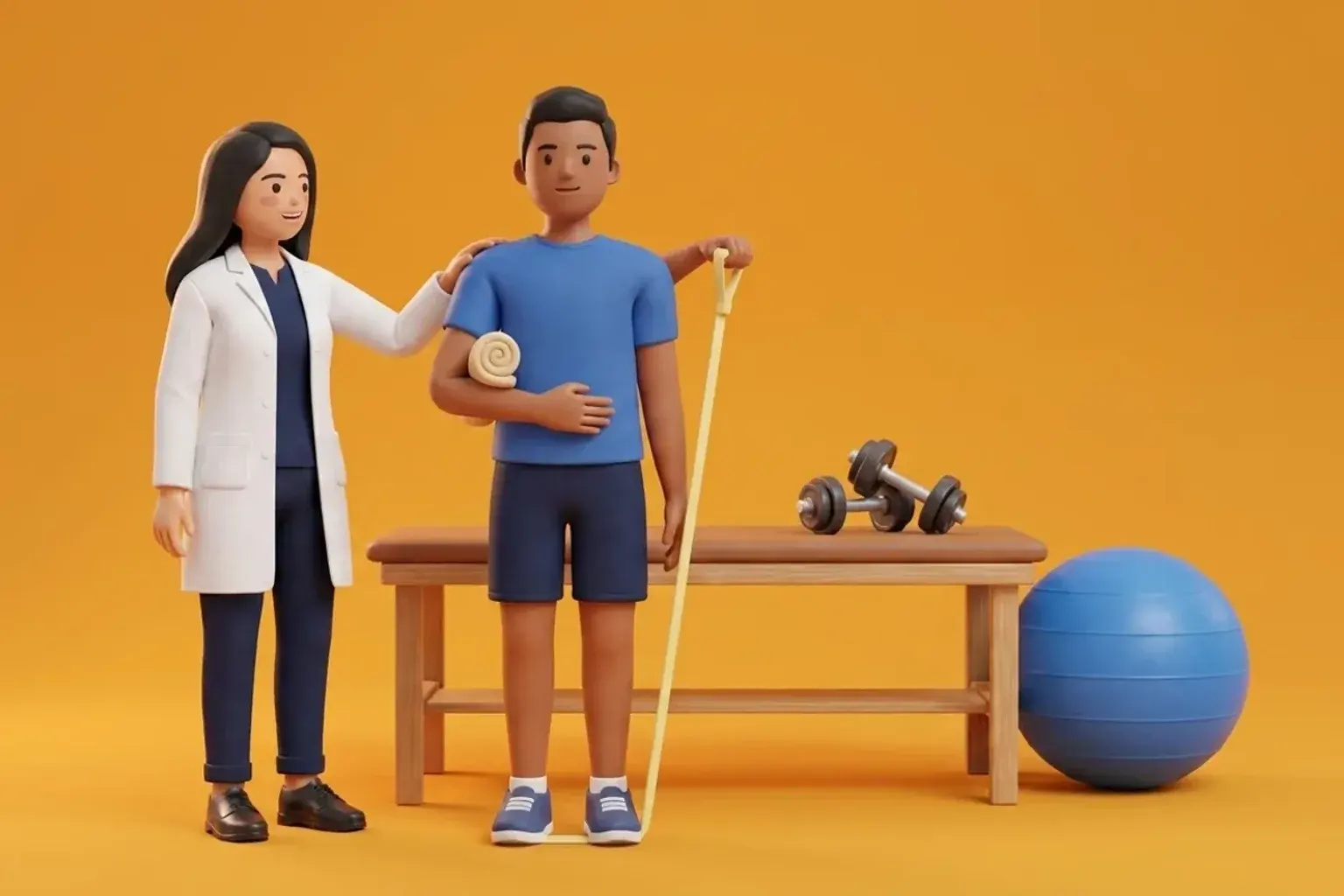
The athletic TFCC protocol spans five progressive phases. Stage 1 (Weeks 1 to 4) enforces acute protection using a sugar-tong splint or WristWidget compression strap, completely eliminating painful rotational shear while maintaining active finger motion. Stage 2 (Weeks 4 to 6) initiates active range of motion strictly within the dart-thrower motion plane, preserving midcarpal mobility without stressing the healing DRUJ. Stage 3 (Weeks 6 to 8) introduces isometric co-contraction of the pronator quadratus and ECU in neutral rotation. Stage 4 (Weeks 8 to 12) progresses to dynamic rotational loading using resistance bands, weighted hammers, and grip dynamometry. Stage 5 (Weeks 12 to 16+) delivers sports-specific conditioning: plyometric medicine ball catches, shadow swings, and progressive impact training.
Dynamic DRUJ Co-Contraction with Elastic Resistance Band Pronosupination
Objective: Recondition dynamic muscular stabilizers of the TFCC to resist rotational shear during athletic movement
- 1Secure your ulnar compression strap (such as a WristWidget) comfortably around your wrist.
- 2Sit with your elbow bent at ninety degrees and pinned firmly against your side, holding one end of an elastic resistance band.
- 3Anchor the opposite end of the band securely under your shoe on the floor.
- 4Starting with your forearm in neutral position (thumb pointing up), slowly rotate your palm upward into supination against band resistance over 2 seconds.
- 5Pause for 2 seconds at the top, then slowly control the return back to neutral over 3 seconds, ensuring zero ulnar clicking or sharp pinching.
| Athletic Protocol Stage | Biomechanical Focus and Protection Level | Clinical Interventions and Sports Progression |
|---|---|---|
| Stage 1: Acute Protection (Wks 1-4) | Strict immobilization; sugar-tong or WristWidget; zero forearm rotation; cryotherapy for acute synovitis. | Active digital tendon gliding, thumb opposition, passive shoulder and elbow range of motion; strict non-weight-bearing. |
| Stage 2: Non-Shear Mobility (Wks 4-6) | Discontinue rigid splint; continuous WristWidget wear; eliminate rotational torque at the DRUJ. | Active dart-thrower motion drills; gentle active wrist flexion and extension; active pronosupination within pain-free mid-arc. |
| Stage 3: Dynamic Stabilization (Wks 6-8) | Recruit pronator quadratus and ECU dynamic muscular clamps; restore baseline grip endurance. | Isometric pronation and supination holds in neutral; soft therapy putty squeezing; supported forearm wrist curls. |
| Stage 4: Progressive Resistance (Wks 8-12) | Rebuild rotational power and tolerance to torsional shear; grip strength reaching > 80% of uninjured hand. | Weighted hammer rotations, elastic band pronosupination, Jamar dynamometer conditioning, light closed-chain wall pushups. |
| Stage 5: Sports Return (Wks 12-16+) | High-velocity athletic tolerance, impact shock absorption, and full unrestricted competitive clearance. | Shadow racquet swings, soft ball feeds, medicine ball rebound catches, cricket batting progression, full pushups on handles. |
Screen athletes for subluxation of the extensor carpi ulnaris (ECU) tendon during provocative rotation testing. If forearm supination combined with wrist flexion causes the ECU tendon to visibly snap or pop out of its groove over the ulnar head, pure TFCC rehabilitation must be modified to include dedicated ECU subsheath stabilization.
Frequently Asked Questions
Can I play badminton or tennis while wearing a WristWidget strap for a TFCC tear?
Yes, in the intermediate and late stages of rehabilitation (typically from week eight onward), wearing a supportive compression strap like a WristWidget allows athletes to resume light rallying and shadow drills. The strap stabilizes the distal radioulnar joint while permitting full wrist bending, protecting healing tissue from unexpected twisting shocks.
Do I need a doctor referral to see a wrist fracture physiotherapist on BookPhysio.in?
BookPhysio.in does not require a physician prescription. Under the National Commission for Allied and Healthcare Professions (NCAHP) Act 2021, patients across India enjoy direct access to autonomous registered physiotherapists. Through BookPhysio.in, you connect directly with verified clinicians and pay per session with transparent fees, completely free from advance package commitments, commission markups, or platform subscription charges.
Related condition guides



Related recovery guides & articles
BookPhysio.in Editorial Team
The BookPhysio.in editorial team writes and maintains this content, checking it against reliable clinical sources. Content follows our medical review policy: general information only, and no page claims a clinical review until a named registered physiotherapist has signed it off.
Read our medical review policy