
Telephysiotherapy and Digital Goniometric Tracking of Active Shoulder Elevation at Home
In short
Telephysiotherapy and smartphone goniometry enable precise, remote frozen shoulder recovery across India. Discover how digital tracking guides home rehabilitation.
In this guide (4 sections)
The integration of digital health platforms and telephysiotherapy has dramatically reshaped the accessibility and consistency of orthopedic rehabilitation across India. For patients residing in tier-2 and tier-3 cities, remote rural districts, or congested urban centres where daily clinic travel is difficult, telephysiotherapy provides continuous, expert clinical guidance. Utilizing high-definition video consultations, smartphone-based digital goniometric tracking, and asynchronous video movement audits, registered physiotherapists can accurately stage adhesive capsulitis, monitor range of motion gains, and correct compensatory movement errors remotely, achieving clinical outcomes comparable to conventional in-person care.
Indian Household Realities: Long Commutes, Remote Care, and Senior Independence
In Indian urban centres, traveling to a clinic three times a week through intense heat, potholes, and dense traffic is physically exhausting and frequently worsens shoulder pain. For older adults and homemakers who do not drive, attending clinic appointments requires pulling adult children away from work to provide transportation. In rural and semi-urban towns, access to qualified musculoskeletal physiotherapists is often severely limited. Telephysiotherapy bridges this geographical gap, allowing patients to connect with expert clinicians from their own living rooms, practicing exercises using their own dining tables, door frames, and walking canes under direct video supervision.
Validation of Digital Goniometry: Accuracy, Intra-Rater Reliability, and Error Control
Clinical research confirms that video-based tele-rehabilitation and smartphone goniometric applications achieve excellent intra-rater and inter-rater reliability when evaluated against traditional universal plastic goniometers. Smartphone accelerometers and computer vision software calculate joint angles by tracking anatomical landmarks (lateral epicondyle, mid-acromion, and mid-axillary line) during active forward flexion and abduction. Studies demonstrate an intra-class correlation coefficient (ICC) exceeding 0.90, with a measurement error margin within 3 to 5 degrees, well within clinical acceptance thresholds. Standardized camera positioning (at eye level, 2 meters perpendicular to the plane of motion) ensures accurate kinematic assessment.
Structuring a Hybrid Digital Rehabilitation Model: Staged Check-Ins and Self-Auditing
Optimal care often follows a hybrid or pure telephysiotherapy model. Following an initial in-depth virtual or in-person staging consultation, the patient is prescribed an individualized digital home exercise program. Weekly or bi-weekly video consultations review exercise execution, address pain flare-ups, and measure active elevation and external rotation. Patients are taught to record standardized weekly photos or video clips performing wall slides or wand elevations, establishing an objective visual timeline of recovery that reinforces motivation and treatment adherence.
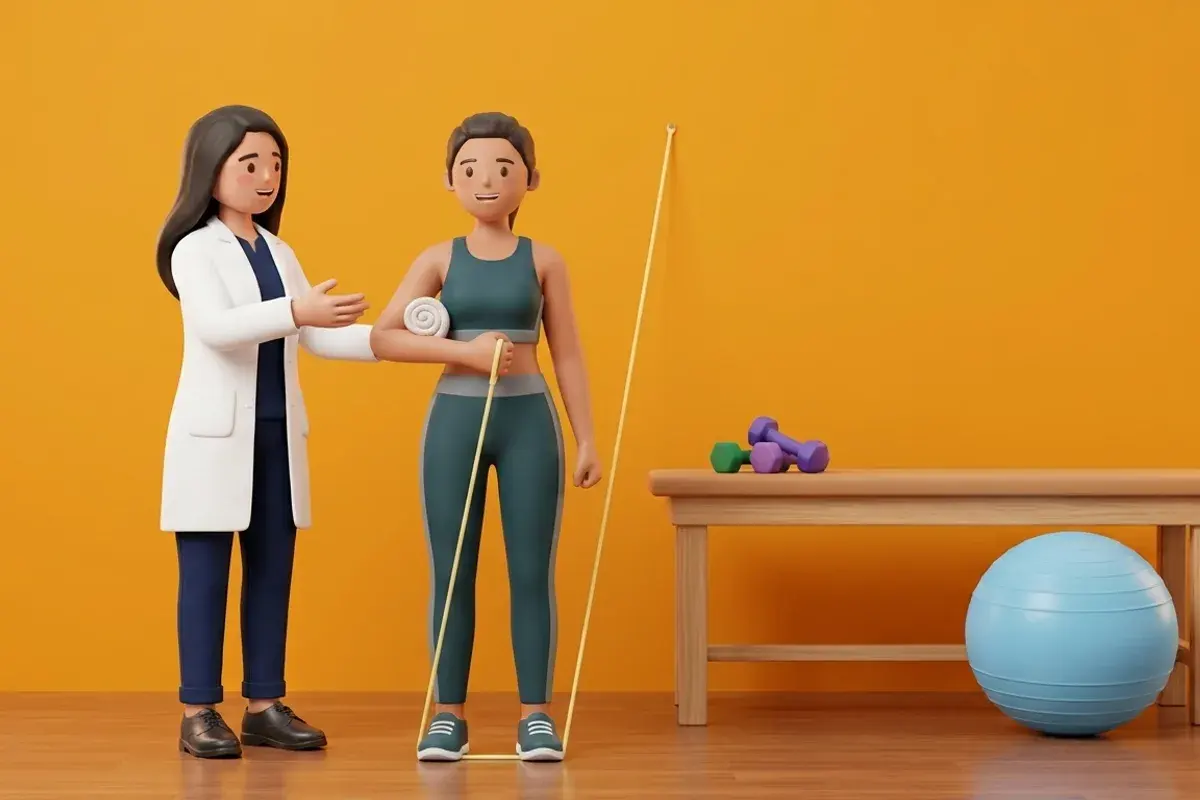
Standardized Wall-Supported Photo Goniometry Position
Objective: Establish a reliable, standardized posture for capturing weekly range of motion photos for remote telephysiotherapy review
- 1Position your smartphone on a stable shelf or tripod at chest height, exactly 2 meters away from a plain wall.
- 2Stand sideways to the camera so your affected arm is facing the camera lens, feet comfortably shoulder-width apart.
- 3Raise your affected arm forward and upward as high as comfortably possible without hiking your shoulder or leaning backward.
- 4Hold the highest comfortable elevation position steadily for 5 seconds while your phone camera records or captures a photo.
- 5Slowly lower your arm, save the image with the date, and share it securely with your registered physiotherapist for angle analysis.
| Clinical Care Dimension | Conventional In-Clinic Physiotherapy | Structured Telephysiotherapy Model |
|---|---|---|
| Accessibility & Convenience | Requires recurring travel through traffic; highly burdensome for older adults or rural patients. | Zero travel required; consultations conducted comfortably from home via smartphone or laptop. |
| Range of Motion Tracking | Manual goniometer measurement recorded in physical clinic charts during visits. | Digital photo/video goniometry with objective angle overlay; digital archive accessible to patient. |
| Home Environment Relevance | Exercises performed on clinic plinths with clinic equipment; difficult to replicate at home. | Exercises calibrated directly to the patient kitchen tables, beds, door frames, and household wands. |
| Cost-Effectiveness & Transparency | Includes clinic overhead, travel costs, and time off work for family members. | Transparent pay-per-session virtual fees; zero transportation expenses; minimal time disruption. |
Telephysiotherapy platforms must enforce strict clinical safety triage. If a patient during a virtual consultation displays red flags, such as systemic fever, localized skin erythema, severe unrelenting rest pain, history of acute trauma with locked rotation, or progressive neurological deficit, virtual care must be paused immediately and the patient directed to an in-person emergency orthopedic facility.
Frequently Asked Questions
Can telephysiotherapy really help a frozen shoulder if the therapist cannot touch my arm?
Yes, clinical trials show that telephysiotherapy produces outcomes equal to in-person care for frozen shoulder. Because recovery relies primarily on staged patient education, correct movement mechanics, and consistent daily home stretching, a physiotherapist can guide, correct, and progress your exercises perfectly over high-definition video without you having to travel to a clinic.
Do I need a doctor referral to see a frozen shoulder physiotherapist on BookPhysio.in?
BookPhysio.in does not require a physician prescription. Under the National Commission for Allied and Healthcare Professions (NCAHP) Act 2021, patients across India enjoy direct access to autonomous registered physiotherapists. Through BookPhysio.in, you connect directly with verified clinicians and pay per session with transparent fees, completely free from advance package commitments, commission markups, or platform subscription charges.
Related condition guides



Related recovery guides & articles
BookPhysio.in Editorial Team
The BookPhysio.in editorial team writes and maintains this content, checking it against reliable clinical sources. Content follows our medical review policy: general information only, and no page claims a clinical review until a named registered physiotherapist has signed it off.
Read our medical review policy