
Terminal Knee Extension (TKE) with Resistance Bands for VMO Firing
In short
Discover why banded Terminal Knee Extension (TKE) is the premier exercise for activating the VMO and restoring extension without meniscal strain.
In this guide (4 sections)
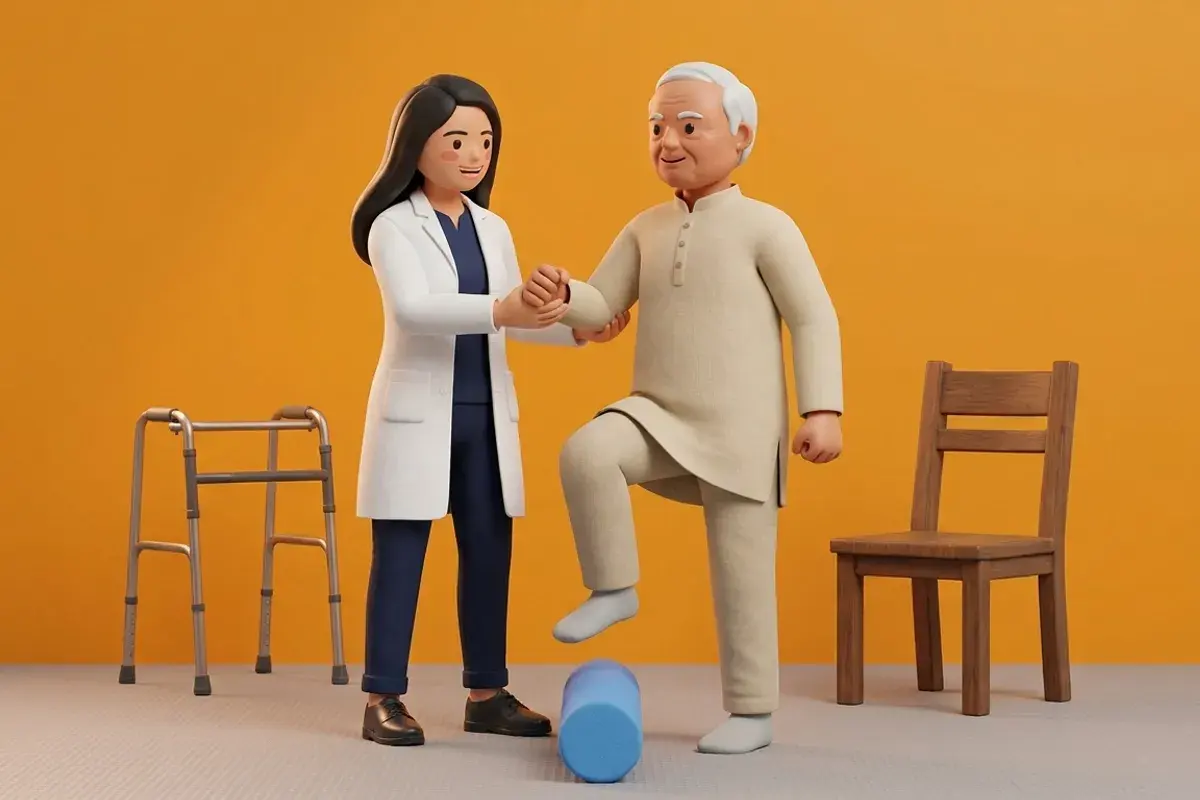
Restoring full, active terminal knee extension is one of the most critical objectives in lower extremity rehabilitation. Following meniscal tears, surgical repairs, or partial meniscectomies, patients frequently develop an extension lag, a clinical presentation where passive knee extension is complete, but voluntary active extension is incomplete. This lag is primarily driven by arthrogenic muscle inhibition of the vastus medialis oblique (VMO), the distal medial component of the quadriceps responsible for terminal joint locking and patellofemoral tracking. The banded Terminal Knee Extension (TKE) exercise has emerged as the premier clinical drill to resolve extension deficits. By applying an anteriorly directed elastic resistance behind the knee, the TKE forces the quadriceps to execute an isolated concentric-eccentric contraction across the final 30 degrees of extension without compressing sensitive posterior meniscal horns.
Indian Household Walking: Market Trips and Marble Floor Stability
In Indian daily life, walking with a subtle knee flexion contracture or extension lag creates substantial functional impairment. Walking with a slightly bent knee forces the patient into a bent-knee gait, which drastically increases metabolic energy expenditure and transmits unbuffered impact shocks through the joint with every step. When navigating crowded local vegetable markets (sabzi mandis) with uneven paving or walking across smooth domestic marble tiles, an unstable knee that cannot lock into terminal extension feels prone to sudden buckling. Rebuilding brisk, confident terminal knee extension through banded TKE drills ensures patients can achieve a normal heel strike and stable midstance, restoring fluid and confident domestic walking.
Screw-Home Mechanism, VMO Vector Alignment, and Anterior Contact Zones
The biomechanical elegance of the banded TKE lies in its synergy with the normal screw-home mechanism of the knee. In the final 15 to 20 degrees of extension, the tibia rotates externally relative to the femur, locking the joint into its close-packed, most stable congruency. The obliquely oriented fibres of the VMO (inserting at approximately 50 to 55 degrees into the medial border of the patella) are uniquely activated during this terminal arc to guide patellar engagement and counter the lateralizing pull of the vastus lateralis. Mechanically, performing terminal extension against an anteriorly anchored resistance band applies a posteriorly directed joint reaction force to the distal femur and an anterior vector to the proximal tibia. This specific force couple loads the knee exclusively within its anterior and central articular zones, completely bypassing the vulnerable posterior meniscal horns.
TKE Execution Technique: Anchoring, Stride Stance, and Isometric Peak Squeeze
Executing the banded TKE accurately requires proper equipment setup and body mechanics. A heavy loop resistance band is anchored securely to a sturdy post, door anchor, or heavy dining table leg at exact knee height. The patient steps inside the loop with the affected leg, placing the band directly across the popliteal crease at the back of the knee. Stepping backward with the opposite leg into a staggered split stance creates firm elastic tension that gently pulls the knee forward into approximately 30 degrees of flexion. From this position, the patient contracts their quadriceps, pressing the back of the knee straight backward against the band resistance until the knee reaches neutral 0-degree extension. The patient holds the terminal contraction firmly for 2 to 3 seconds, focusing on squeezing the medial thigh, before controlling the return over 3 seconds.
Banded Terminal Knee Extension in Staggered Stance with 3-Second Hold
Objective: Isolate vastus medialis oblique recruitment and eliminate active extension lag without compressing posterior meniscal horns
- 1Secure a heavy resistance band to a sturdy plinth or door anchor at exactly knee height.
- 2Step into the loop with your affected leg, positioning the band smoothly across the crease at the back of your knee.
- 3Step backward with your unaffected leg into a comfortable staggered stance until the band exerts strong, steady forward tension.
- 4Allow the band to pull your affected knee forward into approximately 30 degrees of flexion while keeping your heel flat on the floor.
- 5Firmly contract your anterior thigh, pressing the back of your knee backward against the band until your leg is completely straight.
- 6Hold the peak terminal contraction for 3 seconds, feeling the inner thigh muscle harden, then release slowly over 3 seconds.
| Progression Stage | Band Resistance & Setup | Contraction Duration | Target Clinical Outcome | Appropriate Phase |
|---|---|---|---|---|
| Stage 1: Light Elastic | Light resistance band, popliteal placement | 2-second hold at neutral extension | Overcome acute arthrogenic inhibition, re-establish quad firing | Early post-op repair (Weeks 4-6) or acute conservative tear |
| Stage 2: Moderate Resistance | Medium band, staggered split stance | 3-second isometric peak squeeze | Resolve extension lag; restore normal terminal stance phase gait | Subacute rehabilitation (Weeks 6-10) |
| Stage 3: Heavy Resistance with Step | Heavy band combined with forward step-down | Dynamic eccentric braking to terminal lock | Sport-specific deceleration and dynamic screw-home control | Late-stage return to sports and running conditioning |
Patients with severe quadriceps inhibition frequently attempt to cheat the TKE exercise by thrusting their hips forward and hyperextending their lumbar spine to straighten the leg. This compensatory posture stresses the anterior hip capsule and facet joints of the lower back without activating the VMO. Clinicians must ensure the patient maintains an upright torso, engaged abdominal core, and level pelvis, driving extension entirely from the thigh.
Frequently Asked Questions
Why is terminal knee extension so important after a meniscal tear?
Full terminal knee extension is essential for normal human walking. When you walk, your knee must straighten completely to lock into place and absorb body weight efficiently during midstance. If you lack full terminal extension, your thigh muscles must work constantly to prevent your knee from collapsing, leading to rapid muscle fatigue, abnormal gait limping, and uneven cartilage wear.
Do I need a doctor referral to treat a meniscal tear on BookPhysio.in?
BookPhysio.in does not require a doctor referral. Under the National Commission for Allied and Healthcare Professions (NCAHP) Act 2021, patients across India enjoy direct access to autonomous registered physiotherapists. Through BookPhysio.in, you connect directly with verified clinicians and pay per session with transparent fees, completely free from advance package commitments, commission markups, or platform subscription charges.
Related condition guides



Related recovery guides & articles
BookPhysio.in Editorial Team
The BookPhysio.in editorial team writes and maintains this content, checking it against reliable clinical sources. Content follows our medical review policy: general information only, and no page claims a clinical review until a named registered physiotherapist has signed it off.
Read our medical review policy