
Total Contact Casting (TCC) in Healed Osteomyelitis: Plantar Pressure Redistribution
In short
Total Contact Casting is the gold standard for offloading plantar bone voids. Learn how TCC redistributes pressure to prevent recurrent neuropathic breakdown.
In this guide (5 sections)
Total Contact Casting (TCC) is universally recognized as the gold standard mechanical offloading intervention for managing neuropathic plantar ulcers and protecting newly healed osteomyelitis sites in the diabetic foot. Following surgical debridement of infected metatarsal heads or partial calcanectomy, residual structural bone contours create abnormal focal pressure points. TCC utilizes a custom-molded, minimally padded fiberglass and plaster cast that conforms intimately to the exact contours of the foot, ankle, and lower leg, dramatically redistributing vertical and shear forces away from vulnerable bony prominences.
Domestic and Cultural Indian Realities
In Indian home healthcare, managing a non-removable Total Contact Cast requires dedicated family coordination and daily environmental precautions. Water exposure is the primary hazard; bathing must be adapted using sponge baths while keeping the cast elevated and sealed in a heavy-duty waterproof cast protector bag. Family members must ensure that floors remain clean and dry to prevent the rockered rubber walking heel from slipping on wet bathroom tiles or smooth polished stone. Physiotherapists train patients in modified gait patterns and provide assistive devices to ensure safe, stable domestic mobility.
Pascal Principle and Load Transfer to the Leg Conical Geometry
The biomechanical efficacy of TCC operates through Pascal’s principle of fluid mechanics. Because the lower leg and calf soft tissues are enclosed in an unyielding, rigid cylinder, compressive forces applied during stance are converted into hydraulic pressure, transmitting up to thirty-five percent of total ground reaction forces directly onto the conical flare of the gastrocnemius and tibial condyles. Simultaneously, the rockered outer sole eliminates the normal propulsive push-off phase of gait, reducing forefoot peak pressures by over eighty-five percent and preventing mechanical shear over fragile scar tissue.
Gait Retraining with Rockered Sole and Post-TCC Transition
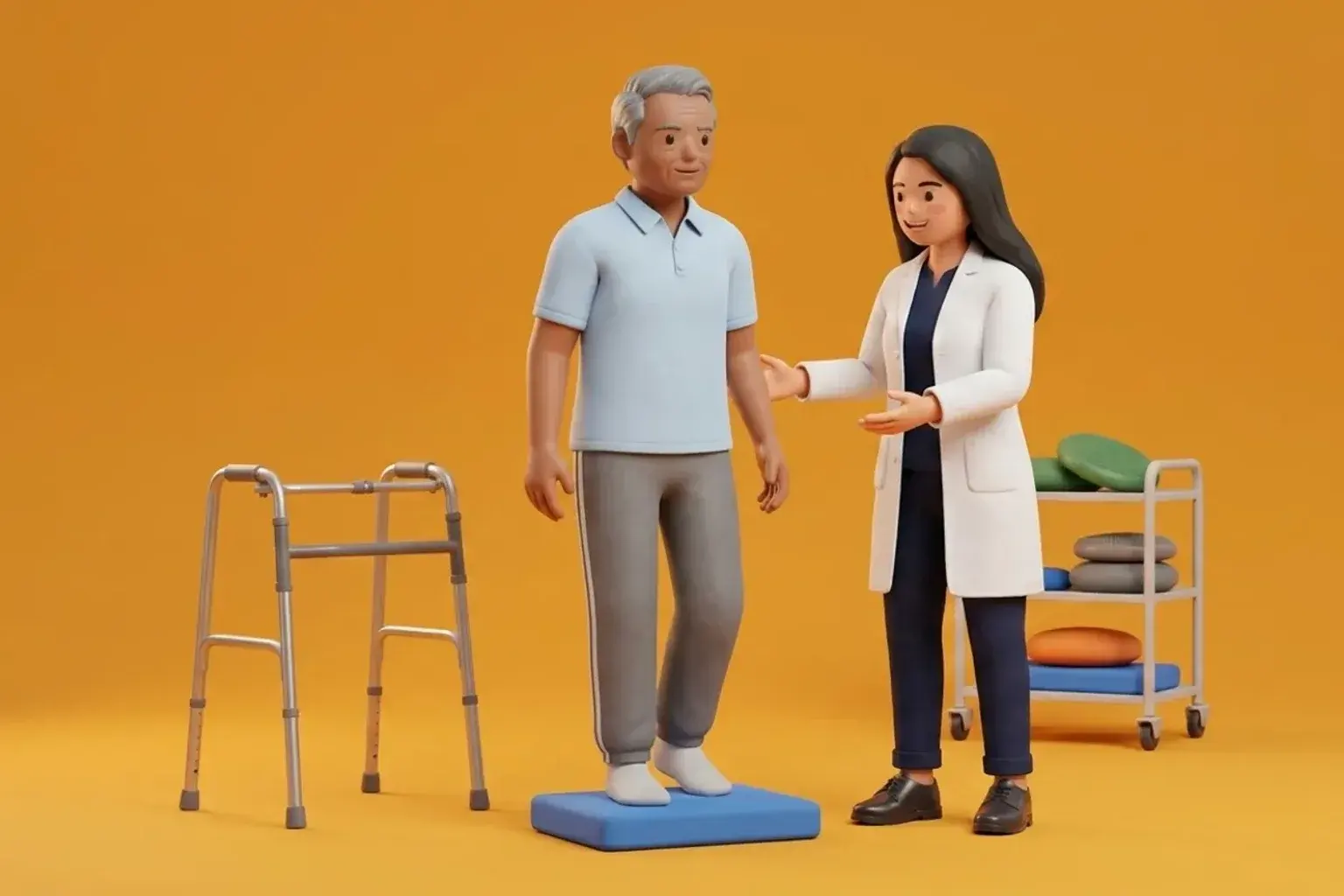
Patients fitted with a TCC experience an altered gait cycle, characterized by a shortened step length, loss of ankle dorsiflexion, and a broad-based stance. Physiotherapy focuses on gait re-education using a single cane or forearm crutch on the contralateral side to enhance stability and reduce limb impact. Once the underlying bone has consolidated and plantar skin is resilient, the patient is transitioned through a structured stepping protocol from TCC to a removable cast walker, and finally into custom diabetic footwear with rigid rocker bottoms and plastazote insoles.
Contralateral Stance Balance and Step-To Cadence Drill
Objective: Promote stable, symmetrical ambulation with a total contact cast without excessive limb swinging
- 1Stand securely holding the handrail of a staircase or a sturdy, non-movable table with your casted leg ready.
- 2Position an assistive walking cane in your hand on the side opposite to your total contact cast.
- 3Advance the cane and the casted limb forward simultaneously, taking a small, deliberate step of about 30 cm.
- 4Step down through the rockered heel smoothly, allowing the curved sole to roll you forward without push-off.
- 5Bring your sound limb forward to meet the casted foot (step-to pattern), resetting your balance before the next step.
| Offloading Feature | Total Contact Casting (TCC) | Custom Diabetic Orthotic Footwear |
|---|---|---|
| Peak Forefoot Pressure Reduction | Exceptional (>85% pressure reduction); complete elimination of propulsive shear | Moderate (30-40% pressure reduction); distributes forces across midfoot arch |
| Patient Compliance Control | Forced compliance; non-removable cast ensures patient cannot walk unprotected | Voluntary compliance; patient may remove shoes at home or walk barefoot indoors |
| Ankle Joint Mobility | Rigidly immobilized at neutral 90 degrees; zero ankle or subtalar motion permitted | Permits physiological ankle dorsiflexion and plantarflexion during walking |
| Primary Clinical Indication | Active neuropathic ulcer healing; immediate post-debridement osteomyelitis protection | Long-term secondary prevention once skin is fully epithelialized and bone healed |
Red Flags and Specialist Escalation
Immediately contact the orthopaedic cast clinic if the total contact cast becomes loose, cracks, softens from moisture, or emits a foul, putrid odor. Furthermore, if you feel a focal burning sensation over the heel or malleoli, or if fluid stains appear through the plaster, the cast must be removed within hours to inspect for iatrogenic pressure ulcers.
Frequently Asked Questions
How do I take a bath if I cannot remove my Total Contact Cast for several weeks?
You must never submerge your cast in a bucket of water or expose it to running water, as wet plaster breaks down and causes severe skin rot. Bathe by sitting on a plastic chair outside the bathing area, covering the entire cast with two layers of heavy-duty plastic bags sealed with waterproof tape, and having a family member assist you with a sponge bath.
Do I need a doctor referral to consult an orthopaedic physiotherapist on BookPhysio.in?
BookPhysio.in does not require a doctor referral. Under the National Commission for Allied and Healthcare Professions (NCAHP) Act 2021, patients in India have direct access to registered physiotherapists. You pay your clinician directly per session with transparent fees and zero booking commissions or platform subscriptions.
Related condition guides



Related recovery guides & articles
BookPhysio.in Editorial Team
The BookPhysio.in editorial team writes and maintains this content, checking it against reliable clinical sources. Content follows our medical review policy: general information only, and no page claims a clinical review until a named registered physiotherapist has signed it off.
Read our medical review policy