
Transparent Pay-Per-Session Knee Arthroplasty Rehabilitation Pricing in India
In short
Discover the financial and clinical benefits of transparent pay-per-session knee arthroplasty rehabilitation over rigid commercial package commitments.
In this guide (4 sections)
Recovering from total or unicompartmental knee arthroplasty involves significant financial planning. In India, where out-of-pocket expenditure accounts for a substantial proportion of healthcare spending, patients and families are highly vulnerable to commercial exploitation during post-discharge recovery. A pervasive, predatory practice in metropolitan home care involves third-party corporate agencies marketing rigid '30-day rehabilitation packages' demanding substantial upfront advance payments, often running into tens of thousands of rupees. These commercial package lock-ins create severe conflicts of interest: agencies frequently rotate inexperienced junior trainees into homes, provide uninspired generic exercise sheets, and refuse refunds if the patient recovers early or requires medical re-admission. Transitioning to an ethical, transparent pay-per-session model restores financial dignity, aligns clinician incentives with rapid functional independence, and delivers superior clinical outcomes.
Out-of-Pocket Expenses, Agency Package Traps, and Domestic Financial Autonomy
In typical Indian families, financing a joint replacement surgery often depletes substantial household savings or exhausts family medical insurance limits. Following hospital discharge, families are emotionally overwhelmed and easily persuaded by agency sales representatives promising 'comprehensive 30-session recovery packages.' Too often, families discover that once the large upfront fee is paid, the agency sends different unvetted attendants, cancels appointments without notice, and drags out therapy long after functional goals are reached. In contrast, an ethical pay-per-session model puts the family in total control. The patient pays an honest, transparent per-visit fee directly to their verified clinician at the conclusion of each session, free from platform subscriptions, commission markups, or predatory lock-ins.
Variable Recovery Trajectories, Healing Velocity, and Biological Pacing
The clinical fallacy of pre-packaged 30-day therapy lies in the extreme variability of human biological healing. Post-arthroplasty recovery is never a linear, standardized conveyor belt. A fit 60-year-old undergoing unicompartmental knee replacement (UKA) may achieve complete functional independence, zero extensor lag, and 115 degrees of flexion within eight to ten supervised sessions, transitioning seamlessly to a self-managed home program. Conversely, an 80-year-old patient with severe osteopenia, pre-operative contractures, and bilateral joint disease may require twelve to sixteen weeks of carefully paced therapy spaced twice weekly. Forcing patients into rigid 30-session daily packages encourages 'over-servicing' where clinicians perform passive, redundant exercises simply to exhaust prepaid sessions, or 'under-servicing' where complex patients are abandoned once the package expires.
The Autonomous Pay-Per-Session Framework, Self-Management, and Value Delivery
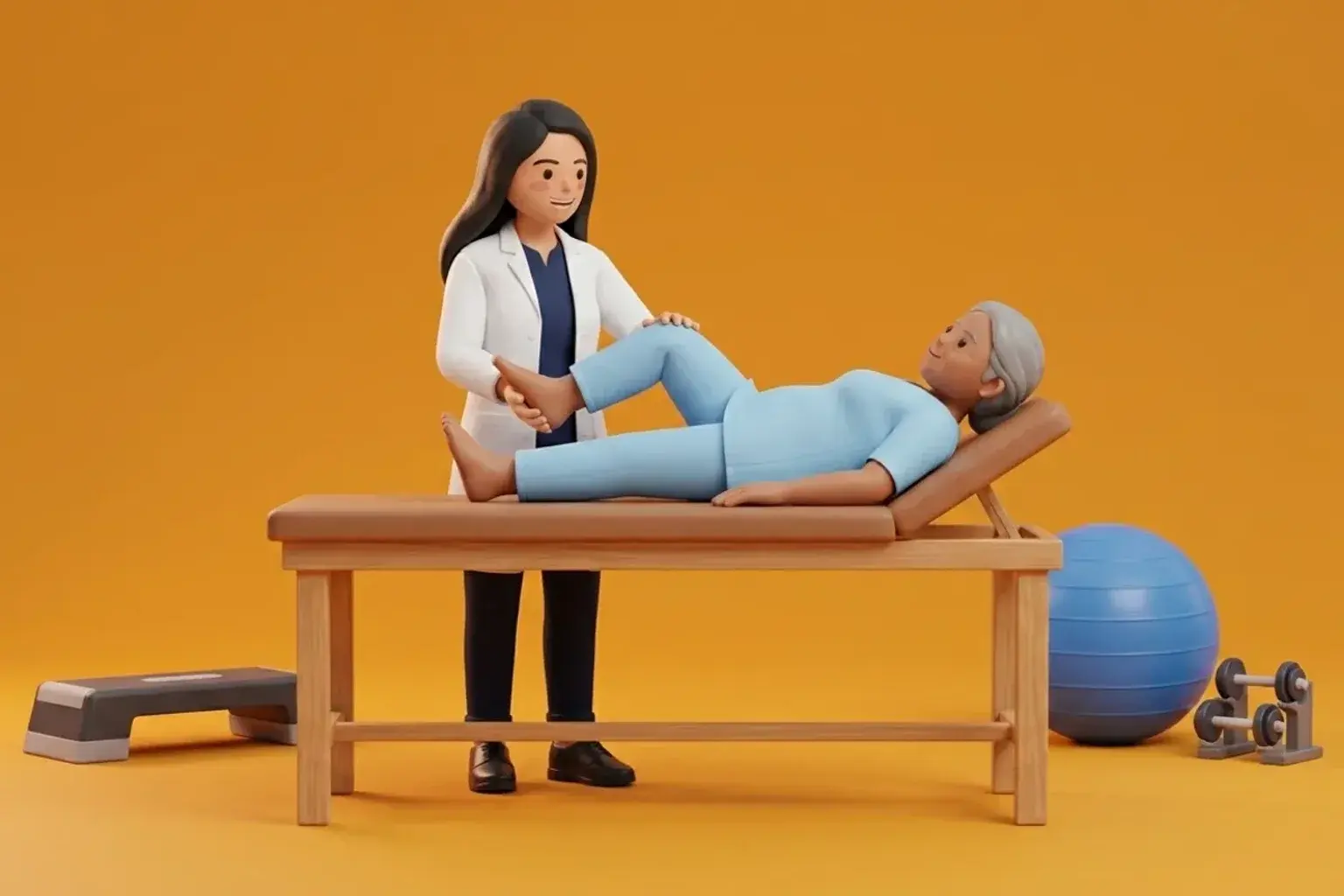
An ethical pay-per-session framework fundamentally realigns clinical incentives toward patient empowerment. The clinician's objective is not to maximize billable visits, but to educate and empower the patient to become completely self-reliant as quickly as possible. During each session, the physiotherapist conducts objective assessments, introduces new functional progressions, refines domestic transfer ergonomics, and prescribes targeted homework drills for the patient to perform independently with family assistance. Sessions are scheduled based strictly on clinical necessity: initially three times weekly during the acute phase, tapering to once weekly or bi-weekly as the patient masters independent walking, stairs, and community mobility.
Self-Directed Home Exercise Mastery and Compliance Verification Circuit
Objective: Build self-reliance and master independent exercise execution between supervised clinical visits
- 1Review your written home exercise diary prescribed by your registered physiotherapist.
- 2Execute 10 terminal knee extensions over a foam roll, verifying full lockout at zero degrees.
- 3Perform 10 active-assisted heel slides on a smooth surface, holding the peak bend for 5 seconds.
- 4Complete 10 countertop supported mini-squats, focusing on keeping your knees aligned over your toes.
- 5Perform 20 rhythmic ankle pumps with your leg elevated, checking off each exercise in your daily logbook.
| Financing & Service Domain | Commercial Agency Package Model (Prepaid Lock-In) | Ethical Pay-Per-Session Framework (BookPhysio.in) |
|---|---|---|
| Financial Payment Structure | Large upfront advance payments (₹20,000 to ₹40,000); strict non-refundable clauses | Transparent pay-per-session fee paid directly to clinician after each visit; zero lock-ins |
| Clinician Continuity & Quality | Frequent staff turnover; unvetted junior assistants rotated into homes; agency commission cuts | Single dedicated, state-registered autonomous clinician; direct clinician-patient relationship |
| Therapy Duration & Scheduling | Rigid daily scheduling designed to exhaust prepaid package; high risk of unnecessary over-servicing | Flexible scheduling tailored to biological healing; tapers as patient achieves self-reliance |
| Clinical Objective & Incentive | Incentivizes ongoing patient dependency to justify package renewals and commercial revenue | Incentivizes rapid patient empowerment, self-management, and functional independence |
Never permit a home care agency to send an unregistered or unqualified assistant or therapy aide to manage your new knee replacement. Post-arthroplasty rehabilitation requires advanced clinical judgment to screen for surgical complications like infection and DVT. Always verify that your treating clinician is a qualified, registered physiotherapist under the NCAHP Act 2021 or State Council.
Frequently Asked Questions
How many total physiotherapy sessions will I realistically need after my knee replacement?
Most patients recovering from an uncomplicated total knee replacement achieve excellent functional independence within 10 to 18 supervised sessions spaced over six to eight weeks. Early sessions focus on swelling control and walking mechanics, while later sessions taper to once or twice weekly as you learn to perform your exercises independently at home. You should never be forced to pre-pay for 30 daily sessions upfront.
Do I need a doctor referral for post-knee replacement physiotherapy on BookPhysio.in?
BookPhysio.in does not require a doctor referral. Under the National Commission for Allied and Healthcare Professions (NCAHP) Act 2021, patients across India enjoy direct access to autonomous registered physiotherapists. Through BookPhysio.in, you connect directly with verified clinicians and pay per session with transparent fees, completely free from advance package commitments, commission markups, or platform subscription charges.
Related condition guides



Related recovery guides & articles
BookPhysio.in Editorial Team
The BookPhysio.in editorial team writes and maintains this content, checking it against reliable clinical sources. Content follows our medical review policy: general information only, and no page claims a clinical review until a named registered physiotherapist has signed it off.
Read our medical review policy