
Two-Wheeler Commute Clearance and Sudden Single-Leg Plant Hazards Post-ACL
In short
Understand the biomechanical hazards of two-wheeler commuting post-ACL reconstruction, sudden single-leg foot plant forces, and objective return-to-ride criteria.
In this guide (4 sections)
In Indian metropolitan centers and semi-urban communities, two-wheelers, including gearless scooters (such as an Activa or Jupiter) and commuter motorcycles, represent the primary mode of personal transportation for millions of citizens. Following ACL reconstruction, returning to two-wheeler commuting is frequently the patient’s most urgent economic and personal priority. However, operating a two-wheeler places unique, high-risk biomechanical demands on the lower extremity that are rarely duplicated in standard clinical testing. While ordinary cruising requires minimal knee effort, emergency traffic maneuvers demand instantaneous, high-velocity motor responses. The most hazardous scenario occurs during an abrupt emergency stop, where the rider must instantly plant a single foot onto an irregular road surface to support their own body weight plus the 100 to 180 kilogram mass of a tipping vehicle, creating extreme multi-planar knee loading.
Indian Traffic Realities: Potholes, Monsoon Slush, and Unannounced Stops
Indian roadway conditions amplify the hazards of two-wheeler operation for a healing knee. Commuters constantly encounter unannounced speed breakers, stray animals, sudden lane changes by auto-rickshaws, and deep potholes hidden under standing water during the monsoon season. When braking unexpectedly on loose gravel or slick road markings, the planted foot often slips outward, forcing the knee into an immediate dynamic valgus collapse, tibial external rotation, and axial shock. If this sudden impact occurs before the reconstructed ACL graft has matured and before quadriceps reactive braking power is fully re-established, the graft is subjected to the exact multi-planar forces that caused the original tear.
Biomechanical Demands of the Emergency Foot Plant: Valgus Torques and Eccentric Braking
From a biomechanical perspective, an emergency single-leg foot plant generates combined axial impact and rotational torque. When a rider drops their foot at a speed of 15 to 20 kilometers per hour, the friction of the pavement arrests the shoe while the vehicle’s forward momentum continues. This creates a large ground reaction force vector passing lateral to the knee joint center, generating an external knee valgus moment exceeding 150 Newton-meters. Simultaneously, holding the vehicle upright requires immediate, powerful eccentric contraction of the quadriceps and hip abductors (gluteus medius) to prevent the pelvis from dropping and the knee from collapsing inward. If neuromuscular reaction time is delayed by even 50 to 100 milliseconds, the passive joint structures, including the healing ACL autograft, absorb the entire energy of the impact.
Objective Clearance Criteria: Reactive Strength, Perturbation Training, and Mount Drills
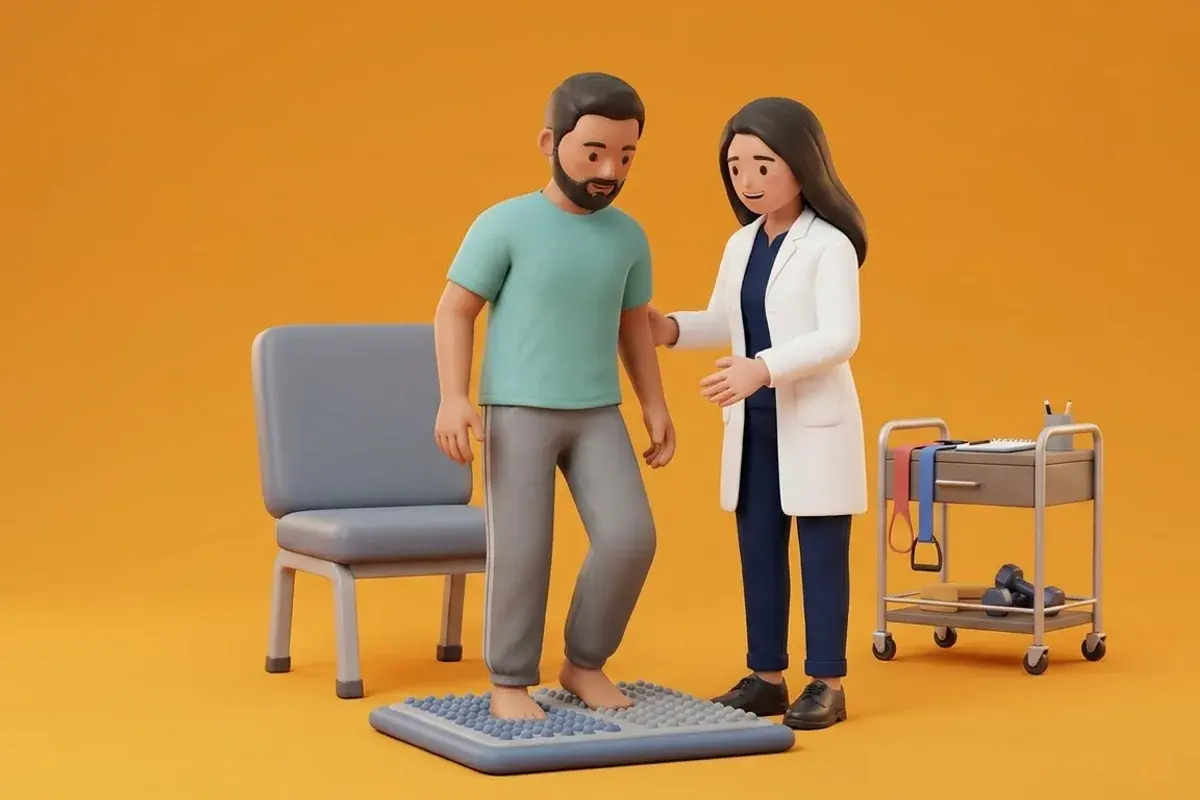
Clearance to resume two-wheeler commuting must never be granted based purely on time elapsed since surgery. Patients must demonstrate rigorous functional competence across four objective domains: a quadriceps limb symmetry index of at least 80 to 85 percent, full pain-free knee extension, zero joint effusion, and successful completion of dynamic single-leg perturbation drills. In the clinic, rehabilitation incorporates balance boards, sudden multidirectional perturbational pushes, and simulated foot-plant drills. Patients must also demonstrate the ability to mount and dismount the vehicle smoothly and manually hoist the scooter onto its center double stand without pain or compensatory movement.
Single-Leg Perturbation Foot-Plant Reaction Drill
Objective: Train instantaneous reactive quadriceps braking and hip abductor stabilization during sudden single-leg ground contact
- 1Stand tall on a non-slip floor wearing supportive athletic shoes with your weight centered on your uninjured leg.
- 2Have a physiotherapist or partner stand in front of you holding a lightweight ball or visual cue.
- 3On an unexpected verbal command or visual cue, take a rapid, decisive step forward onto your surgical leg, planting your foot firmly as if stopping a scooter.
- 4Absorb the landing by flexing your knee smoothly to approximately 30 degrees, keeping your kneecap tracking directly over your second toe without letting it collapse inward.
- 5Hold this rock-solid single-leg stabilization for 3 seconds while your partner tosses the ball slightly off-center to challenge your balance.
| Two-Wheeler Milestones | Physical & Clinical Benchmarks | Permitted Vehicle & Road Conditions | Safety Constraints & Prohibitions |
|---|---|---|---|
| Stage 1: Pillion Rider Clearance (Weeks 6 to 8) | Active knee flexion >= 110°, normal walking gait, zero extensor lag | Riding strictly as a pillion (passenger) with both legs resting on footrests | Prohibited from driving; avoid side-saddle seating; avoid crowded rush hours |
| Stage 2: Light Scooter Clearance (Weeks 12 to 16) | Quadriceps LSI >= 80%, trace effusion, single-leg hop landing without valgus | Driving light gearless scooter (<105 kg) on quiet, familiar neighborhood roads | Avoid heavy traffic, night riding, wet monsoon roads, and high-speed corridors |
| Stage 3: Full Commute Clearance (Months 4 to 6+) | Quadriceps LSI >= 85-90%, full hop test battery >= 85%, normal perturbation balance | Unrestricted commuting on heavy motorcycles, geared bikes, and busy urban roads | Maintain safe following distances; use anti-skid riding footwear with ankle support |
If a patient who resumed two-wheeler riding experiences an emergency stop where their foot slipped on loose gravel followed by an immediate pop, severe knee pain, and rapid swelling within two hours, treat this as a suspected graft rupture. Cease all driving, immobilize the knee, and obtain an urgent orthopedic consultation and MRI.
Frequently Asked Questions
Can I start riding my gearless scooter at 6 weeks if I only drive slowly near my house?
No, riding a two-wheeler at 6 weeks post-surgery is exceptionally dangerous. Even if you intend to drive slowly, you cannot control other vehicles, pedestrians, or road hazards. If you must brake suddenly and drop your operated leg to keep a 100 kg scooter from tipping, the violent twisting force can instantly rupture your healing graft, which is biologically at its weakest stage between weeks 6 and 12.
Do I need a doctor referral to rehabilitate an ACL reconstruction on BookPhysio.in?
BookPhysio.in does not require a doctor referral. Under the National Commission for Allied and Healthcare Professions (NCAHP) Act 2021, patients across India enjoy direct access to autonomous registered physiotherapists. Through BookPhysio.in, you connect directly with verified clinicians and pay per session with transparent fees, completely free from advance package commitments, commission markups, or platform subscription charges.
Related condition guides



Related recovery guides & articles
BookPhysio.in Editorial Team
The BookPhysio.in editorial team writes and maintains this content, checking it against reliable clinical sources. Content follows our medical review policy: general information only, and no page claims a clinical review until a named registered physiotherapist has signed it off.
Read our medical review policy