
Two-Wheeler Riding Post Ankle Fracture: Weight-Bearing Clearance and Safety Benchmarks
In short
Understand the clinical prerequisites, emergency reaction time benchmarks, and brake pedal mechanics for resuming two-wheeler riding post ankle fracture.
In this guide (4 sections)
In India, two-wheelers, including gearless scooters (such as the Honda Activa) and geared motorcycles, serve as the primary mode of personal transportation for tens of millions of commuters. Following surgical stabilization or casting for an ankle fracture, resuming two-wheeler operation is an urgent socioeconomic priority for returning to work and daily family life. However, riding a motorized two-wheeler demands complex physical and neuromuscular capabilities that extend far beyond simple walking. The rider must be capable of executing rapid, forceful foot-down stabilization maneuvers during sudden traffic stops, balancing a one-hundred-kilogram vehicle on an uneven road surface, and exerting precise motor control over foot controls. Clearing a patient to ride too early risks catastrophic loss of vehicle control, hardware failure, or severe re-injury.
Navigating Dense Urban Traffic, Sudden Auto Stops, and Monsoon Potholes
Operating a two-wheeler in Indian traffic involves continuous, unpredictable physical stresses. Commuters regularly encounter dense, stop-and-go congestion where the rider must repeatedly plant one or both feet firmly on the ground every few seconds to support the vehicle's weight. Unexpected hazards, such as stray animals crossing the road, sudden braking by auto-rickshaws, or pedestrians stepping into traffic, necessitate violent emergency foot-down reflexes. During such events, the planted foot often strikes the road with the ankle in an uncontrolled combination of inversion and plantarflexion, absorbing sudden impact forces exceeding twice body weight. Furthermore, balancing a scooter over slippery monsoon mud, loose gravel, or deep road craters requires robust dynamic eversion stability from the peroneal muscles to prevent the ankle from rolling inward.
Right Versus Left Ankle Demands: Rear Brake Control Versus Gear Shifting
The mechanical requirements for operating a two-wheeler differ fundamentally depending on whether the injured limb is the right or left ankle, and whether the vehicle is a geared motorcycle or a gearless scooter. On a geared motorcycle, the right foot operates the rear mechanical brake pedal, demanding rapid, forceful plantarflexion and precise proprioceptive pressure modulation. The left foot operates the gearshift lever, requiring repetitive dorsiflexion lifting forces and inversion-eversion positioning. On a gearless scooter, both brakes are hand-operated via handlebar levers, reducing the direct foot pedal burden; however, the flat footboard offers zero lateral ankle support, and the rider must bear the entire deadweight of the vehicle through the planted foot at every halt. In both scenarios, inadequate bone consolidation or persistent ankle stiffness severely impairs brake reaction time and postural stability.
Objective Clearance Benchmarks: Reaction Times, Heel Raises, and Perturbations
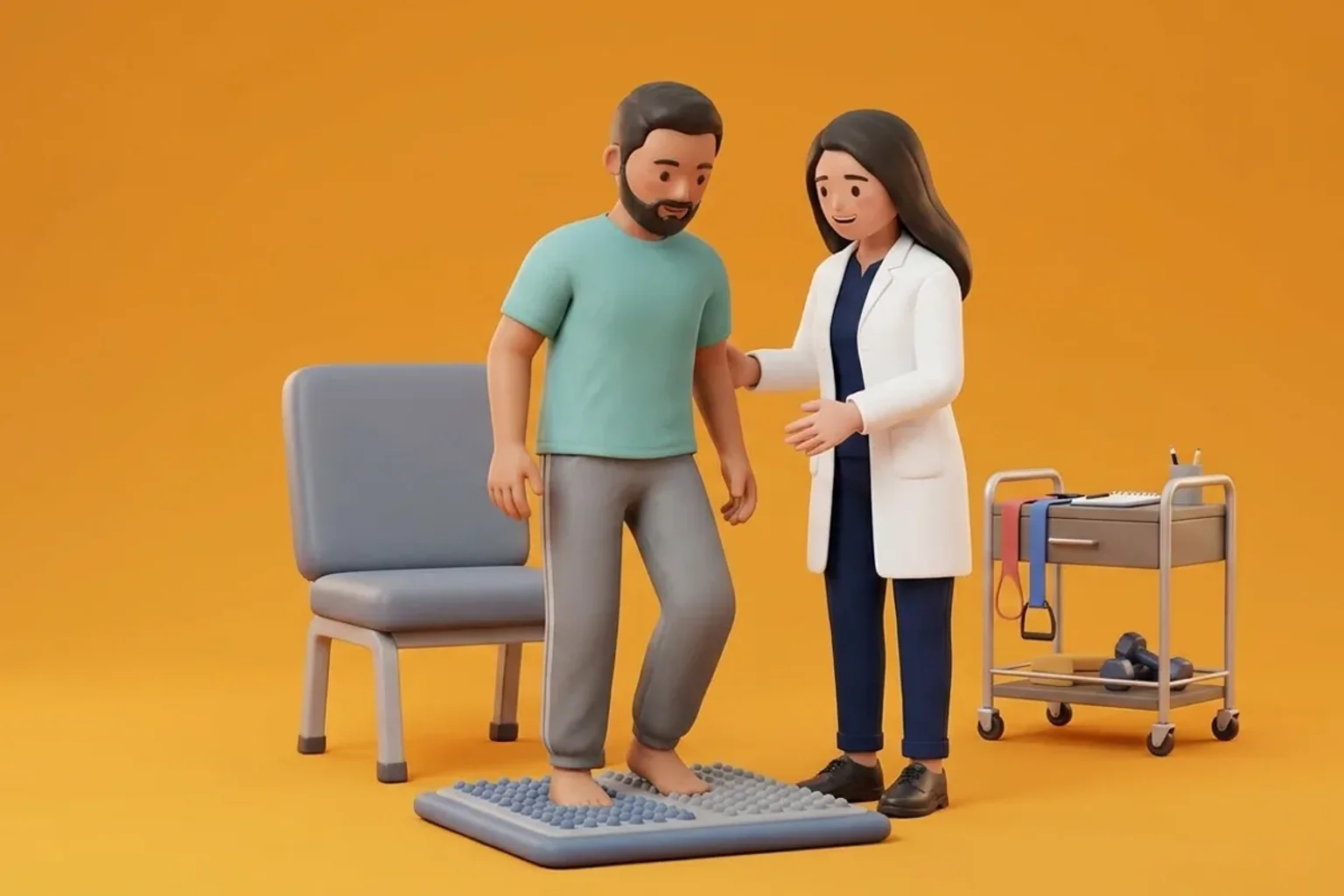
Physiotherapists must administer a battery of objective functional tests before granting clinical clearance for two-wheeler operation. Clearance requires complete radiographic union of all fracture sites, full unrestricted weight-bearing, and absence of resting or post-activity swelling. The patient must demonstrate the ability to perform twenty consecutive single-leg calf raises to prove adequate gastrocnemius-soleus strength. Rapid motor response is evaluated using dynamic reaction-time drills, such as light-board stepping tests and rapid deceleration drops from a four-inch step. Proprioceptive stability is tested on an unstable wobble board, requiring the patient to withstand unexpected multi-directional manual perturbations without losing balance. Finally, simulated stationary vehicle mounting, dismounting, and foot-down emergency catches must be executed flawlessly in the clinic.
Rapid Step-Down Deceleration and Single-Leg Stabilization Drill
Objective: Train rapid neuromuscular deceleration to prepare the recovering ankle for sudden foot-down stops in traffic
- 1Stand upright on a firm, four-inch wooden exercise step or domestic entrance step, wearing supportive athletic shoes.
- 2Maintain your balance on your uninjured leg while hovering your recovering foot slightly off the front edge of the step.
- 3Upon a cue or clap from a helper, rapidly step forward and downward onto the floor with your recovering foot.
- 4Immediately absorb the impact by flexing your knee and ankle, sticking the landing firmly on the flat foot without allowing the ankle to wobble inward or outward.
- 5Hold the stable, single-leg landing posture for three seconds, ensuring your knee tracks directly over your middle toes before stepping back up.
| Vehicle & Foot Assignment | Primary Physical Task | Key Muscular & Joint Demands | Objective Clearance Benchmark |
|---|---|---|---|
| Motorcycle: Right Ankle | Rear brake pedal depression and rapid emergency stops | Fast concentric plantarflexion, rapid reaction time | Brake pedal reaction time under 0.6 seconds; 20 heel raises |
| Motorcycle: Left Ankle | Gear lever up-shifts and down-shifts | Isolated active dorsiflexion, tibialis anterior strength | Painless active dorsiflexion against manual resistance Grade 5 |
| Gearless Scooter: Either Ankle | Vehicle stabilization at traffic halts; emergency foot-down | Dynamic subtalar eversion stability, shock absorption | Single-leg stance on foam pad for 30 seconds; hop-to-stop test |
Attempting to ride a two-wheeler before achieving solid radiographic bone union and single-leg landing stability is extremely hazardous. If a rider is forced to suddenly plant their recovering foot down to catch a falling scooter, the sudden axial and rotational shock can tear healing ligaments, bend titanium plates, or cause acute periprosthetic re-fracture. Always obtain written clearance from your orthopaedic team before riding.
Frequently Asked Questions
Is it easier to return to riding a gearless scooter than a geared motorcycle after an ankle fracture?
Yes, gearless scooters are generally easier to resume because both the front and rear brakes are operated by hand levers on the handlebars, eliminating the need to push a foot brake pedal. However, you still need sufficient bone strength, calf power, and balance to firmly plant your foot on the asphalt and support the weight of the scooter whenever you stop in traffic.
Do I need a doctor referral to rehabilitate an ankle fracture on BookPhysio.in?
BookPhysio.in does not require a doctor referral. Under the National Commission for Allied and Healthcare Professions (NCAHP) Act 2021, patients across India enjoy direct access to autonomous registered physiotherapists. Through BookPhysio.in, you connect directly with verified clinicians and pay per session with transparent fees, completely free from advance package commitments, commission markups, or platform subscription charges.
Related condition guides



Related recovery guides & articles
BookPhysio.in Editorial Team
The BookPhysio.in editorial team writes and maintains this content, checking it against reliable clinical sources. Content follows our medical review policy: general information only, and no page claims a clinical review until a named registered physiotherapist has signed it off.
Read our medical review policy