
Two-Wheeler Riding Post-Rib Fractures: Vibration Damping and Safety
In short
Safe return to two-wheeler riding after rib fractures: road vibration damping, potholes, shock absorption, and minimum healing timelines.
In this guide (2 sections)
In India, motorized two-wheelers (motorcycles and scooters) represent the primary mode of personal daily commuting for tens of millions of individuals. Returning to two-wheeler riding following multiple rib fractures or chest wall stabilization presents major mechanical challenges. Road surface irregularities, such as speed breakers, potholes, unpaved gravel, and continuous engine vibrations, transmit high-frequency axial shock waves and torsional impulses through the pelvis and spinal column directly into the thoracic cage. Resuming riding prematurely can disrupt healing bone callus, provoke acute pain flares, or risk catastrophic re-fracture.
Axial Shock Transmission and Whole-Body Vibration Mechanics
When a two-wheeler strikes a bump or pothole at speed, the vehicle's suspension absorbs only a fraction of the kinetic energy. The remainder transmits upward through the footpegs, seat, and handlebars into the rider's musculoskeletal system. In an upright or forward-leaning riding posture, this vertical shock creates compressive axial loading along the spine, while engine vibrations (typically between 20 and 50 Hz) generate resonance within thoracic soft tissues. In an unhealed rib fracture, this mechanical shaking subjects the soft cartilaginous callus to micro-motion and tensile fatigue, delaying cortical bridging and triggering intense reflex intercostal muscle spasms.
| Recovery Timeline | Riding Status | Mechanical Hazard | Clinical Clearance Prerequisite | |
|---|---|---|---|---|
| Weeks 1 to 6 | Strictly Prohibited (both rider and pillion) | High vibration shock disrupts early soft callus | Zero tolerance; rely exclusively on 4-wheel transport | |
| Weeks 7 to 10 | Permitted as Pillion on smooth paved roads | Mild passive vibration on well-suspended vehicle | Must wear firm chest support; avoid sudden braking | |
| Weeks 10 to 12+ | Independent Riding cleared progressively | Full active control, emergency braking tolerance | Solid radiographic bone bridging & pain-free trunk rotation |
Physiotherapy Clearance Protocol for Riding Readiness
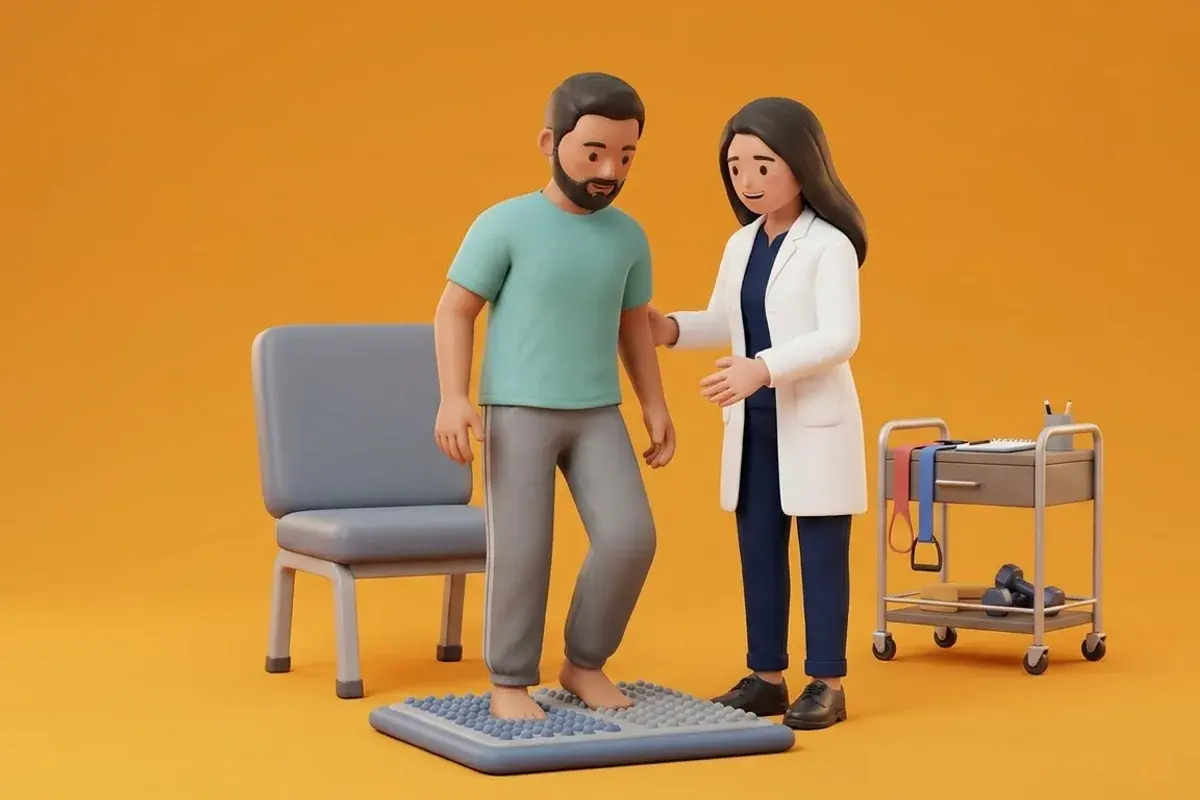
Before granting clinical clearance for independent riding, the physiotherapist conducts rigorous functional testing. The patient must demonstrate complete, pain-free active thoracic rotation (essential for shoulder checking blind spots in Indian traffic), normal bilateral grip strength, and the ability to brace firmly through the arms without chest wall discomfort. Dynamic perturbation testing, such as balancing on an unstable wobble board while resisting unexpected torso pushes, verifies that reactive core stability has fully recovered.
5-Step Core and Handlebar Shock-Absorption Drill
Objective: Recondition upper limb and core stabilizing muscles to absorb road shock without stressing healing ribs.
- 1Stand in a balanced athletic stance facing a wall with knees slightly flexed and feet shoulder-width apart.
- 2Place both hands firmly on the wall at handlebar height, maintaining a slight bend in your elbows.
- 3Gently push into the wall while bracing your abdominal core, simulating a sudden braking maneuver.
- 4Have a partner or physiotherapist apply gentle, unexpected taps to your shoulders to test reactive stabilization.
- 5Hold the braced position for 5 seconds while breathing calmly through your nose, repeating for 8 controlled repetitions.
Practical Indian Road Navigation and Damping Modifications
When resuming riding in Indian cities, ergonomic vehicle modifications help damp road shocks. Install a high-density gel seat cover or memory foam cushion on the scooter or motorcycle to absorb vertical road impacts. Plan daily commute routes along well-paved arterial roads, deliberately bypassing roads under construction or unpaved alleyways. When riding as a pillion passenger, hold securely onto the rear grab rail with both hands rather than sitting sideways, maintaining symmetrical spinal alignment over speed breakers.
Long-Term Rehabilitation Trajectory and Clinical Follow-Up
Over eight to twelve weeks, cortical bone union solidifies. Following a successful phased progression from pillion riding on smooth roads to short solo trips, the patient regains full confidence and functional independence, navigating bustling Indian urban traffic safely.
Do not ride a two-wheeler while taking opioid analgesics or sedating neuropathic pain medications (gabapentin or pregabalin), as slowed reaction times and impaired balance dramatically increase the risk of road accidents.
Can I ride my scooter as a pillion passenger if someone else drives slowly?
You should completely avoid riding even as a pillion passenger for the first six weeks. After six weeks, short trips as a pillion are acceptable only on smooth, paved roads, provided you sit forward with both hands on the grab rail and wear a supportive cushion.
Do I need a doctor referral to consult a home physiotherapist in India?
Under the National Commission for Allied and Healthcare Professions (NCAHP) Act 2021, patients in India have direct access to registered physiotherapists without requiring a physician referral. At BookPhysio.in, you connect with verified physiotherapists and pay directly per session, with zero advance fees, zero package lock-ins, and no platform commissions.
Related condition guides



Related recovery guides & articles
BookPhysio.in Editorial Team
The BookPhysio.in editorial team writes and maintains this content, checking it against reliable clinical sources. Content follows our medical review policy: general information only, and no page claims a clinical review until a named registered physiotherapist has signed it off.
Read our medical review policy