
ACL reconstruction recovery: week-by-week rehabilitation protocol
Conditions and RecoveryIn short
Successful recovery from anterior cruciate ligament (ACL) reconstruction requires systematic graft protection and progressive neuromuscular training. Learn the clinical milestones from week 1 to 12, essential quad reactivation drills, and critical contraindications.
In this guide (5 sections)
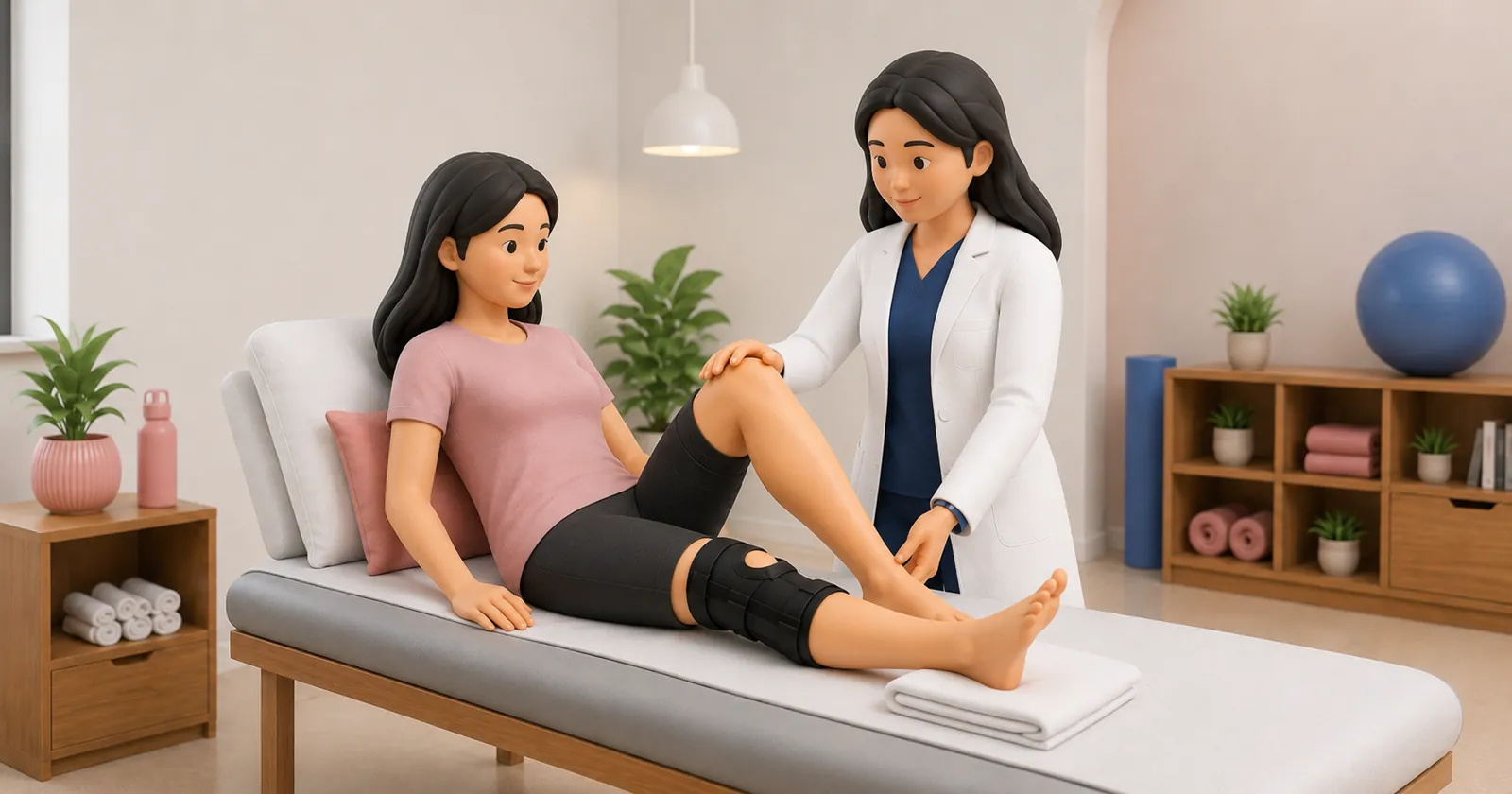
Rehabilitation following anterior cruciate ligament (ACL) reconstruction is as critical to knee stability as the surgical procedure itself. Whether using a bone-patellar tendon-bone (BPTB) autograft or a hamstring tendon autograft, progressive post-operative rehabilitation guides graft ligamentization, restores muscular control, and minimizes long-term joint complications.
Rehabilitation phases and milestone timeline
Post-operative recovery follows biological healing windows. Rushing through phases before tissue maturation increases graft failure rates:
| Phase and Post-Op Timeline | Primary Clinical Goal | Permitted Exercises | Key Precautions |
|---|---|---|---|
| Phase 1: Weeks 1 to 2 | Restore full passive knee extension (0°), reduce joint effusion, reactivate quadriceps | Isometric quad sets, ankle pumps, patellar mobilizations, assisted heel slides to 90° | Avoid active open-chain knee extension against resistance; sleep with knee locked in full extension |
| Phase 2: Weeks 3 to 6 | Wean off axillary crutches, achieve normal gait mechanics, attain 120° knee flexion | Mini-squats (0° to 45°), stationary upright cycling with zero resistance, step-ups, calf raises | Do not pivot or twist on the operated knee; monitor for increased joint effusion after activity |
| Phase 3: Weeks 7 to 12 | Full bilateral range of motion, symmetrical single-leg squat stability, hamstring hypertrophy | Leg press (closed-chain), Romanian deadlifts, proprioception boards, double-leg landing drills | Graft reaches peak biological vulnerability (ligamentization nadir); strictly no running or cutting |
| Phase 4: Months 4 to 9+ | Straight-line jogging, progressive plyometrics, agility drills, return-to-sport testing | Single-leg hop tests, change-of-direction ladders, sport-specific rotational training | Return to cutting sports only after passing objective limb symmetry criteria (>90% threshold) |
Weeks 1 to 2: Why full knee extension is priority number one
Patients frequently worry about bending their knee (flexion), but restoring full terminal extension (0 degrees) identical to the uninjured limb within the first 14 days is the single most critical factor in preventing permanent arthrofibrosis and anterior knee pain. An extension deficit of even 3 to 5 degrees causes abnormal joint loading and chronic quad inhibition.
Prone Knee Hang for Terminal Extension
Objective: Use gravity to achieve full symmetrical terminal extension without active muscular force.
- 1Lie face down on a firm bed or treatment table with your lower legs hanging off the edge from just above the kneecap.
- 2Allow gravity to gently pull the operated knee into complete extension.
- 3Keep your thigh and calf muscles completely relaxed during the hang.
- 4If tolerated comfortably without muscle guarding, maintain the position for 5 to 10 minutes.
Supine Quadriceps Isometric Sets with Towel Roll
Objective: Re-establish neurological motor unit recruitment of the vastus medialis oblique (VMO) without shear forces.
- 1Sit or lie flat on your back with your legs extended straight in front of you.
- 2Place a small rolled washcloth directly beneath your operated knee.
- 3Tighten the top of your thigh muscle to push the back of your knee firmly downward into the towel roll.
- 4Focus on contracting the inner thigh (VMO) and pulling your kneecap up toward your hip.
- 5Hold the maximal contraction for 5 seconds, breathe normally, and release slowly.
Clinical boundaries, graft vulnerability, and red flags
Between weeks 6 and 12 post-surgery, the reconstructed graft undergoes a biological transition called ligamentization. Mechanically, the graft is at its weakest point during this window even though your knee feels stronger and pain-free. Strictly avoid open-chain seated knee extension machines between 0 and 45 degrees, as they place excessive anterior shear stress on the healing graft. If you experience calf tenderness, persistent swelling unresponsive to ice and elevation, severe joint effusion accompanied by heat, or sudden mechanical locking, contact your orthopaedic surgeon immediately. Post-surgical physiotherapy requires careful coordination with your operating surgeon’s protocol.
Review our dedicated clinical condition overview for ACL tear causes, imaging guidelines, and post-operative milestones.
ACL tear rehabilitation overview →Frequently asked questions
Why is full knee extension more urgent than knee flexion after ACL surgery?
Regaining full terminal extension prevents permanent joint stiffness, anterior scar tissue formation (cyclops lesion), and abnormal limp during walking. Flexion naturally improves over 6 to 8 weeks, but extension must be restored early.
When can I walk without crutches after ACL reconstruction?
Most patients wean off crutches between weeks 2 and 4, provided they achieve full extension, zero extension lag on straight-leg raise, and a non-antalgic gait without limping, subject to surgeon approval.
Can I start running at 6 weeks after surgery?
No. Straight-line jogging is rarely permitted before 12 to 16 weeks, and only after achieving full range of motion, zero effusion, and at least 70% to 80% limb symmetry on quad strength testing.
What is the standard criteria to return to competitive sports?
Safe return to pivoting sports typically requires 9 to 12 months, accompanied by passing validated battery tests: >90% limb symmetry on isokinetic quad testing, single-leg hop tests, and a psychological readiness score.
Can home physiotherapy replace in-clinic rehabilitation for ACL recovery?
In the first 4 to 6 weeks, home physiotherapy is ideal for swelling control, early extension, and gait training. Later phases (weeks 7+) require gym equipment and functional agility surfaces, often combining clinic and home exercise.
Evidence reviewed 20 September 2026. General information only. BookPhysio.in is a booking platform, not a clinic.
Sources reviewed
American Journal of Sports Medicine (AJSM) Evidence-Based Clinical Practice Guidelines for ACL Rehabilitation; British Journal of Sports Medicine (BJSM) Return to Sport Consensus; Indian Orthopaedic Association Consensus on ACL Reconstruction.
Related condition guides

BookPhysio.in Editorial Team
Editorial Team
The BookPhysio.in editorial team writes and maintains this content, checking it against reliable clinical sources. Content follows our medical review policy: general information only, and no page claims a clinical review until a named registered physiotherapist has signed it off.
Read our medical review policy