
Adolescent Idiopathic Scoliosis: Cobb Angle Measurement, Risser Staging, and Progression Risk
In short
Adolescent Idiopathic Scoliosis requires tracking Cobb angles and Risser bone maturity stages, bracing rapidly progressing curves between 25 and 45 degrees.
In this guide (4 sections)
Pathophysiology and 3D Deformity of Adolescent Idiopathic Scoliosis
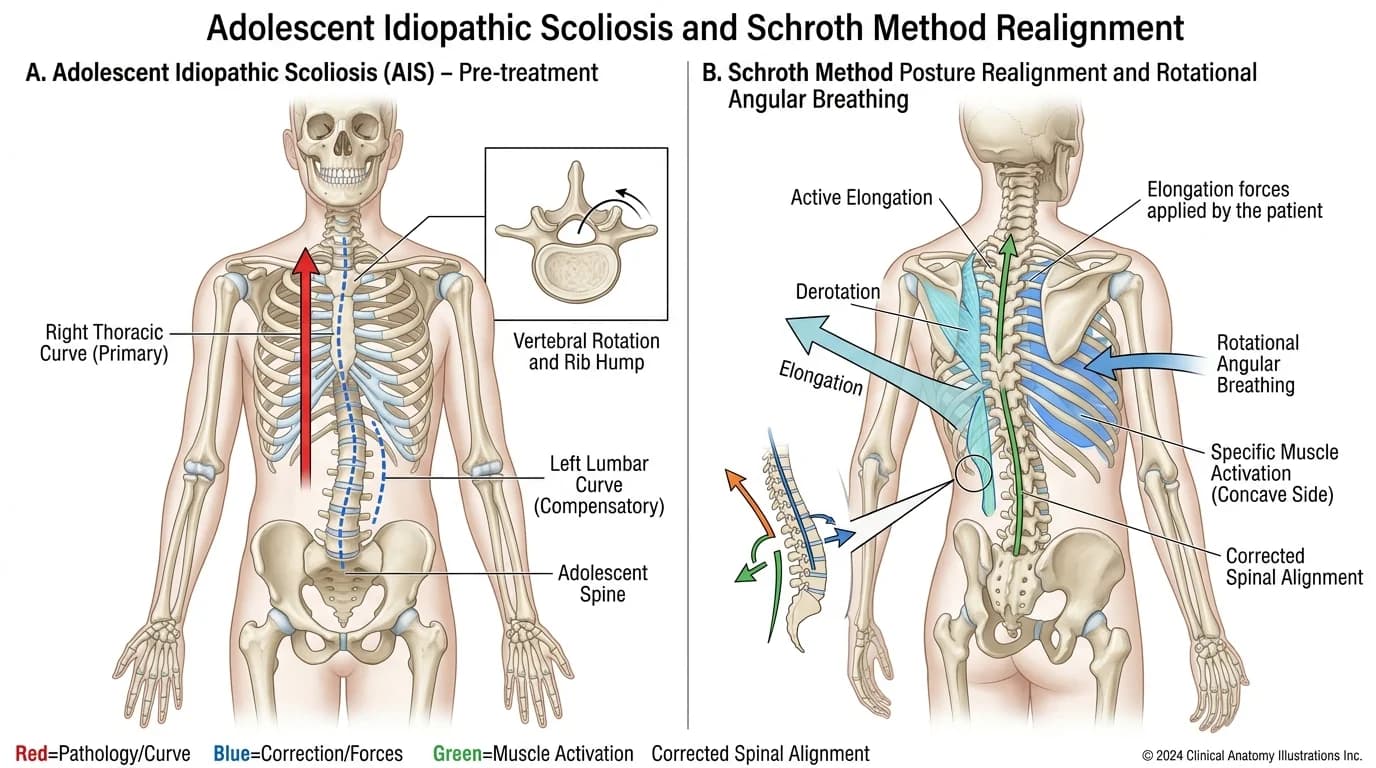
Adolescent Idiopathic Scoliosis (AIS) is a three-dimensional spinal deformity characterized by lateral coronal curvature >= 10 degrees with associated vertebral axial rotation and lordotic sagittal plane flattening. Developing during the pubertal growth spurt (ages 10 to 18), AIS affects roughly 2% to 3% of the adolescent population, exhibiting a pronounced female predominance (up to 8:1 for severe curves).
The primary clinical challenge in AIS is predicting which curves will remain stable versus which will relentlessly progress. Curve acceleration is driven by the Heuter-Volkmann principle: asymmetric mechanical compressive loading across the vertebral growth plates inhibits bone growth on the concave side while relative unloading accelerates growth on the convex side, creating progressive vertebral wedging during rapid skeletal growth.
Cobb Angle and Risser Skeletal Maturity Staging Matrix
| Risser Sign (Iliac Apophysis) | Skeletal Growth Potential | Cobb Angle 10 to 19 deg | Cobb Angle 20 to 29 deg | Cobb Angle 30 to 45 deg | |
|---|---|---|---|---|---|
| Risser 0 (No ossification) | Peak growth velocity ahead (high risk) | 25% progression risk; physiotherapeutic scoliosis exercises (PSSE) | 60% progression risk; immediate rigid bracing | 100% progression risk; aggressive bracing & PSSE | |
| Risser 1 (Lateral 25% capped) | High residual growth velocity | 20% progression risk; 6-month X-ray review | 50% progression risk; rigid brace 18-23 hrs/day | 90% progression risk; brace + Schroth therapy | |
| Risser 2 (50% excursion) | Moderate residual growth velocity | 15% progression risk; posture training | 30% progression risk; bracing if progressing | 75% progression risk; rigid bracing | |
| Risser 3 (75% excursion) | Slowing growth velocity | 10% progression risk; observation | 20% progression risk; night bracing | 50% progression risk; daytime or nighttime brace | |
| Risser 4 (Complete excursion) | Cessation of spinal growth | < 5% progression risk; core stabilization | < 10% progression risk; begin brace weaning | 20% progression risk; Schroth core maintenance | |
| Risser 5 (Complete fusion to ilium) | Full skeletal maturity reached | Zero growth-related progression | Stable curve; discharge from active bracing | Curves > 50 deg progress ~1 deg/year in adulthood |
Standardized Clinical Evaluation and Bracing Thresholds
- Accurate Cobb Angle Measurement Protocol: Identify the superior endplate of the most tilted upper vertebra and the inferior endplate of the most tilted lower vertebra; erect intersecting perpendicular lines to measure the true Cobb angle; a difference of >= 5 degrees between serial radiographs confirms true clinical curve progression.
- The SOSORT Bracing Criteria: Prescribe a custom-molded rigid thoracolumbosacral orthosis (TLSO, such as a Chêneau brace) for skeletal immature patients (Risser 0-2) with curves between 25 and 45 degrees; mandate 18 to 23 hours of daily wear compliance to prevent surgical progression.
- Physiotherapeutic Scoliosis-Specific Exercises (PSSE): Prescribe curve-specific Schroth exercises alongside bracing; active 3D auto-elongation, rotational breathing, and isometric stabilization preserve spinal flexibility and improve in-brace corrective force coupling.
Frequently Asked Questions
What is the Cobb angle in scoliosis?
The Cobb angle is the gold standard medical measurement of spine curvature on an X-ray, measured in degrees. A curve under 10 degrees is normal posture variation. A curve over 10 degrees is diagnosed as scoliosis, while curves between 25 and 45 degrees usually need a back brace during teenage growth.
What does a Risser score mean on a teen's pelvic X-ray?
The Risser score (from 0 to 5) checks the growth plate on top of the hip bone to see how much growing a teenager has left. Risser 0 means rapid growth is still ahead (high risk of curve worsening), while Risser 5 means the skeleton is fully grown and the spine is set.
Can exercise cure scoliosis completely and make the spine straight?
Specific exercises (like the Schroth method) cannot completely erase a structural spinal curve, but they strengthen core muscles, stop mild curves from worsening, improve appearance and lung capacity, and help teenagers avoid spinal fusion surgery.
Related condition guides


Related recovery guides & articles
BookPhysio.in Editorial Team
The BookPhysio.in editorial team writes and maintains this content, checking it against reliable clinical sources. Content follows our medical review policy: general information only, and no page claims a clinical review until a named registered physiotherapist has signed it off.
Read our medical review policy