
Ankylosing Spondylitis: Axial Spondylitis, Postural Maintenance, and Physiotherapy in India
In short
Ankylosing spondylitis threatens spinal flexibility and chest expansion. Discover how axial spondyloarthritis develops, why morning stiffness occurs, and targeted physio exercises.
In this guide (5 sections)
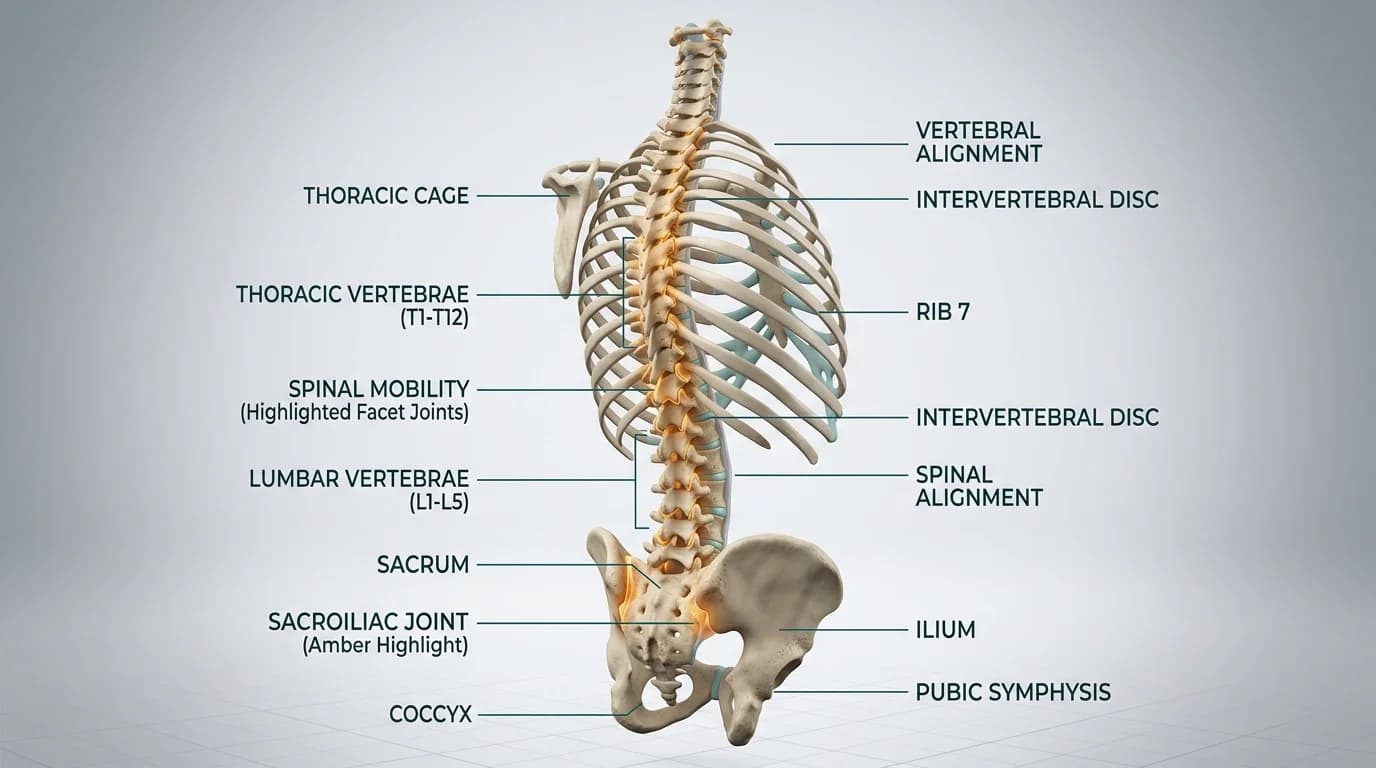
Ankylosing spondylitis (AS): now classified under the broader clinical diagnostic framework of axial spondyloarthritis (axSpA): is a chronic, progressive inflammatory arthropathy primarily targeting the sacroiliac joints and axial skeleton. In India, AS predominantly affects young adults between the ages of 18 and 35, showing a marked genetic association with the human leukocyte antigen HLA-B27. Because early symptoms frequently mimic non-specific mechanical lower back pain, young Indian patients often experience diagnostic delays of five to eight years before receiving an accurate rheumatological evaluation.
The hallmark of axial spondyloarthritis is inflammatory back pain: characterized by severe early morning spinal stiffness lasting greater than 45 minutes, nocturnal awakening during the second half of the night, and pain that improves with physical activity but worsens with rest. Pathologically, chronic enthesitis (inflammation where ligaments and tendons insert into bone) triggers progressive chondroid metaplasia and ossification. Left unchecked, syndesmophytes bridge adjacent vertebral bodies, resulting in the dreaded 'bamboo spine': a rigid, ankylosed column vulnerable to catastrophic fracture.
1. Inflammatory vs Mechanical Back Pain: The Berlin Diagnostic Criteria
Differentiating axial spondyloarthritis from common mechanical back pain is critical for initiating early disease-modifying treatment and preserving spinal posture.
| Clinical Feature | Inflammatory Back Pain (AxSpA / AS) | Mechanical Lower Back Pain (Disc / Facet) |
|---|---|---|
| Age of Onset | Typically insidious onset in young individuals (<40 years old) | Can occur at any age; frequently linked to lifting or physical trauma |
| Morning Stiffness Duration | Prolonged morning stiffness: strictly >45 minutes; improves with hot bath | Transient stiffness (<15 to 30 minutes); eases quickly with movement |
| Effect of Exercise vs Rest | Pain improves dramatically with exercise; completely unimproved by rest | Pain aggravated by sustained activity or heavy lifting; relieved by lying down |
| Night Pain Pattern | Severe nocturnal pain awakening patient in the second half of the night | Pain occurs when turning in bed; patient can sleep once positioned comfortably |
| Chest Expansion | Progressively diminished (<2.5 cm measured at 4th intercostal space) | Completely normal physiological chest excursion (>4 to 5 cm) |
2. Clinical Measurements: BASDAI and Spinal Mobility Indices
Rheumatologists and specialized physiotherapists monitor disease activity using the Bath Ankylosing Spondylitis Disease Activity Index (BASDAI) and spinal mobility using the BASMI. Key clinical metrics include the modified Schober test (measuring lumbar flexion excursion), occiput-to-wall distance (measuring progressive thoracic kyphosis and forward head posture), and chest expansion measured at the fourth intercostal space.
While biologic therapies (such as TNF inhibitors and IL-17 blockers) have revolutionized inflammatory control, medical therapy alone cannot restore lost mobility or prevent kyphotic postural deformities. Daily, lifelong physiotherapy is the essential co-pillar of management, ensuring that as inflammation settles, the spine retains functional alignment and vital thoracic excursion.
3. Daily Spinal Maintenance and Postural Extension Protocol
The following targeted exercises counteract the forward flexion forces that drive the classic stooped posture of ankylosing spondylitis.
Phase 1: Prone On-Elbows and Press-Up Spinal Extension
Objective: Counteract progressive thoracic kyphosis and maintain lumbar lordosis.
- 1Lie face down on a firm mat on the floor with your palms flat beside your shoulders.
- 2Relax your gluteal muscles and lower back completely, allowing your pelvis to sink heavy into the floor.
- 3Slowly press through your palms, straightening your elbows to lift your chest and torso off the floor.
- 4Keep your hips firmly in contact with the mat, creating gentle backward extension through your lumbar and thoracic spine.
- 5Pause at the top for 5 seconds while breathing out, then lower smoothly back down.
Phase 2: Apical Deep Breathing and Chest Wall Expansion
Objective: Mobilise the costovertebral and costotransverse joints to prevent restrictive pulmonary disease.
- 1Sit tall in a supportive chair with your back straight and feet flat on the floor.
- 2Place your hands across the sides of your ribcage, or clasp your hands behind your head.
- 3Take a slow, deep breath in through your nose, actively focusing on expanding your ribs outward against your hands.
- 4Simultaneously draw your elbows backward to stretch your pectoral muscles and expand your chest.
- 5Hold the full breath for 3 seconds, then exhale slowly through pursed lips, allowing your ribs to relax.
Phase 3: Corner Wall Postural Alignment (Occiput-to-Wall Retraction)
Objective: Prevent forward head posture (poking chin) and reinforce cervical-thoracic alignment.
- 1Stand with your back flat against an unobstructed wall, heels positioned approximately 5 centimetres from the baseboard.
- 2Ensure your buttocks and upper back are touching the wall.
- 3Gently tuck your chin in (as if making a double chin) and draw the back of your head (occiput) toward the wall.
- 4Touch the back of your head to the wall without tilting your face upward toward the ceiling.
- 5Hold this lengthened posture for 10 seconds while breathing smoothly, then relax.
Ankylosing spondylitis is associated with extra-articular manifestations. If you experience sudden painful eye redness, severe photophobia (light sensitivity), or blurred vision, seek emergency ophthalmology care for acute anterior uveitis. Additionally, because an ankylosed spine behaves like a brittle long bone, any sudden neck trauma or fall requires immediate emergency immobilisation and CT imaging to rule out chalk-stick cervical spinal fractures.
4. Clinical Settings and Transparent Fee Standards in India
Outpatient clinic physiotherapy provides access to specialized hydrotherapy pools, spinal extension traction plinths, and group exercise classes that foster peer support. For patients during acute painful flare-ups or those living with advanced spinal deformities, home-visit physiotherapy provides essential personalized postural assessments and ergonomics setup for Indian home offices.
In major Indian cities, clinical physiotherapy sessions for ankylosing spondylitis typically range from ₹400 to ₹1,500 per visit. In-home physiotherapy sessions range from ₹600 to ₹2,000 depending on clinical expertise and travel distance. Transparent direct payments ensure clinical trust.
5. Frequently Asked Questions Regarding Ankylosing Spondylitis Physiotherapy
Can exercise stop the progression of spinal fusion in ankylosing spondylitis?
While exercise cannot alter genetic HLA-B27 expression or completely halt the biological molecular cascade of enthesitis, regular spinal extension and chest expansion exercises play a decisive role in slowing the rate of joint ossification. Crucially, if fusion does eventually occur, consistent physiotherapy ensures that the spine fuses in an upright, functional posture rather than a severely bent, forward-hunched (hyperkyphotic) deformity that impairs walking and breathing.
Which sleeping mattress and pillow setup is best for ankylosing spondylitis?
Patients with AS should sleep on a firm, supportive orthopaedic mattress that maintains spinal alignment without sagging. Avoid soft, sinking mattresses that encourage spinal flexion. Use a single thin, low-profile pillow under your head to prevent your neck from being forced forward into flexion. Sleeping prone (flat on your stomach) for 20 to 30 minutes each day is also an excellent natural way to stretch your hips and spine into extension.
Is swimming good for ankylosing spondylitis?
Swimming is widely considered the single best whole-body aerobic exercise for axial spondyloarthritis. The buoyancy of water unloads gravity and axial compressive stress from inflamed sacroiliac and vertebral joints, while the rhythmic arm strokes (particularly breaststroke and backstroke) promote thoracic extension, ribcage expansion, and cardiovascular endurance without impact trauma.
Should I exercise during an acute inflammatory flare-up?
During an acute flare characterized by severe inflammatory pain and fatigue, intense strenuous resistance exercises should be temporarily dialed back. However, complete bed rest is strictly contraindicated, as immobilisation causes rapid joint stiffening. Continue gentle active range-of-motion movements, Codman pendulums, deep breathing exercises, and warm water showers to maintain mobility until the acute flare subsides under rheumatological medical care.
How often do I need to perform my physiotherapy exercises?
For ankylosing spondylitis, exercise is not a temporary 6-week treatment: it is a vital daily health routine, similar to brushing your teeth. Dedicating 20 to 30 minutes every single day to spinal extension, hip flexor stretches, and deep chest expansion exercises is essential for maintaining lifelong spinal mobility and functional independence.
Related condition guides


BookPhysio.in Editorial Team
The BookPhysio.in editorial team writes and maintains this content, checking it against reliable clinical sources. Content follows our medical review policy: general information only, and no page claims a clinical review until a named registered physiotherapist has signed it off.
Read our medical review policy