
Tailbone Pain (Coccydynia) from Long Office Sitting: Ergonomic Cushions and Pelvic Relief Protocol
In short
Prolonged sitting on firm office chairs with poor pelvic alignment places intense localized pressure on the coccyx. Learn why donut cushions worsen tailbone pain, how U-cutout cushions offload the joint, and clinical pelvic floor release drills.
In this guide (5 sections)
Tailbone pain, clinically termed Coccydynia, is one of the most agonizing, frustrating, and misunderstood musculoskeletal conditions affecting sedentary desk workers across Indian corporate offices. Patients describe an intense, localized, sharp or throbbing ache directly over the base of the spine that flares agonizingly whenever they sit down, lean back against an office chair, or transition from sitting to standing. Despite its small anatomical size, an inflamed coccyx can render a normal 8-hour workday completely intolerable.
A frequent error made by patients and well-meaning colleagues is purchasing a generic circular "donut cushion" from a local pharmacy. Counter-intuitively, circular donut cushions often exacerbate coccydynia by increasing intra-perineal venous pressure and stretching the pelvic floor ligaments outward. True clinical relief requires understanding the biomechanics of sacrococcygeal loading, selecting specialized ergonomic cut-out cushions, and addressing hypertonic pelvic floor musculature.
1. Anatomy of the Coccyx and Sedentary Loading Biomechanics
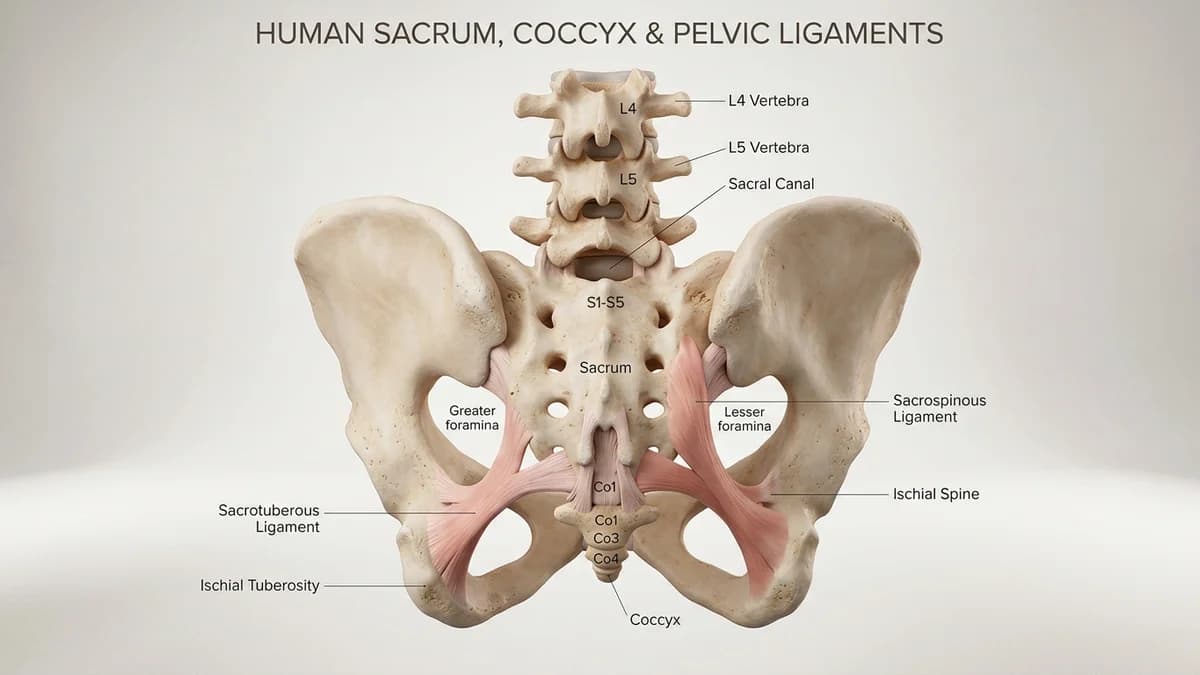
The coccyx is the terminal triangular bone of the human vertebral column, consisting of three to five fused or semi-mobile rudimentary segments situated inferior to the sacrum. Far from being a useless vestigial organ, the coccyx serves as a critical structural anchor for an intricate network of muscles, ligaments, and fascia.
Specifically, the levator ani muscle complex (pubococcygeus and iliococcygeus), the coccygeus muscle, and the anococcygeal ligament insert directly into the anterior and lateral margins of the coccyx, forming the pelvic floor hammock that supports the bladder, bowel, and pelvic organs. Furthermore, the gluteus maximus attaches to its posterior surface, and the sacred sacrotuberous and sacrospinous ligaments tether it to the pelvic pelvis.
When a person sits with ideal anterior pelvic tilt, approximately 65% of upper body weight is transferred down through the bilateral ischial tuberosities (the "sit bones"), leaving the coccyx virtually unloaded. However, when an office worker slumps into a rounded posterior pelvic tilt, the pelvis rocks backward onto the sacrum and coccyx. The coccyx is compressed directly against the firm chair cushion, bearing massive localized axial load. Over months of 10-hour workdays, this sustained compression induces chronic sacrococcygeal joint synostosis, periosteal contusion, ligamentous micro-tears, and reactive protective spasms of the surrounding levator ani muscles.
2. The Donut Cushion Fallacy vs The Ergonomic U-Cutout Wedge
The most widespread clinical mistake in coccydynia self-management is using an inflatable or circular donut cushion. It is vital to understand why donut cushions fail and what design works instead:
| Cushion Feature | Circular Donut Ring Cushion | Ergonomic U-Cutout Wedge Cushion | Biomechanical & Clinical Rationale |
|---|---|---|---|
| Design Geometry & Tailbone Contact | Circular ring with a closed central hole; edges press directly against outer coccygeal margin | Open rear U-shaped or V-shaped cutout that completely suspends the coccyx in open air | Donut rings trap and pinch perineal tissues; U-cutout wedges guarantee zero physical contact with the coccyx |
| Pelvic Incline & Postural Tilt | Flat or dished profile; encourages the pelvis to sink backwards into a slouched posterior tilt | Forward-sloping wedge profile (5° to 8° decline) that tilts the pelvis forward into neutral | Wedge incline automatically shifts 85% of body weight forward onto the ischial tuberosities and thighs |
| Pelvic Floor Muscle Tension | Forces the pelvic floor muscles to splay outward under body weight, increasing levator ani spasm | Maintains balanced support across the gluteal and hamstring pads without spreading the pelvic floor | Relieves hypertonic muscle pull on the anococcygeal ligament, breaking the pain-spasm cycle |
| Foam Density and Long-Session Durability | Low-density inflatable vinyl or cheap polyfill that bottoms out within 30 minutes of sitting | High-density 50D+ polyurethane memory foam that maintains 40 mm height under heavy load | High-density memory foam prevents the coccyx from bottoming out onto the hard chair base |
3. Three-Phase Clinical Pelvic Floor and Mobility Protocol
Because coccydynia is intimately linked with pelvic floor hypertonicity, traditional back exercises that increase intra-abdominal pressure can worsen tailbone pain. Rehabilitation must prioritize pelvic floor down-training, piriformis release, and gluteal activation.
Three-Phase Coccydynia Pelvic Floor and Hip Mobility Protocol
Objective: Down-train hypertonic levator ani muscles, restore sacrococcygeal mobility, and re-establish ischial weight-bearing.
- 1Phase 1 (Diaphragmatic Pelvic Floor Down-Training): Lie supine with knees bent and feet flat on the floor. Place one hand on your belly. Breathe deeply into your lower abdomen for a 4-second inhale, consciously visualizing your pelvic floor muscles dropping and expanding outward like a flower blossoming. Exhale passively without pushing. Practice 10 minutes daily.
- 2Phase 2 (Piriformis and Gluteal Mobilization): In a supine position, cross your affected ankle over the opposite knee (Figure-4 position). Gently draw the opposite thigh toward your chest until a comfortable stretch is felt deep in the buttock, away from the tailbone. Hold for 30 seconds; complete 3 repetitions.
- 3Phase 3 (Ischial Weight-Bearing and Hip Hinge Re-education): Stand tall in front of a chair. Practice the hip hinge by pushing your hips straight backward while maintaining an anterior pelvic tilt and keeping your chest lifted. Lower until your sit bones lightly touch the chair, then return to standing by squeezing your gluteal muscles. Perform 3 sets of 10 repetitions.
- 4Sit-to-Stand Transition Technique: When standing up from an office chair, never slide forward across the seat. Lean your chest forward from the hips, place hands on your thighs, and drive upward through your heels, completely unweighting the coccyx.
4. Office Ergonomics and Sit-Stand Transition Strategies
Modifying your daily office environment is critical to healing. Deploy these targeted workstation adjustments:
- Deploy the U-Cutout Cushion Correctly: Ensure the open U-cutout is positioned at the back of the chair, directly beneath your tailbone. Your coccyx should hover completely in the open slot without touching the cushion foam.
- Slight Forward Seat Pan Tilt: If your ergonomic office chair allows seat pan angle adjustments, tilt the seat pan forward by 3 to 5 degrees. This prevents your pelvis from rocking backward into a slump.
- Implement the 45-15 Sit-Stand Interval: If using an adjustable standing desk, limit continuous sitting to 45 minutes, followed by 15 minutes of standing work. When standing, wear supportive footwear and avoid locking your knees.
- Avoid Hard Wooden Dining Chairs When WFH: Never work from home seated on unpadded wooden dining chairs or metal stools. If a temporary chair is unavoidable, always use your high-density U-cutout wedge cushion.
Frequently Asked Questions
Why does tailbone pain hurt most when getting up from a chair?
When transitioning from sitting to standing, your gluteus maximus contracts powerfully to extend your hip. Because the gluteus maximus and the sacrotuberous ligament attach directly to the posterior surface of the coccyx, contracting these muscles exerts a sudden mechanical traction pull on the inflamed sacrococcygeal joint, generating a sharp, stabbing flash of pain.
Can falling on the buttocks years ago cause sudden coccydynia now?
Yes. A previous fall on the ice, staircase, or wet bathroom floor can cause a subtle subluxation, micro-fracture, or chronic hypermobility of the sacrococcygeal joint. While the body initially compensates, transitioning to a high-volume sedentary desk job years later adds continuous mechanical compression that decompensates the old injury and triggers acute inflammation.
Is manual coccygeal manipulation performed by physiotherapists safe and effective?
Yes, specialized pelvic health physiotherapists perform internal or external sacrococcygeal joint mobilization to release chronic levator ani muscle spasm and gently mobilize a rigid, anteriorly subluxated coccyx. Clinical trials demonstrate high success rates for manual therapy combined with pelvic floor down-training in chronic coccydynia that has failed conservative cushioning.
What dynamic X-ray views are needed to evaluate coccydynia in India?
Standard static lying-down X-rays are notoriously inaccurate for coccydynia because the tailbone is completely unloaded. The gold-standard diagnostic imaging protocol is a dynamic sitting-versus-standing lateral coccyx X-ray series. Comparing the two views reveals whether the coccyx is hypermobile (flexing forward more than 25 degrees when seated) or rigidly subluxated.
How does BookPhysio.in assist patients suffering from coccydynia?
BookPhysio.in connects individuals suffering from tailbone and pelvic pain with verified musculoskeletal and pelvic health physiotherapists across India. Clinicians offer in-depth biomechanical assessments, pelvic floor release, and ergonomic guidance with transparent per-session pricing (₹400 to ₹1,500 clinic, ₹600 to ₹2,000 home visits) and zero platform commission.
Related condition guides


BookPhysio.in Editorial Team
The BookPhysio.in editorial team writes and maintains this content, checking it against reliable clinical sources. Content follows our medical review policy: general information only, and no page claims a clinical review until a named registered physiotherapist has signed it off.
Read our medical review policy