
Cross-Legged Sitting (Sukhasana) Stiffness: Hip Mobility, Meniscal Protection, and Physio Protocols
In short
Struggling to sit cross-legged for meals or puja rituals indicates hip and meniscal restriction. Discover evidence-based hip opening and knee-safe physiotherapy.
In this guide (5 sections)
In Indian cultural and spiritual life, sitting cross-legged on the floor: whether in the simple Sukhasana (Palthi), the meditative Padmasana (Lotus Pose), or during prayer rituals (puja), wedding ceremonies, and traditional floor dining (pangat): is a foundational physical practice deeply entwined with daily identity. Yet, as urban Indian lifestyles have shifted toward modern western chairs, sofas, and car seats, millions of adults find that by their forties, sitting cross-legged has become an excruciating anatomical struggle.
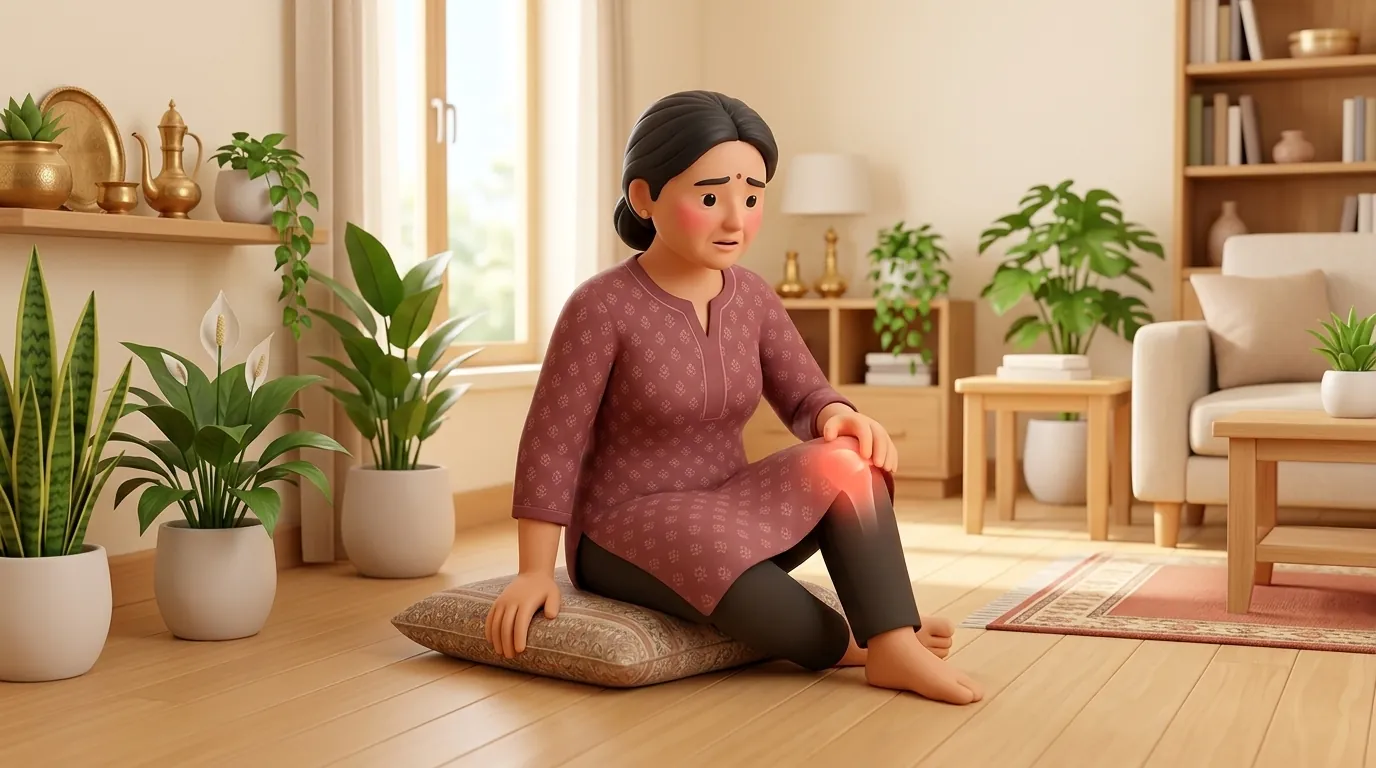
When attempting to cross their legs, their knees hover awkwardly 12 to 18 inches off the ground, their groin and outer hips burn intensely, their lower backs round into painful slouching, and a sharp pinching ache erupts inside the medial knee joint. Rather than an unavoidable sign of old age, this stiffness is the direct result of adaptive hip capsular contracture and posterior meniscal impingement. Structured orthopaedic physiotherapy restores functional hip mobility and protects vulnerable knees.
1. Biomechanics: The Tri-Planar Hip Demands and The "Meniscal Pinch"
Sitting cross-legged comfortably on the floor requires extraordinary, coupled three-dimensional range of motion from the ball-and-socket hip joint (acetabulofemoral joint). Specifically, comfortable Sukhasana demands: 1. Hip Flexion: 95 to 115 degrees. 2. Hip Abduction: 35 to 50 degrees. 3. Hip External Rotation: 45 to 60 degrees.
When an individual spends decades sitting in office chairs with hips locked in neutral 90-degree flexion, the anterior hip capsule shortens, and the external rotators (piriformis, obturator internus, quadratus femoris) become chronically stiff and fibrotic. Concurrently, Femoroacetabular Impingement (FAI) or early labral fraying mechanically blocks the femoral neck from clearing the anterior acetabular rim.
When a person with stiff hips attempts to force their legs down flat into a cross-legged position, the body searches for compensatory motion down the kinetic chain. Because the hip cannot rotate externally, the rotational torque is transferred directly into the hinge-like knee joint. The tibia twists externally on the femur, stretching the Medial Collateral Ligament (MCL) while violently crushing and pinching the posterior horn of the medial meniscus. Forcing a cross-legged posture with tight hips is the leading non-traumatic cause of degenerative medial meniscus tears in Indian adults.
| Anatomical Segment | Normal Ideal Kinematics for Floor Sitting | Compensatory Breakdown with Stiff Hips | Clinical Physiotherapy Solution |
|---|---|---|---|
| Hip (Acetabulofemoral Joint) | 105 deg flexion, 45 deg abduction, 50 deg external rotation | External rotation blocked < 25 deg; anterior capsular impingement | 90/90 hip mobility drills; manual anterior capsular glides; stretch |
| Knee (Tibiofemoral Joint) | Pure hinge flexion; zero rotational or valgus torque | Forced tibial external rotation; severe medial meniscus posterior pinch | Support knees with yoga blocks; elevate pelvis on 10 cm cushion |
| Lumbar Spine & Pelvis | Neutral pelvis; slight anterior pelvic tilt; inward lumbar lordosis | Posterior pelvic tilt; slouched lumbar kyphosis; severe disc strain | Pelvic wedge cushions; hamstring & gluteal myofascial release |
2. Indian Social Pressures: Temple Floor Rituals, Family Weddings, and Guilt
The inability to sit on the floor in India carries profound psychological and social embarrassment. During religious ceremonies (satyanarayan puja, havan), wedding festivities, or temple visits, everyone is expected to sit cross-legged on carpets for two to three hours. Seniors and middle-aged adults who request a plastic chair frequently feel ostracized, self-conscious, or disrespectful to family traditions.
To avoid embarrassment, many individuals grit their teeth and force themselves to sit cross-legged through excruciating pain. After an hour, their legs go completely numb due to common peroneal nerve compression against the fibular head, and they cannot stand up without assistance from two people, limping severely for days afterward.
Scientific physiotherapy replaces painful stoicism with biomechanical intelligence: providing dignified, discreet adaptations that allow individuals to participate fully in sacred rituals while protecting their joints.
3. Three-Phase Hip Opening and Knee-Protection Protocol
Three-Phase Sukhasana Hip Mobility and Floor Sitting Protocol
Objective: Safely expand hip external rotation, eliminate rotational knee torque, and master dignified floor sitting adaptations.
- 1Phase 1 (The Elevated Pelvis Golden Rule - Immediate): NEVER attempt to sit directly flat on a hard floor if your hips are stiff. Elevate your sitz bones onto a firm 10 to 15 centimetre cushion, folded woollen blanket, or meditation block (zafu). Elevating your pelvis tilts the sacrum forward, instantly relieving 40 degrees of hip flexion demand and allowing your knees to drop naturally below your hip crests. If your knees still hover in the air, place soft yoga blocks or rolled towels directly underneath both knees to support them, completely eliminating rotational shear across the medial menisci.
- 2Phase 2 (The 90/90 Dynamic Hip Mobility Matrix - 4 Days Weekly): Sit on the floor with both knees bent at 90 degrees: front leg in 90 degrees external rotation, trailing leg in 90 degrees internal rotation. Sit tall with an open chest. Gently hinge your torso forward over your front knee for 30 seconds to stretch the deep external rotators and piriformis. Next, slowly windshield-wiper your knees across to the opposite side without using your hands. Perform 8 controlled transitions.
- 3Phase 3 (Figure-4 Piriformis and Adductor Remodeling - Daily): Lie on your back in crook-lying. Cross your right ankle over your left knee (Figure-4). Thread your hands through and gently draw your left thigh toward your chest until a deep, pleasant stretch is felt in the outer right hip and buttock. Hold for 30 seconds. Repeat 3 times per side. Pair with the seated Butterfly stretch with back against a wall.
- 4Numbness Warning Rule: If you feel tingling, pins and needles, or numbness spreading along the top of your foot while sitting cross-legged, your common peroneal nerve is being compressed against the hard floor. Uncross your legs immediately and stretch them straight out in front.
4. Critical Red Flags: Recognizing Meniscal Tears and Severe Hip Osteoarthritis
It is essential to distinguish simple muscular capsular tightness from true structural joint pathology. Seek immediate orthopaedic specialist evaluation if you experience a sharp, audible "pop" or tearing sensation inside your knee while crossing your legs followed by immediate joint swelling, true mechanical joint locking where your knee physically jams and cannot straighten or bend, severe deep groin pain during walking that radiates into the anterior thigh indicating advanced hip osteoarthritis (coxarthrosis) or avascular necrosis of the femoral head (AVN), or inability to bear weight on the limb after attempting floor sitting.
Frequently Asked Questions
Why does my inner knee ache and pinch when I try to sit cross-legged?
When your hip joints lack adequate external rotation, your body attempts to compensate by twisting your knee. This rotational shear forces the tibia to rotate on the femur, stretching your Medial Collateral Ligament (MCL) and pinching the posterior horn of your medial meniscus against the bone.
Can yoga hip openers (like Pigeon Pose) damage stiff hips if forced?
Yes! Forcing deep yoga postures like the Pigeon Pose or Padmasana (Lotus Pose) when you have underlying capsular stiffness or bone spurs (FAI) can tear the acetabular labrum and crush knee menisci. Progress gradually using elevated cushions and props rather than forcing end-range postures.
How high should a floor cushion be to make cross-legged sitting comfortable?
For most adults with moderate hip stiffness, a firm cushion or folded blanket measuring 10 to 15 centimeters (4 to 6 inches) is ideal. The cushion should be high enough so that your knees rest level with or slightly below your anterior hip bones (ASIS).
Is it acceptable to sit with legs stretched straight out during religious ceremonies?
Yes, absolutely. Long-sitting (sitting with legs straight out in front, optionally with a light shawl covering your legs for modesty) is a completely acceptable, joint-friendly alternative that preserves spinal alignment without stressing tight hips or arthritic knees.
How do I book a hip and knee mobility assessment through BookPhysio.in?
BookPhysio.in connects patients across Indian cities with certified musculoskeletal physiotherapists who specialize in lower limb kinematics, joint mobilization, and functional mobility. Sessions are available at clinic (₹400 to ₹1,500) or via home visits (₹600 to ₹2,000) with zero platform fees and direct payment per visit.
Related condition guides

BookPhysio.in Editorial Team
The BookPhysio.in editorial team writes and maintains this content, checking it against reliable clinical sources. Content follows our medical review policy: general information only, and no page claims a clinical review until a named registered physiotherapist has signed it off.
Read our medical review policy