
Home Visits vs Clinic Setup: Travel Boundaries, Portable Equipment, and Practice Economics in India
In short
Deciding between launching an in-clinic practice or a mobile home-visit service? Compare exact capital expenditure, overheads, hourly revenue, and travel boundaries.
In this guide (5 sections)
For early-career and experienced physiotherapists across India, choosing between setting up a brick-and-mortar clinic and building a specialized mobile home-visit practice is one of the most critical financial and operational decisions of their careers. Many clinicians believe the traditional notion that a physical clinic with a prominent street-facing sign is the only way to build a credible, lucrative practice. However, shifting patient demographics, soaring commercial real estate rents in Tier-1 and Tier-2 Indian cities, and traffic congestion have fundamentally altered healthcare unit economics.
A rigorous financial analysis demonstrates that a mobile home-visit practice offers substantially higher profit margins, near-zero capital risk, and immediate positive cash flow compared to the heavy fixed overheads of a physical clinic. Conversely, an established clinic allows for higher daily patient volume and passive staff scaling. Understanding the exact CapEx, OpEx, hourly earnings, and geographical travel boundaries enables clinicians to make informed business decisions.
1. Financial Modeling: CapEx, OpEx, and Breakeven Comparison
Establishing a modern 500-to-800 square foot physiotherapy clinic in an Indian metro (such as Bengaluru, Mumbai, Delhi-NCR, Hyderabad, or Pune) requires substantial Capital Expenditure (CapEx): security deposit for commercial lease (₹3 to ₹8 lakhs), interior fit-outs and partitioning (₹2 to ₹5 lakhs), electrotherapy equipment and treatment couches (₹1.5 to ₹3 lakhs), air conditioning and reception furniture (₹1 to ₹2 lakhs), bringing initial startup costs to ₹7 to ₹18 lakhs before treating a single patient.
Monthly Operating Expenditure (OpEx) for a physical clinic includes commercial rent (₹35,000 to ₹80,000), electricity and air conditioning bills (₹5,000 to ₹12,000), clinic assistant or receptionist salary (₹12,000 to ₹20,000), and marketing costs, requiring ₹55,000 to ₹1,15,000 in monthly fixed revenue just to break even. In contrast, a home-visit practice has virtually zero lease CapEx, minimal equipment costs (₹15,000 to ₹25,000 for a portable kit), and variable OpEx limited strictly to fuel and vehicle maintenance.
| Economic Metric | In-Clinic Practice (Single Clinician) | Mobile Home-Visit Practice (Solo) | Hybrid Model (Part-Time Clinic + Visits) |
|---|---|---|---|
| Initial Startup CapEx | ₹7,00,000 to ₹18,00,000 (deposit, interiors, equipment) | ₹20,000 to ₹40,000 (portable modalities, kit bag) | ₹1,50,000 to ₹3,00,000 (shared room rental, portable kit) |
| Monthly Fixed OpEx | ₹55,000 to ₹1,15,000 (rent, power, assistant salary) | ₹5,000 to ₹12,000 (fuel, maintenance, phone, insurance) | ₹20,000 to ₹40,000 (hourly room rental, travel) |
| Session Fee Benchmark | ₹400 to ₹1,500 per session | ₹600 to ₹2,000 per session | ₹500 clinic / ₹800 home visit |
| Daily Patient Capacity | 10 to 16 patients per day (high throughput) | 4 to 6 patients per day (travel-limited) | 6 to 8 patients per day (combined scheduling) |
| Net Profit Margin | 35% to 50% after accounting for fixed clinic overheads | 85% to 92% (almost entire gross revenue is net profit) | 60% to 70% balanced operational return |
2. The Geography of Burnout: Setting Strict Travel Boundaries
The primary risk in a mobile home-visit practice is not financial failure: it is clinician physical exhaustion and travel burnout. Indian urban traffic in peak hours can turn a 5-kilometer commute into a grueling 45-minute ordeal. If a physiotherapist accepts home visits indiscriminately across an entire city, they spend four hours sitting in traffic to treat only three patients, resulting in severe back ache, respiratory pollution fatigue, and low hourly earnings.
Sustainable practice requires establishing a strict Cluster-Scheduling protocol within a defined service radius of maximum 4 to 6 kilometers from your home base. Group morning visits in a single neighbourhood cluster (e.g., within 1.5 km of each other) to minimize transit time between sessions to under 10 minutes. Establish a minimum home-visit fee threshold (₹600 to ₹800 base) that properly reflects travel time and vehicle costs.
3. Essential Portable Equipment Checklist for Mobile Practitioners
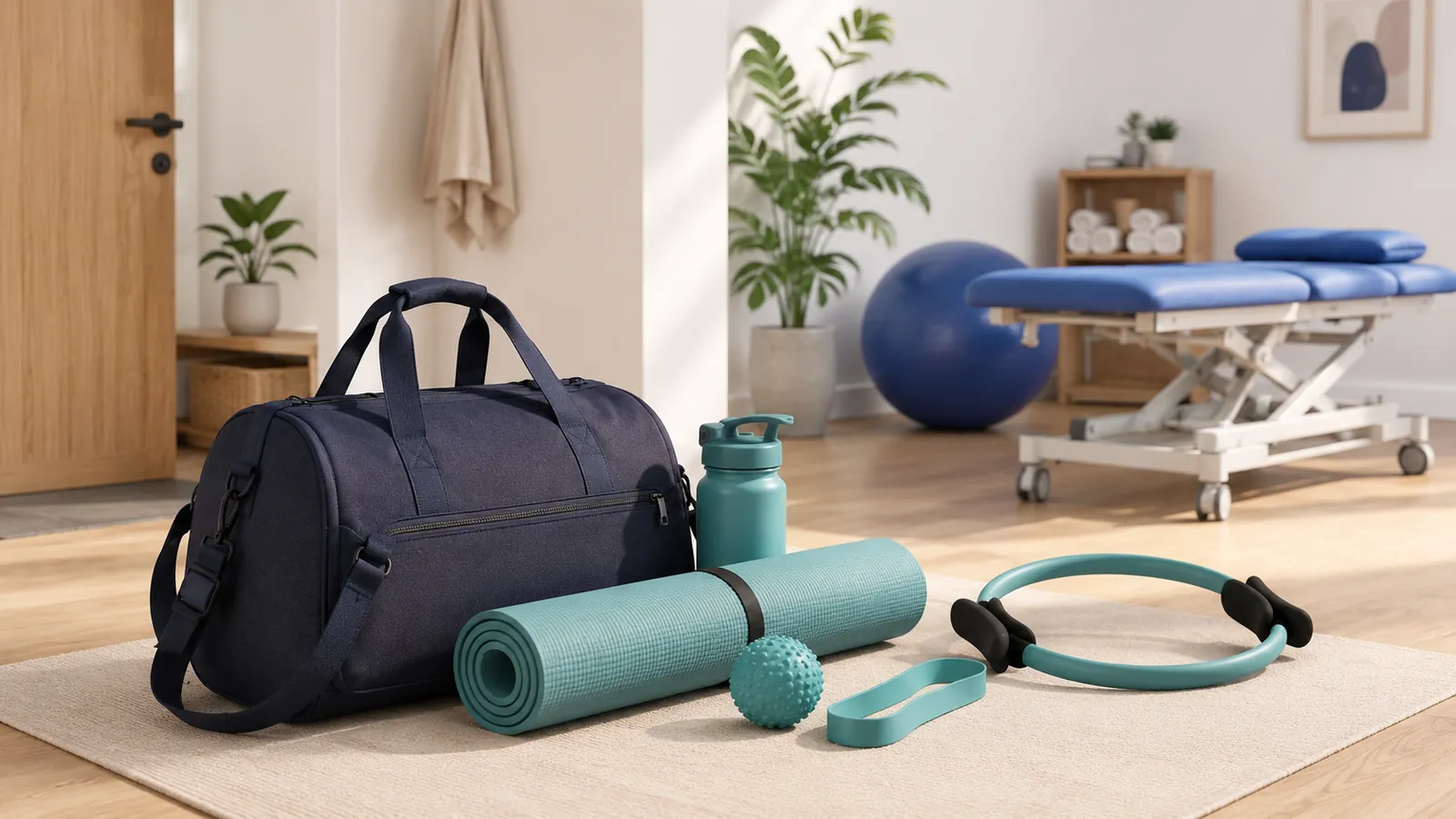
A high-earning home visit practitioner does not need heavy, cumbersome machines; modern evidence-based therapy emphasizes active exercise and targeted portable modalities.
Essential Portable Toolkit for Professional Home-Visit Physiotherapists
Objective: Equip mobile practitioners with compact, high-utility equipment for comprehensive home care.
- 1Item 1 (Portable Combo Electrotherapy Unit): Invest in a compact, rechargeable, battery-operated dual-channel TENS and Muscle Stimulator (IFT/EMS) unit weighing less than 500 grams with extra self-adhesive electrode pads.
- 2Item 2 (Progressive Resistance Toolkit): Carry a set of color-coded loop resistance bands and 1.5-meter latex/non-latex resistance bands (yellow, red, green, blue). Resistance bands allow full-body strengthening without bulky dumbbells.
- 3Item 3 (Diagnostic & Assessment Tools): A 360-degree clear plastic goniometer, a digital blood pressure monitor, an adult pulse oximeter, and a 10g monofilament for diabetic neuropathy checks.
- 4Item 4 (Mobilisation and Soft Tissue Tools): A lightweight folding foam balance pad (for neurological balance drills), a silicone massage cup, medical dry needles (with a compact sharps container if certified), and hypoallergenic kinesiology tape.
- 5Item 5 (Hygiene & Documentation Kit): Hand sanitizer, disposable shoe covers (essential for respecting Indian home traditions), disinfectant wipes for equipment, and a tablet for digital exercise prescriptions and consent forms.
4. Critical Red Flags: Client Screening and Personal Safety
Solo mobile practitioners: particularly female physiotherapists: must institute strict personal safety and client screening protocols before accepting home visit requests. Never accept a home visit from an anonymous caller without obtaining verified contact details: full patient name, complete address with landmark, referral source, and medical diagnosis. For initial consultations with new clients, inform a family member or colleague of your location and scheduled appointment time. If a home environment appears unsafe, unsanitary, or threatening upon arrival, politely decline the session and leave immediately.
Frequently Asked Questions
Can a physiotherapist build a six-figure monthly income exclusively through home visits in India?
Yes, easily. Treating 5 home-visit patients per day at an average fee of ₹800 per session yields ₹4,000 per day. Working 25 days a month generates ₹1,00,000 in gross revenue. With vehicle and equipment operating expenses under ₹10,000, net monthly earnings exceed ₹90,000 with zero commercial rent liabilities.
How do I transition from home visits to opening my own clinic later?
Starting with home visits is the smartest stepping stone to opening a clinic. A mobile practice allows you to build a loyal patient base, establish word-of-mouth credibility, and accumulate investment capital with zero financial risk. Once you have 15 to 20 recurring patient referrals each month, you can confidently lease a commercial clinic space with built-in demand.
What is the ideal pricing strategy for home visits versus in-clinic sessions?
Home visits should always be priced 40 to 60 percent higher than in-clinic sessions to account for travel time, vehicle depreciation, fuel, and the premium convenience of one-on-one personalized care in the patient's home. If your clinic fee is ₹500, your home visit fee should be ₹800 to ₹1,000.
How do I handle footwear etiquette during home visits in Indian households?
In Indian households, wearing outdoor footwear inside the home is culturally unacceptable. Carry a packet of clean, disposable medical shoe covers that slip easily over your shoes, or carry clean, dedicated indoor crocs or clinic sandals used exclusively inside patient homes. Patients deeply appreciate this cultural respect.
How does BookPhysio.in help physiotherapists grow their home-visit and clinic practices?
BookPhysio.in connects physiotherapists directly with patients searching for both home visits and clinic appointments in their immediate neighborhood. The platform takes zero commission, allows clinicians to set their own transparent fees, and ensures that 100 percent of the patient fee goes directly into the physiotherapist's pocket.
BookPhysio.in Editorial Team
The BookPhysio.in editorial team writes and maintains this content, checking it against reliable clinical sources. Content follows our medical review policy: general information only, and no page claims a clinical review until a named registered physiotherapist has signed it off.
Read our medical review policy