
How to Register a Physiotherapy Clinic in India: Step-by-Step NCAHP & CEA Guide
In short
Starting an independent physiotherapy clinic in India requires navigating statutory regulations across the Clinical Establishments Act, NCAHP compliance, municipal trade licensing, biomedical waste disposal, and fire safety. Here is your step-by-step launch roadmap.
In this guide (6 sections)
Opening an independent physiotherapy clinic or rehabilitation centre is the primary entrepreneurial ambition for thousands of qualified Bachelor of Physiotherapy (BPT) and Master of Physiotherapy (MPT) graduates across India. However, transitioning from clinical employment in a tertiary hospital to running an autonomous healthcare facility involves strict regulatory, legal, and municipal compliances. Operating without valid statutory permissions exposes clinicians to heavy municipal fines, sealing notices, civil litigation, and criminal liability under state healthcare acts.
Historically, the absence of a unified national regulatory body led to fragmentation, allowing unverified training institutes and unqualified practitioners to open centres without scrutiny. With the enactment and nationwide rollout of the National Commission for Allied and Healthcare Professions (NCAHP) Act 2021, physiotherapy in India has attained formal statutory status as an independent, autonomous healthcare profession. Physiotherapists are legally recognized as first-contact practitioners with the authority to assess, diagnose movement dysfunctions, formulate treatment plans, and discharge patients without mandatory medical gatekeeping. Along with this autonomy comes institutional accountability: every independent clinic must meet defined infrastructure, safety, and legal standards.
1. Professional Registration: State Council and NCAHP Mandate
Before signing a commercial lease, hiring interior contractors, or purchasing electrotherapy equipment, the principal clinician must verify that their professional credentials are legally registered with the appropriate statutory body. In India, a valid licence to practice physiotherapy does not come from voluntary professional associations, societies, or private bodies. It derives exclusively from an enacted statutory State Council or the Central NCAHP registry.
In states with functional statutory councils, such as the Maharashtra State Council for Occupational Therapy and Physiotherapy (MSOTPTC), the Delhi Council for Physiotherapy and Occupational Therapy (DCPTOT), and the Gujarat State Council for Physiotherapy (GSCPT), state registration is legally mandatory before offering clinical consultations. In states transitioning under the central NCAHP framework, practitioners must register with the State Allied and Healthcare Council once notified. Practicing or establishing a clinic without statutory council registration is a cognizable offence punishable under Section 41 of the NCAHP Act, attracting penalties of up to ₹5,00,000 and potential imprisonment.
To register, clinicians must present proof of a recognized four-and-a-half-year BPT degree from an accredited university, completion of a six-month compulsory rotatory internship, state domicile or transfer certificate, and character verification. If you plan to hire associate physiotherapists or clinical interns, each treating professional must also hold individual statutory registration. Clinics employing unqualified staff risk immediate closure during health department inspections.
Statutory Invariant: A valid licence to practice physiotherapy in India derives exclusively from an enacted State Council or the Central NCAHP registry. Private association memberships carry zero statutory licensing authority.
2. Clinical Establishments Act (CEA) Registration Workflow
The Clinical Establishments (Registration and Regulation) Act, enacted by the Central Government and adopted by the majority of Indian states, governs the physical setup of all healthcare facilities. Clinics operating in states that have enacted the CEA or their own state-specific legislation (such as the West Bengal Clinical Establishments Act or Karnataka Private Medical Establishments Act) must register with the District Registering Authority (DRA), chaired by the District Magistrate or Chief Medical Officer (CMO).
The registration process follows a two-tier framework: provisional registration and permanent registration. Provisional registration is granted online upon submitting qualification certificates, identity proofs, facility address proofs, and floor layout sketches. It is typically issued within 10 to 30 days and remains valid for one year, allowing the clinic to commence operations while preparing for physical inspection.
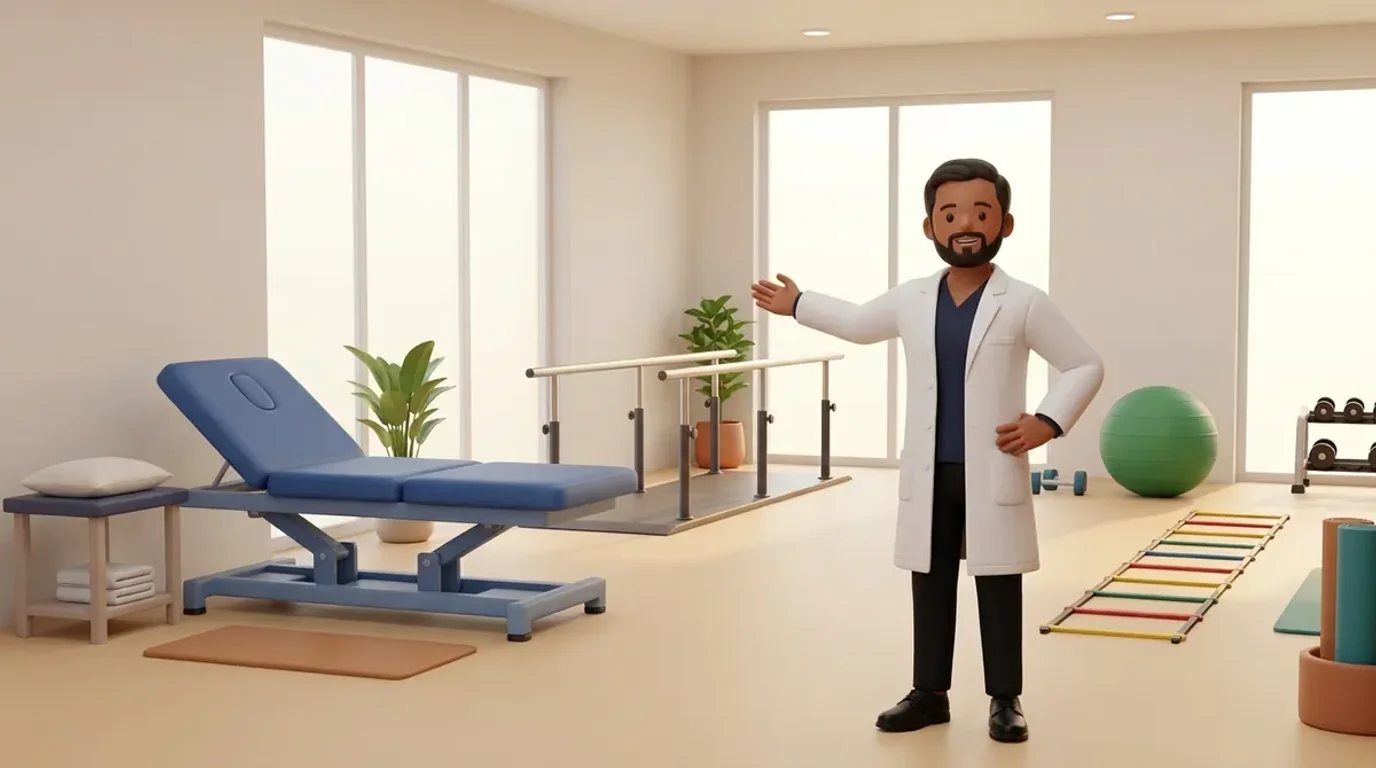
- Minimum treatment area dimensions: Individual treatment cubicles must provide adequate space around the examination plinth, typically requiring a minimum of 100 to 120 square feet per bed to allow therapist circulation, mobilization access, and patient privacy curtains.
- Rehabilitation gym and exercise space: An active rehabilitation area requires a minimum of 150 to 200 square feet of clear, unobstructed floor space to safely accommodate parallel bars, balance boards, posture mirrors, and gait training equipment.
- Barrier-free accessibility and ramps: Because physiotherapy clinics cater to patients with mobility impairments, post-surgical recovery, and neurological conditions, ground-floor access or elevators is mandatory. Any steps must feature non-slip ramps with a maximum gradient of 1:12 and sturdy bilateral handrails.
- Mandatory public display of tariff and credentials: The CEA mandates that clinical establishments prominently display their registration certificate, treating clinicians degrees and council registration numbers, and a clear schedule of fees in both English and the local state language in the waiting area.
3. Municipal Licences, Zoning, and Environmental Approvals
Securing medical registration is only half the battle. Operating a commercial establishment within an Indian municipality requires specific municipal and civic approvals. Neglecting local civic bylaws can result in surprise municipal sealing drives or utility cut-offs by urban local bodies such as the BMC in Mumbai, MCD in Delhi, or BBMP in Bangalore.
First, ensure that the selected property complies with local land-use zoning regulations. While some cities allow ground-floor clinics in designated mixed-use residential zones, opening a clinic in a purely residential cooperative housing society requires a formal No Objection Certificate (NOC) from the society management committee and commercial electricity conversion. High patient footfall, ambulance arrivals, and parking demands frequently cause disputes if society permissions are not formalized in writing.
Second, environmental and waste disposal regulations are strictly enforced under the Biomedical Waste Management (BMW) Rules 2016. If your clinic performs dry needling, sharp debridement, or wound management, you must register with the State Pollution Control Board (SPCB) and enter into an annual contract with an authorized Common Biomedical Waste Treatment Facility (CBWTF). Used dry needles must be discarded in puncture-proof, tamper-proof translucent sharps containers, while soiled cotton swabs and dressings require yellow biohazard bags with barcoded tracking.
| Statutory Requirement | Issuing Authority | Required Documentation / Standard | Processing Window | Consequence of Non-Compliance |
|---|---|---|---|---|
| NCAHP / State Council Registration | State Physiotherapy Council / State Allied Health Authority | BPT/MPT Degree, university marks cards, 6-month rotatory internship certificate, identity proof | 30 to 90 days | Criminal prosecution under Section 41, fines up to ₹5,00,000, disqualification from clinical practice |
| Clinical Establishment Licence | District Registering Authority (CMO / District Magistrate Office) | Council registration, clinic layout blue-print, equipment list, fire safety measures, staff register | 15 to 30 days (Provisional) | Immediate sealing of facility, cancellation of trade licence, recurring daily financial penalties |
| Municipal Trade Licence / Shop Act | Municipal Corporation / Local Urban Development Authority | Commercial property tax receipt, registered lease deed, property zone clearance, electricity bill | 15 to 45 days | Commercial utility disconnection, municipal closure notices, compounding fines |
| Biomedical Waste Agreement | State Pollution Control Board & Authorized CBWTF Operator | Needle destroyer, puncture-proof sharps bins, color-coded bags, waste collection agreement | 15 to 30 days | Pollution board closure order, criminal liability under Environment Protection Act 1986 |
| Fire Safety NOC | City / District Fire and Emergency Services Department | ISI marked ABC/CO2 extinguishers, clear 1-metre escape corridors, emergency lighting, signage | 30 to 60 days | Denial of CEA permanent licence, insurance claim invalidation during fire incidents |
4. Clinical Records, Informed Consent, and DPDP Compliance
Modern clinical governance requires rigorous documentation. In Indian civil and consumer courts, incomplete medical records create severe legal vulnerability during consumer dispute claims. Clinics must maintain structured Subjective, Objective, Assessment, and Plan (SOAP) records for every patient encounter.
Under the Digital Personal Data Protection (DPDP) Act, patient health records are classified as sensitive personal data. If your clinic uses electronic medical record (EMR) software, you must obtain explicit, verifiable patient consent before collecting mobile numbers, demographic details, or clinical histories. Physical intake records must be stored in locked filing cabinets, and electronic data must reside on encrypted servers located within Indian jurisdiction. Clinical records must be preserved for a statutory minimum of three years from the date of the last treatment session.
Standardised SOAP Intake and Consent Documentation Protocol
Objective: Establish a legally defensible, structured clinical documentation workflow for independent OPD clinics.
- 1Administer written informed consent covering treatment objectives, physical examination touch boundaries, risks of temporary muscle soreness, and procedure-specific risks before the first assessment.
- 2Execute specialized written consent for high-velocity spinal manipulation, dry needling, pelvic floor internal assessments, or therapeutic electrical stimulation.
- 3Document subjective history, pain rating scales (NPRS 0-10), aggravating and easing postures, daily functional limitations, and systemic medical history including diabetes and cardiac status.
- 4Record objective physical examination metrics: active range of motion in degrees, manual muscle testing grades (0-5), neurodynamic tension tests, and regional orthopaedic special tests.
- 5Formulate an evidence-informed treatment plan outlining treatment frequency, targeted functional milestones, active rehabilitation exercises, and expected discharge timelines.
- 6Obtain the patient signature on daily treatment tracking logs confirming session completion and receipt of home exercise guidance.
5. Taxation, Accounting, and Professional Fee Transparency
A common question among new clinic owners is whether physiotherapy services attract Goods and Services Tax (GST). Under Notification No. 12/2017-Central Tax (Rate), healthcare services provided by clinical establishments or authorized medical practitioners are exempt from GST. Clinical physiotherapy consultations, manual therapy treatments, and exercise rehabilitation sessions attract zero GST.
However, this exemption applies strictly to healthcare services. If your clinic maintains a retail inventory selling ergonomic lumbar supports, resistance bands, hot/cold gel packs, compression garments, or cervical pillows, those retail merchandise sales attract regular GST and require separate commercial accounting. If annual turnover from retail taxable goods exceeds statutory thresholds (typically ₹20 to ₹40 lakhs depending on state category), GST registration becomes legally mandatory.
Standard professional physiotherapy fees across Indian tier-1 and tier-2 cities range from ₹400 to ₹1,500 for clinic consultations and ₹600 to ₹2,000 for specialized home visits. Transparent per-session billing ensures high patient trust. On BookPhysio.in, verified physiotherapists receive direct payments from patients at each visit, with zero commission deductions and complete clinical autonomy.
Frequently Asked Questions
Can a physiotherapist in India write the prefix "Dr." before their name?
Under the National Commission for Allied and Healthcare Professions (NCAHP) Act 2021, physiotherapy is designated as an autonomous allied healthcare profession, not a branch of medicine or surgery governed by the National Medical Commission (NMC). Various High Court judgements and medical council directives have clarified that the prefix "Dr." is reserved for registered medical practitioners of modern medicine and recognized AYUSH systems. State councils generally advise physiotherapists to use their professional designation (e.g., "PT John Doe, Consultant Physiotherapist") to maintain legal clarity, prevent consumer misrepresentation claims, and uphold professional identity.
Do physiotherapy clinics need GST registration in India?
Pure clinical healthcare services, including physiotherapy evaluations, manual therapy, and therapeutic exercise programmes provided in a clinic or home visit, are fully exempt from GST under Notification No. 12/2017-Central Tax (Rate). However, if your clinic retails commercial physical goods such as ergonomic pillows, resistance bands, braces, or electrotherapy equipment, you must maintain separate commercial accounting. If the turnover from selling these retail taxable physical goods exceeds state thresholds (typically ₹20 to ₹40 lakhs annually), GST registration for commercial trade is required.
Is it legal to practice dry needling in an independent physiotherapy clinic in India?
Yes, certified physiotherapists who hold recognized postgraduate training, accredited certification, or formal curriculum coursework in intramuscular manual therapy / dry needling can legally perform the procedure as an adjunct to musculoskeletal rehabilitation. However, because dry needling involves penetrating the skin, the clinic must hold an active Biomedical Waste Management (BMW) agreement with an authorized waste management handler, use single-use disposable sterile needles, maintain needle-stick injury protocols, and obtain explicit written informed consent from the patient detailing potential risks including pneumothorax, transient bruising, and muscle soreness.
Can a physiotherapy clinic operate in a residential apartment in Indian cities?
Operating an outpatient clinical facility from a residential apartment is subject to strict local municipal corporation rules and cooperative housing society bylaws. While some municipalities permit professional consulting offices on ground floors with minimal commercial footprint, operating a high-volume physiotherapy clinic with multiple treatment plinths, heavy equipment, and continuous patient footfall generally requires commercial property conversion. Clinicians must obtain a written No Objection Certificate (NOC) from the residential housing society and ensure compliance with parking, fire safety, and commercial electricity tariff regulations to prevent eviction or municipal closure.
Is a medical doctor referral legally mandatory before evaluating or treating a patient?
No. Under the NCAHP Act 2021, qualified physiotherapists in India hold first-contact practitioner status with legal autonomy to assess, formulate movement diagnoses, prescribe exercise therapy, and treat patients without an initial referral from an MBBS physician. However, ethical and clinical standards require immediate referral to an orthopaedic surgeon, neurologist, or emergency physician whenever a clinical evaluation reveals red-flag signs such as cauda equina syndrome, unexplained unremitting night pain, acute fracture, progressive neurological deficits, or infectious osteomyelitis.
Related condition guides


BookPhysio.in Editorial Team
The BookPhysio.in editorial team writes and maintains this content, checking it against reliable clinical sources. Content follows our medical review policy: general information only, and no page claims a clinical review until a named registered physiotherapist has signed it off.
Read our medical review policy