
Scoliosis Brace Weaning: Skeletal Maturity Criteria, Risser 4 Staging, and Part-Time Protocols
In short
Brace weaning in idiopathic scoliosis requires verified skeletal maturity (Risser 4-5) and a phased reduction in wear time over 6 to 12 months to prevent curve rebound.
In this guide (4 sections)
The Physiology of Skeletal Maturity and Curve Rebound
Rigid bracing (e.g., Chêneau, Boston) is the proven non-surgical standard for preventing progression of adolescent idiopathic scoliosis during rapid pubertal growth. However, concluding brace treatment is a high-stakes clinical milestone. Abruptly discontinuing a brace too early - before the spinal osteochondral growth plates have fully fused - commonly precipitates 'rebound progression', where curves rapidly lose their in-brace correction.
Successful brace weaning requires rigorous verification of skeletal maturity across multiple biological markers. Because full bone mineral density and spinal ligamentous stiffness lag behind longitudinal height cessation by roughly 12 to 18 months, weaning must follow a structured, phased reduction in daily wear hours combined with intensive physiotherapeutic stabilization.
Biological Maturity Criteria for Initiating Brace Weaning
| Biological / Radiographic Marker | Premature (Do NOT Wean) | Ready to Initiate Weaning | Clinical Significance | |
|---|---|---|---|---|
| Risser Sign (Iliac Apophysis) | Risser 0 to 3 (active spinal growth remains) | Risser 4 (in females) or Risser 5 (in males) | Risser 4 indicates 100% excursion across iliac crest | |
| Post-Menarchal Timing (Females) | Pre-menarchal or < 18 months post-menarche | >= 18 to 24 months post-menarche | Peak height velocity occurs ~6-12 months before menarche | |
| Serial Standing Height Velocity | Growing > 1.0 cm over past 6 months | Growth velocity < 0.5 cm over past 6 consecutive months | Confirms cessation of rapid longitudinal spinal growth | |
| Sanders Skeletal Maturity Score | Sanders Stage 1 to 6 on hand/wrist radiograph | Sanders Stage 7 or 8 (mature / closed epiphyses) | More accurate than Risser for true growth plate closure | |
| Out-of-Brace Radiograph Stability | Curve progresses > 5 deg after 24 hrs out of brace | Curve remains within 2 to 3 deg of baseline | Verifies intrinsic muscular and ligamentous spinal stability |
Standardized 4-Stage Phased Weaning Protocol
- Phase 1: Reduction to 16 Hours Daily (Month 1 to 3): Reduce brace wear from full-time (20-22 hours) to 16 hours per day; the patient wears the brace during school and sleep, but leaves it off for late afternoon sports, social activities, and exercise.
- Phase 2: Nighttime-Only Wear (10 to 12 Hours, Month 4 to 6): Drop daytime brace wear completely; maintain rigid brace wear exclusively during sleep (10 to 12 hours); nighttime wear resists gravitational flattening and preserves spinal curve memory while core muscles adapt to gravity.
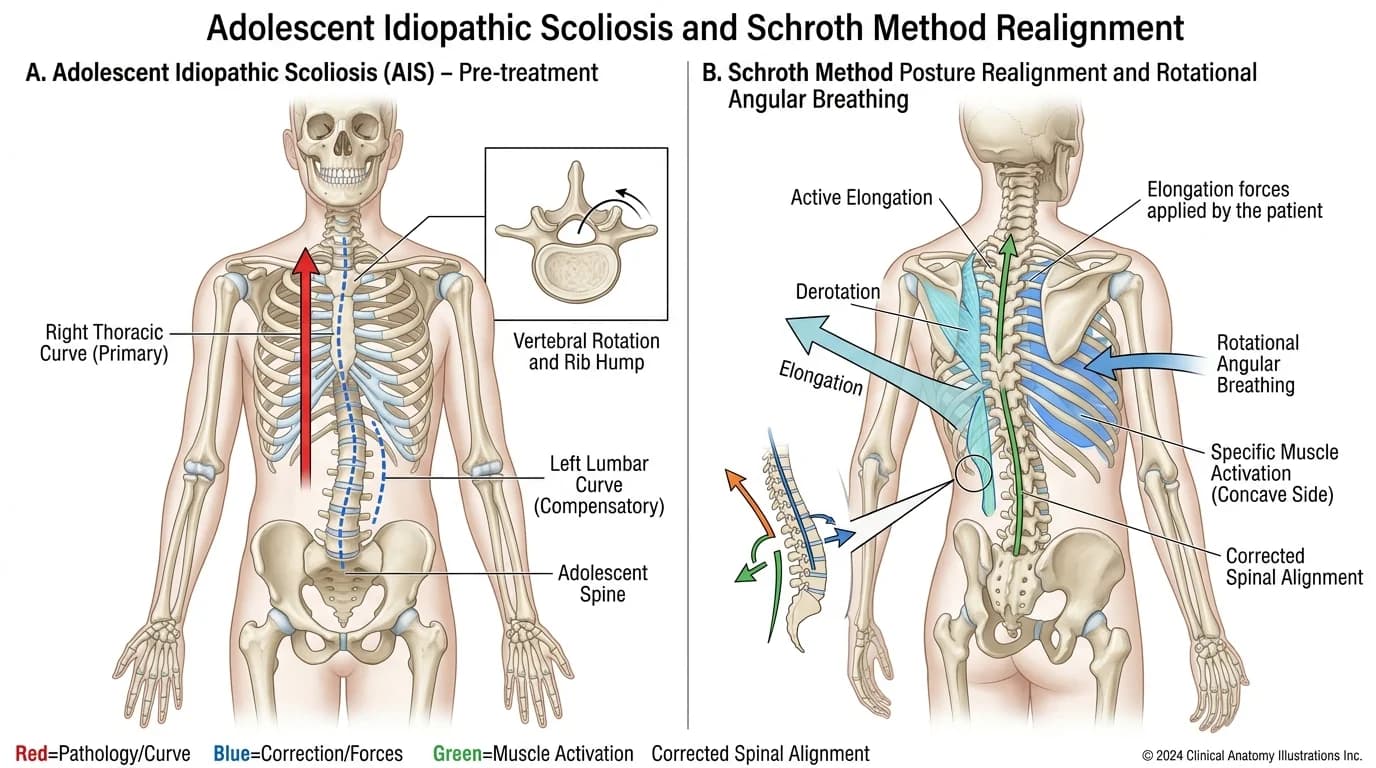
- Phase 3: Alternate Night Weaning (Month 7 to 9): Transition to wearing the brace every other night for 8 to 12 weeks; double daily Schroth or SEAS core stabilization exercises to maintain active muscular self-correction.
- Phase 4: Complete Cessation and 6-Month X-Ray Audit: Discontinue the brace 100%; obtain a standing out-of-brace radiograph 6 months after full cessation to confirm final permanent curve stability in skeletal adulthood.
Frequently Asked Questions
How do doctors know when a teenager can stop wearing a scoliosis brace?
Doctors look for four green lights: the growth plates on the hip X-ray are fully closed (Risser 4 or 5), the teenager has had her period for at least two full years, longitudinal height has stopped growing for six months, and hand X-rays show mature bones.
What happens if you stop wearing a scoliosis brace cold turkey?
Stopping cold turkey is dangerous because your back muscles are not used to holding your spine up against gravity all day without the plastic support. The spine can suddenly slump and lose several degrees of correction (curve rebound).
What is the best way to wean off a back brace gradually?
Weaning takes 6 to 12 months. You go from wearing the brace 20 hours a day down to 16 hours, then just at night while sleeping, then every other night, and finally zero hours, all while doing daily back exercises.
Related condition guides


Related recovery guides & articles
BookPhysio.in Editorial Team
The BookPhysio.in editorial team writes and maintains this content, checking it against reliable clinical sources. Content follows our medical review policy: general information only, and no page claims a clinical review until a named registered physiotherapist has signed it off.
Read our medical review policy