
Knee Osteoarthritis and the Indian Toilet: Deep Squatting Biomechanics, Modifications, and Physio Rehab
In short
Deep squatting on traditional Indian toilets generates 7-8 times body weight across arthritic knees. Discover clinical modifications and strengthening exercises.
In this guide (5 sections)
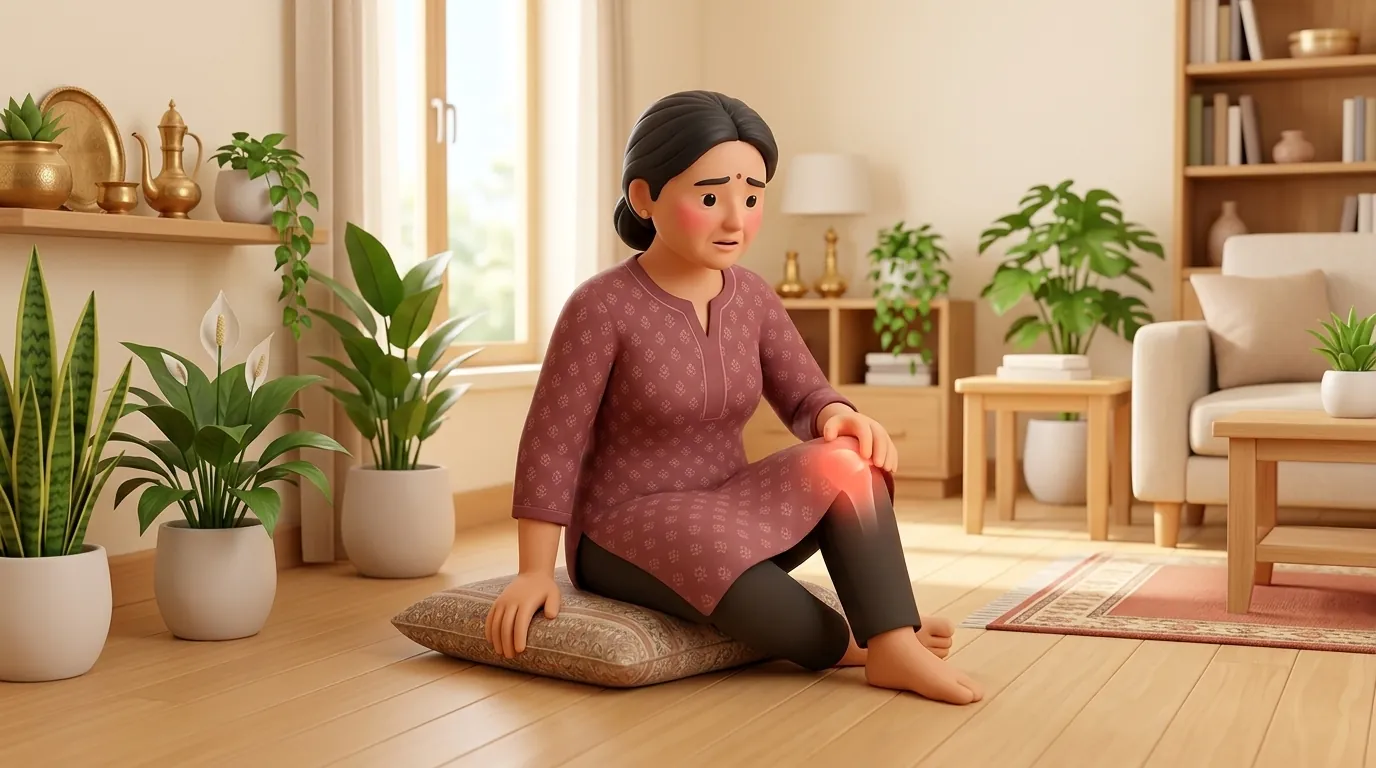
In millions of households across tier-1, tier-2, and rural India, the most dreaded daily physical ordeal for an individual suffering from knee osteoarthritis is not walking or climbing stairs; it is using a traditional Indian squatting toilet (desi commode). What was once an effortless, natural posture in youth becomes an agonizing anatomical trap in one's fifties and sixties: getting down into a deep squat provokes intense joint grinding, and rising back up feels mechanically impossible without desperately clutching onto door frames, washbasins, or water pipes.
While the squatting posture offers proven gastrointestinal and colorectal benefits (aligning the anorectal angle for effortless bowel evacuation), full deep knee flexion past 120 degrees generates astronomical mechanical stresses across the degenerative knee joint. For an arthritic knee with thinned articular cartilage and frayed menisci, repeated unassisted deep squatting accelerates cartilage destruction and precipitates acute inflammatory effusions. Specialized orthopaedic physiotherapy, domestic commode modifications, and targeted quadriceps rehabilitation preserve dignity and joint longevity.
1. Biomechanics: Patellofemoral and Tibiofemoral Compressive Forces in Deep Squatting
The human knee joint operates as a modified hinge, but its contact mechanics change drastically throughout the arc of flexion. In standing (0 degrees), the patella rests loosely in the supratrochlear pouch with minimal compressive stress. As the knee flexes during a squat, the patella engages deeply into the femoral trochlear groove, and the quadriceps tendon wraps tightly around the anterior distal femur.
In a full Indian toilet squat (requiring 130 to 155 degrees of acute knee flexion), the lever arm of the body weight shifts far behind the knee axis. To prevent the body from collapsing, the quadriceps mechanism must generate tremendous contractile force. Biomechanical kinematic studies confirm that patellofemoral joint reaction forces (PFJRF) spike to a staggering 7.0 to 8.5 times body weight, while tibiofemoral compressive loads reach 4.5 to 5.5 times body weight.
In a healthy young joint, thick viscoelastic hyaline cartilage and intact menisci absorb and dissipate these massive loads. In an osteoarthritic knee, however, articular cartilage is denuded, exposing subchondral bone. Furthermore, acute knee hyperflexion squeezes the posterior horns of the medial and lateral menisci backward like an orange seed pinched between fingers, causing painful meniscal extrusion, subchondral bone bruising, and micro-fractures.
| Daily Activity | Knee Flexion Arc | Patellofemoral Peak Load Multiple | Clinical Joint Impact in Osteoarthritis |
|---|---|---|---|
| Level Ground Walking | 0 to 65 degrees (at toe-off) | 1.5 to 2.0 times body weight | Well tolerated; stimulates synovial fluid circulation and nourishment |
| Climbing Standard Stairs | 85 to 105 degrees | 3.5 to 4.0 times body weight | Moderate stress; provokes anterior knee aching if quadriceps are weak |
| Western Commode Sitting | 85 to 95 degrees | 2.5 to 3.0 times body weight | Safe for moderate-to-severe OA; manageable sit-to-stand transition |
| Traditional Indian Squatting | 130 to 155 degrees (full deep squat) | 7.0 to 8.5 times body weight | Severe destructive stress; pinches posterior menisci and crushes cartilage |
2. Indian Domestic Realities: Cultural Hygiene Beliefs and Rental Constraints
The transition from an Indian squat toilet to a Western commode is fraught with deep-seated cultural, psychological, and financial hurdles. Many traditional Indian seniors possess an intense aversion to Western commodes, viewing them as unhygienic due to direct skin contact with the toilet seat, or believing that sitting upright leads to incomplete evacuation and chronic constipation.
Furthermore, millions of families live in rented apartments or ancestral joint-family houses where landlords forbid structural plumbing alterations or where tearing up concrete floor slabs to install a Western porcelain commode is financially prohibitive. In these bathrooms, slippery tile surfaces around the floor pan, wet footprints from bathing, and the absence of any wall rails turn every toilet visit into a high-risk fall event.
Clinical physiotherapy bridges this gap with practical, non-destructive domestic modifications: portable bedside commode chairs, over-the-pan metal toilet frames, and the "Squatty Potty" physiological compromise that preserves healthy defecation dynamics without crushing arthritic knees.
3. Three-Phase Quadriceps Strengthening and Toilet Transition Protocol
Three-Phase Knee Preservation and Toilet Transfer Protocol
Objective: Strengthen the vastus medialis oblique (VMO), master safe partial sit-to-stand transfers, and implement domestic commode adaptations.
- 1Phase 1 (Non-Destructive Domestic Bathroom Modifications - Day 1): If your home has only an Indian toilet pan, install an over-toilet portable commode chair (a rust-proof aluminum frame with a plastic toilet seat and splash guard) placed directly over the existing squatting pan. This instantly converts the floor pan into a 90-degree Western-height seat without plumbing work. Mount heavy-duty screw-in grab bars on the wall at a 45-degree angle beside the toilet to enable safe arm-assisted sit-to-stand transitions.
- 2Phase 2 (The Western Commode + Footstool Compromise - Daily): If using a Western commode, place a small 15 to 20 centimetre footstool (or wooden stool) under your feet while sitting. Raising your knees above your hips flexes the hips to 35 degrees, relaxing the puborectalis muscle and straightening the anorectal canal for effortless evacuation: achieving all the digestive benefits of squatting while keeping knee joints comfortably supported at 90 degrees.
- 3Phase 3 (Targeted Quadriceps and VMO Strength Rebuilding - 4 Days Weekly): 1. Isometric Quad Sets: lie on your back with a rolled towel under your knee; press the back of your knee firmly into the towel, tensing your front thigh for 6 seconds; repeat 10 times. 2. Seated Terminal Knee Extension: sit tall in a chair, straighten one knee fully until the leg is horizontal, hold for 3 seconds, lower slowly. 3. Chair Mini-Squats: stand in front of a dining chair, lower your hips halfway down toward the seat (bending knees to only 60 degrees), then push through your heels to stand back up.
- 4Transfer Technique Rule: When standing up from any toilet seat, never push down through your knees. Slide your feet back until your heels are firmly grounded, lean your chest forward over your knees ("nose over toes"), and push down firmly through your armrests or wall grab bars.
4. Critical Red Flags: Recognizing When Knee Degeneration Requires Surgical Review
While conservative physiotherapy and lifestyle modifications provide lasting relief for mild to moderate knee osteoarthritis, advanced joint structural failure warrants orthopaedic joint replacement consultation. Seek specialist surgical evaluation if you experience severe resting knee pain that wakes you from sleep every night despite medications, progressive knee deformity where your legs have bowed severely inward (severe genu varum / "bandy legs") accompanied by lateral joint instability, complete inability to walk more than 50 to 100 meters without stopping due to agonizing pain, or mechanical locking where a torn meniscus fragment physically wedges inside the joint space, preventing the leg from straightening.
Frequently Asked Questions
Why does squatting on an Indian toilet cause severe pain inside the back of my knee?
Deep squatting forces the knee into extreme flexion (130 to 150 degrees). In this position, the posterior horn of the medial meniscus is compressed with immense force between the rounded femoral condyle and the flat tibial plateau, pinching degenerated cartilage and inflamed synovial plicae.
Can I continue using an Indian toilet if my doctor diagnosed Grade 1 or 2 knee osteoarthritis?
In early-stage osteoarthritis, occasional squatting is possible if you possess excellent quad strength and zero pain. However, continuing daily unassisted deep squatting accelerates joint wear and tear. It is strongly advised to transition to a modified raised commode to preserve your remaining articular cartilage for decades to come.
How does using a footstool with a Western commode simulate natural squatting?
Placing your feet on a 15 to 20 cm footstool while sitting on a Western toilet flexes your hips to roughly 35 degrees. This reproduces the natural anorectal angle of squatting, allowing the puborectalis muscle to fully relax for smooth bowel evacuation while keeping knee flexion at a joint-friendly 90 degrees.
Are portable commode chairs sturdy enough for heavy Indian adults?
Yes. High-quality medical-grade commode chairs are constructed from reinforced steel or heavy-duty powder-coated aluminum, with weight capacities ranging from 120 to 180 kilograms. They feature non-skid rubber feet that grip wet bathroom floors securely.
How do I book a home assessment for knee osteoarthritis through BookPhysio.in?
BookPhysio.in connects patients across major Indian cities with verified orthopaedic physiotherapists who evaluate knee joint kinematics and conduct home ergonomic audits. Transparent fees range from ₹400 to ₹1,500 in clinic and ₹600 to ₹2,000 for home visits, with direct payment to your clinician and zero platform commission.
Related condition guides

BookPhysio.in Editorial Team
The BookPhysio.in editorial team writes and maintains this content, checking it against reliable clinical sources. Content follows our medical review policy: general information only, and no page claims a clinical review until a named registered physiotherapist has signed it off.
Read our medical review policy