
Lateral Epicondylalgia (Tennis Elbow): The Tyler Twist, Cozen's Test and Eccentric Loading
In short
Tennis elbow affects desk workers and athletes alike. Learn Extensor Carpi Radialis Brevis pathology, the Tyler Twist with resistance bars, and eccentric loading progressions.
In this guide (5 sections)
Patho-Anatomy of Lateral Epicondylalgia
Lateral epicondylalgia, universally known as 'Tennis Elbow', is an overuse tendinopathy affecting the common extensor origin on the lateral epicondyle of the humerus.
While historically termed 'epicondylitis', landmark histological studies by Nirschl demonstrated an absence of acute inflammatory cells. Instead, the condition represents angiofibroblastic tendinosis: collagen fiber breakdown, tenocyte hypercellularity, and disorganized vascular hyperplasia.
The primary anatomical culprit is the Extensor Carpi Radialis Brevis (ECRB) tendon, which undergoes repetitive microtrauma and abrasion against the lateral edge of the capitellum during combined wrist extension and gripping.
Clinical Examination Cluster: Cozen's, Mill's and Maudsley's Tests
Physical examination identifies localized tenderness directly over the ECRB origin (1 to 2 cm distal to the lateral epicondyle) and reproduces pain under resisted wrist extension.
| Clinical Special Test | Examination Technique | Positive Test Finding | Target Anatomical Structure | |
|---|---|---|---|---|
| 1. Cozen's Test | Pronate forearm, make fist, radially deviate and actively extend wrist against examiner resistance | Severe sharp pain reproduced at lateral epicondyle | Confirms ECRB contractile tendon pathology. | |
| 2. Mill's Test | Passively pronate forearm, fully flex wrist and fingers, and extend elbow fully | Sharp pain along lateral epicondyle as tissues stretch | Confirms mechanical tensile intolerance of extensor origin. | |
| 3. Maudsley's Test | Resist active extension of the middle finger (3rd digit) distal to PIP joint | Localized pain at lateral epicondyle | Stresses extensor digitorum communis and ECRB tendon slip. | |
| 4. Grip Dynamometry | Measure maximum grip force with elbow extended vs flexed to 90 degrees | Marked grip strength deficit with extended elbow due to pain | Standardized baseline metric for tracking functional recovery. |
The Tyler Twist Protocol Using a Resistance Bar
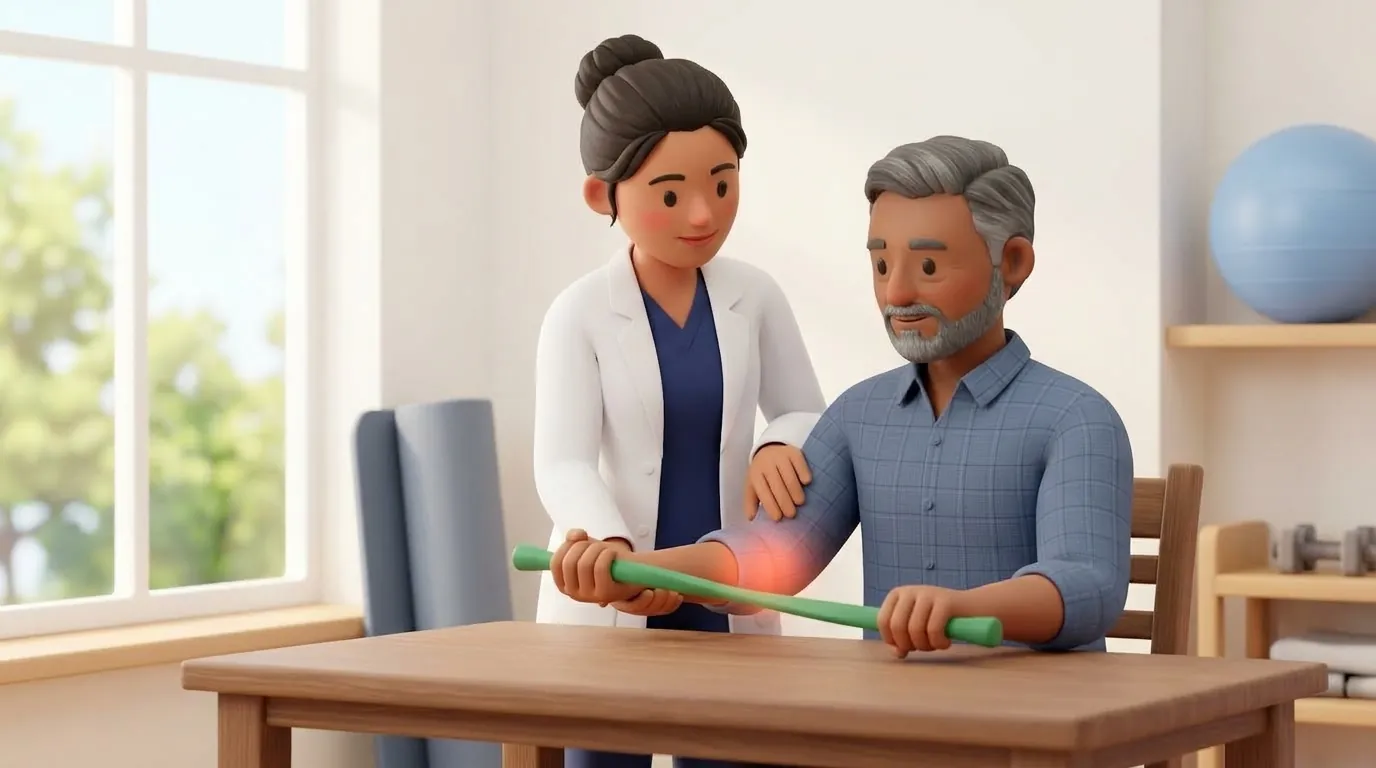
Developed by Timothy Tyler and colleagues, the 'Tyler Twist' utilizes a flexible rubber resistance bar (such as a TheraBand FlexBar) to isolate eccentric loading of the ECRB without stressing the concentric phase.
Clinical trials demonstrate that adding the Tyler Twist to standard care produces marked improvements in pain and strength within 6 to 8 weeks.
- Step 1: Grasping the Bar: Hold the rubber bar vertically in front of you with the painful arm, wrist fully extended (bent back).
- Step 2: Twisting with Sound Hand: Grasp the top of the bar with the healthy sound hand, palm facing away, and twist the bar into flexion.
- Step 3: Bringing Arms Forward: Extend both arms straight out in front of the chest while maintaining the twisted torque on the bar.
- Step 4: The Controlled Eccentric Release: Slowly release the twist using only the painful hand, allowing the wrist to move from full extension into full flexion over 3 to 4 seconds.
- Prescribed Dosing: Perform 3 sets of 15 repetitions once daily, 5 days per week. Advance to higher resistance bar colors as pain diminishes.
Counterforce Bracing and Indian IT Ergonomics
In India, over 60 percent of tennis elbow presentations occur in non-athletes: IT software professionals with prolonged mouse gripping, homemakers rolling chapatis, and manual mechanics.
Applying a counterforce elbow strap (placed 2 to 3 cm distal to the epicondyle over the forearm muscle belly) acts as a pseudo-origin, dissipating gripping forces away from the damaged enthesis.
Physiotherapists prescribe vertical ergonomic mice and forearm-supported keyboard trays.
Frequently Asked Questions
What is the PRTEE score?
The Patient-Rated Tennis Elbow Evaluation (PRTEE) is a 15-item questionnaire scoring elbow pain and functional disability across daily tasks from 0 to 100, serving as the gold standard outcome measure.
Why do cortisone injections make tennis elbow worse in the long run?
Cortisone provides rapid pain relief for 4 to 8 weeks, but high-quality clinical trials show that by 6 to 12 months, patients receiving cortisone have significantly higher recurrence rates and worse tendon degeneration than those treated with exercise.
How long does tennis elbow take to heal completely?
With consistent eccentric loading (the Tyler Twist) and ergonomic modifications, most patients achieve substantial pain relief within 8 to 12 weeks, with full tendon remodeling taking 6 to 12 months.
Related condition guides

Related recovery guides & articles
BookPhysio.in Editorial Team
The BookPhysio.in editorial team writes and maintains this content, checking it against reliable clinical sources. Content follows our medical review policy: general information only, and no page claims a clinical review until a named registered physiotherapist has signed it off.
Read our medical review policy