
Medial Epicondylalgia (Golfer's Elbow): Reverse Tyler Twist, Pronator Teres and Ulnar Nerve Care
In short
Medial elbow pain affects golfers, throwers, and manual workers. Learn flexor-pronator tendon pathology, the Reverse Tyler Twist, ulnar nerve screening, and loading protocols.
In this guide (5 sections)
Patho-Anatomy of Medial Epicondylalgia
Medial epicondylalgia, commonly known as 'Golfer's Elbow', is an overuse tendinopathy affecting the common flexor-pronator tendon origin on the medial epicondyle of the humerus.
The primary tendon structures involved are the Pronator Teres and the Flexor Carpi Radialis (FCR), which undergo degenerative angiofibroblastic microtrauma due to repetitive forceful wrist flexion and forearm pronation.
Although less common than tennis elbow (occurring at a 1:5 ratio), medial epicondylalgia is frequently more challenging to rehabilitate due to its intimate proximity to the ulnar nerve traversing the retrocondylar cubital tunnel.
Differentiating Tendon Pain from Ulnar Neuropathy
Up to 20 percent of patients with medial elbow pain present with coexisting ulnar nerve neuropathy (cubital tunnel syndrome) due to traction or friction.
| Diagnostic Feature | Medial Epicondylalgia (Golfer's Elbow) | Cubital Tunnel Syndrome (Ulnar Nerve) | Clinical Action | |
|---|---|---|---|---|
| 1. Site of Tenderness | Point tenderness directly over medial epicondyle / tendon | Tenderness in the cubital tunnel groove behind medial epicondyle | Palpate anterior vs posterior to epicondyle. | |
| 2. Neurological Deficits | STRICTLY ABSENT; normal sensation in all digits | Paresthesias, numbness in small finger and ulnar half of ring finger | Sensory symptoms confirm ulnar nerve involvement. | |
| 3. Provocative Tests | Resisted wrist flexion and resisted forearm pronation reproduce pain | Positive Tinel sign tapping cubital tunnel; elbow flexion test | Separate tendon contractile testing from nerve provocation. | |
| 4. Grip Impairment | Painful weak grip due to tendon strain | Weakness of intrinsic hand muscles; Froment sign positive | Screen intrinsic hand muscle strength. |
The Reverse Tyler Twist Protocol
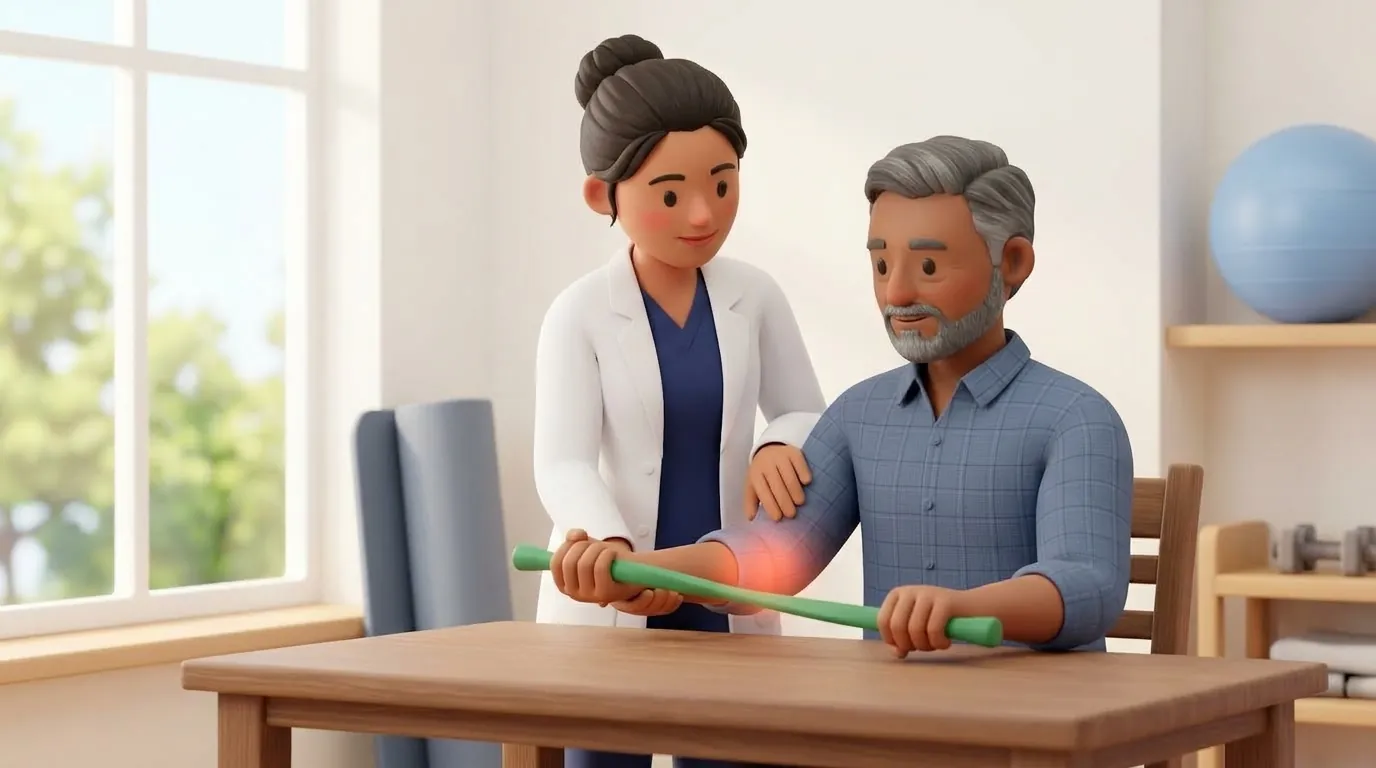
The 'Reverse Tyler Twist' adapts flexible rubber bar technology to isolate eccentric loading of the wrist flexors and pronator teres without concentric strain.
- Step 1: Grasping the Bar: Hold the rubber bar vertically in front of you with the painful arm, wrist fully flexed (curled in), elbow bent to 90 degrees.
- Step 2: Twisting with Sound Hand: Grasp the upper end of the bar with the healthy sound hand, palm facing toward you, and twist the bar backward.
- Step 3: Extending Both Arms: Extend both arms straight forward at shoulder height, maintaining tension on the twisted bar.
- Step 4: Slow Eccentric Release: Slowly allow the painful wrist to be pulled from full flexion into full extension over 3 to 4 seconds against the resistance of the untwisting bar.
- Prescribed Dosing: Perform 3 sets of 15 repetitions once daily, 5 days per week for 6 to 8 weeks.
Manual Work and Domestic Chores in India
In India, golfer's elbow is common among cooks tossing heavy woks (kadai), plumbers turning wrenches, and gym-goers performing heavy chin-ups with poor grip mechanics.
Physiotherapists prescribe neutral wrist splinting during heavy chores, teach open-palm lifting techniques, and incorporate ulnar nerve neural gliding exercises.
Frequently Asked Questions
How does golfer's elbow differ from tennis elbow?
Tennis elbow affects the lateral (outer) elbow and involves wrist extensor tendons. Golfer's elbow affects the medial (inner) elbow and involves wrist flexor and forearm pronator tendons.
Can I continue doing pull-ups with golfer's elbow?
Standard supinated chin-ups place extreme tensile strain on the medial epicondyle. Transition to neutral-grip pull-ups (palms facing each other) or use gymnastic rings that rotate freely with movement.
What is an ulnar nerve glide exercise?
Ulnar nerve glides gently mobilize the nerve along its track: bring the hand into an 'OK' sign, invert the hand, and bring it up to the eye like a monocle, feeling a gentle stretch without triggering numbness.
Related condition guides

Related recovery guides & articles
BookPhysio.in Editorial Team
The BookPhysio.in editorial team writes and maintains this content, checking it against reliable clinical sources. Content follows our medical review policy: general information only, and no page claims a clinical review until a named registered physiotherapist has signed it off.
Read our medical review policy