
Lumbar Spinal Stenosis in Older Adults: Flexion Biased Rehabilitation and Walking Tolerances
In short
Neurogenic claudication from lumbar spinal stenosis limits walking distance in older adults. Learn why flexion provides immediate relief, cycling protocols, and core decompression exercises.

In this guide (5 sections)
Understanding Lumbar Spinal Stenosis and Neurogenic Claudication
Lumbar spinal stenosis (LSS) is characterized by narrowing of the central spinal canal, lateral recesses, or neural foramina, most frequently at L3-L4 and L4-L5 levels in adults over 60.
The hallmark clinical manifestation is neurogenic claudication: cramping, aching, heaviness, numbness, and tingling in the buttocks, thighs, and calves that worsens with upright standing and walking, and resolves rapidly when sitting or bending forward.
The patho-mechanism is posture-dependent ischemia: standing and lumbar lordosis decrease spinal canal cross-sectional area by up to 20 percent, pinching the cauda equina microvasculature. Lumbar flexion widens the central canal and foramina, restoring arterial perfusion and venous outflow.
Differential Diagnosis: Neurogenic vs Vascular Claudication
Distinguishing neurogenic claudication from peripheral artery disease (vascular claudication) is essential for accurate clinical triage.
| Diagnostic Feature | Neurogenic Claudication (Spinal Stenosis) | Vascular Claudication (PAD) | Physiological Differentiation | |
|---|---|---|---|---|
| 1. Posture Dependency | Relief when bending forward or sitting down | Relief when stopping walking (regardless of standing or sitting) | Spinal canal dimensions expand during flexion. | |
| 2. Walking Uphill vs Downhill | Tolerates walking uphill (body naturally flexes) | Equally painful or worse uphill due to high metabolic demand | Flexion posture during incline gait decompresses nerve roots. | |
| 3. Stationary Cycling | Tolerates prolonged cycling without leg cramping | Quickly triggers ischemic calf cramping during cycling | Trunk flexion on bicycle opens central canal. | |
| 4. Peripheral Pulses | Dorsalis pedis and posterior tibial pulses normal | Diminished or absent peripheral pedal pulses | Arterial blood flow to feet is intact in spinal stenosis. | |
| 5. Shopping Cart Sign | Marked walking distance improvement when leaning on trolley | No change in walking distance with trolley | Leaning forward widens foramina and central spinal canal. |
The Flexion-Biased Rehabilitation Protocol
Unlike acute disc herniations which often benefit from McKenzie extension protocols, spinal stenosis is exacerbated by lumbar extension. The rehabilitation program emphasizes flexion-biased spinal decompression and pelvic mobility.
Stationary cycling is utilized as the primary cardiovascular conditioning modality, allowing patients to maintain aerobic endurance and leg muscle perfusion without precipitating neurogenic symptoms.
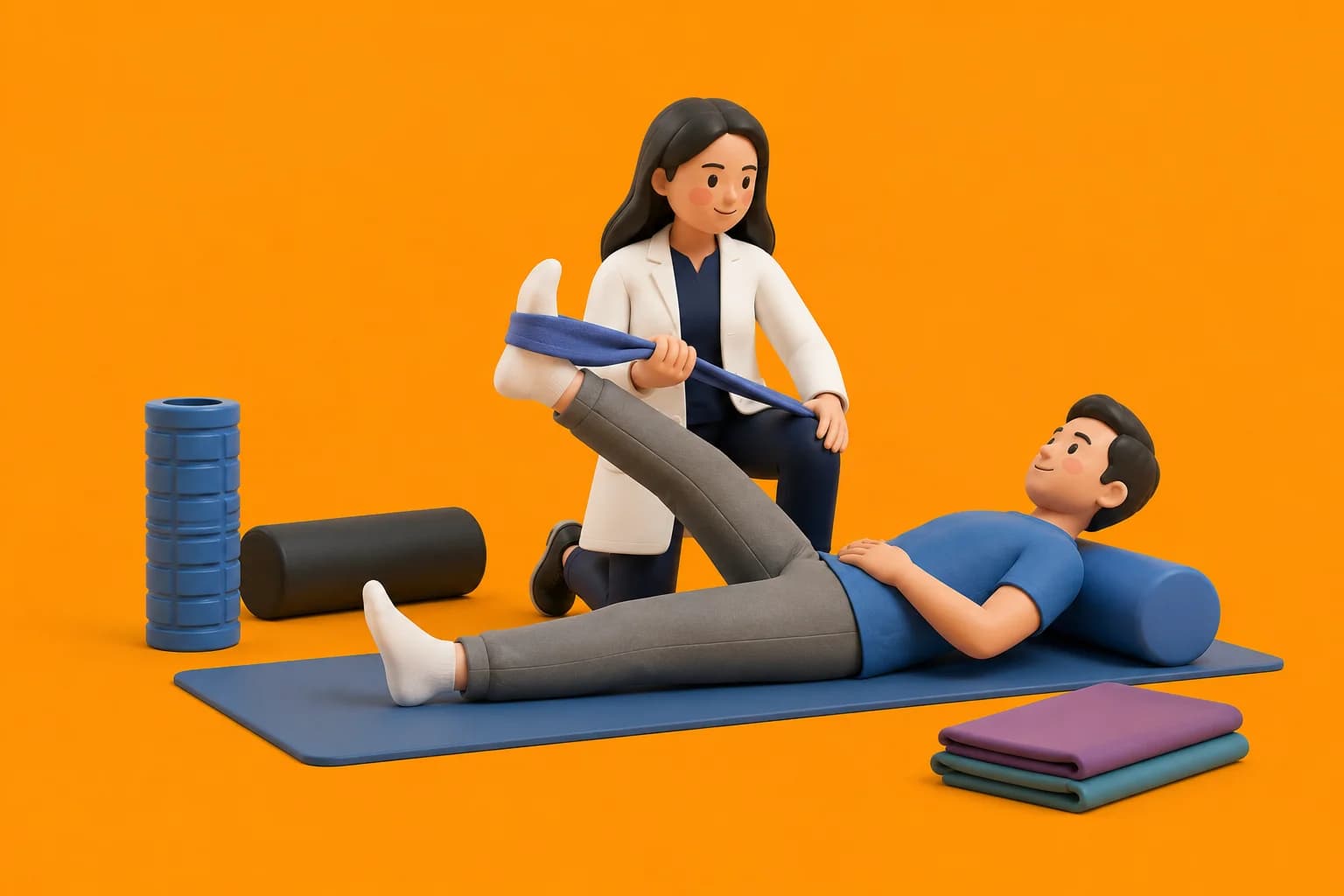
- Double Knee-to-Chest Lumbar Flexion: Supine gentle knees-to-chest hold for 30 seconds, 3 to 5 repetitions, opening the intervertebral foramina.
- Posterior Pelvic Tilts: Flattening the lumbar lordosis against the bed or mat to engage transverse abdominis and reduce compressive facet loading.
- Hip Flexor (Psoas) Lengthening: Stretching tight iliopsoas muscles to prevent excessive anterior pelvic tilt and compensatory lumbar lordosis during standing.
- Interval Walking Protocol: Prescribing structured walking bouts below the symptom threshold (for example, walking 4 minutes, sitting for 1 minute) to extend total daily distance without triggering severe ischemic pain.
Adapting Indian Home and Daily Living Routines
In Indian urban environments, older adults with stenosis struggle during morning temple visits (standing in lines) and park walks.
Physiotherapists teach patients to use sitting benches for short 60-second recovery breaks, recommend supportive footwear, and introduce seated adaptations for prayer and social gatherings.
Frequently Asked Questions
Why does leaning on a shopping cart or walker help spinal stenosis?
Leaning forward flexes the lumbar spine, which stretches the ligamentum flavum and expands the cross-sectional area of the spinal canal by 15 to 20 percent, relieving venous congestion around compressed nerve roots.
Should older adults with stenosis do back extension exercises?
No. Lumbar hyperextension (such as prone press-ups or cobra poses) narrows the spinal canal and facet joints, worsening leg numbness and cramping. Flexion-biased movements are favored.
When is surgery necessary for lumbar stenosis?
Surgical decompression (laminectomy) is indicated when walking tolerance drops below 5 to 10 minutes despite 3 months of physiotherapy, or when progressive motor weakness (foot drop) or cauda equina syndrome develops.

Related recovery guides & articles
BookPhysio.in Editorial Team
The BookPhysio.in editorial team writes and maintains this content, checking it against reliable clinical sources. Content follows our medical review policy: general information only, and no page claims a clinical review until a named registered physiotherapist has signed it off.
Read our medical review policy