
Multilingual Clinical Communication in Indian Physiotherapy OPDs: Explaining Biomechanics Without Jargon
In short
Explaining disc bulges, osteoarthritis, and tendon mechanics across multilingual Indian patient populations requires ditching medical jargon and using culturally resonant, empowering analogies. Here is the clinician communication handbook.
In this guide (5 sections)
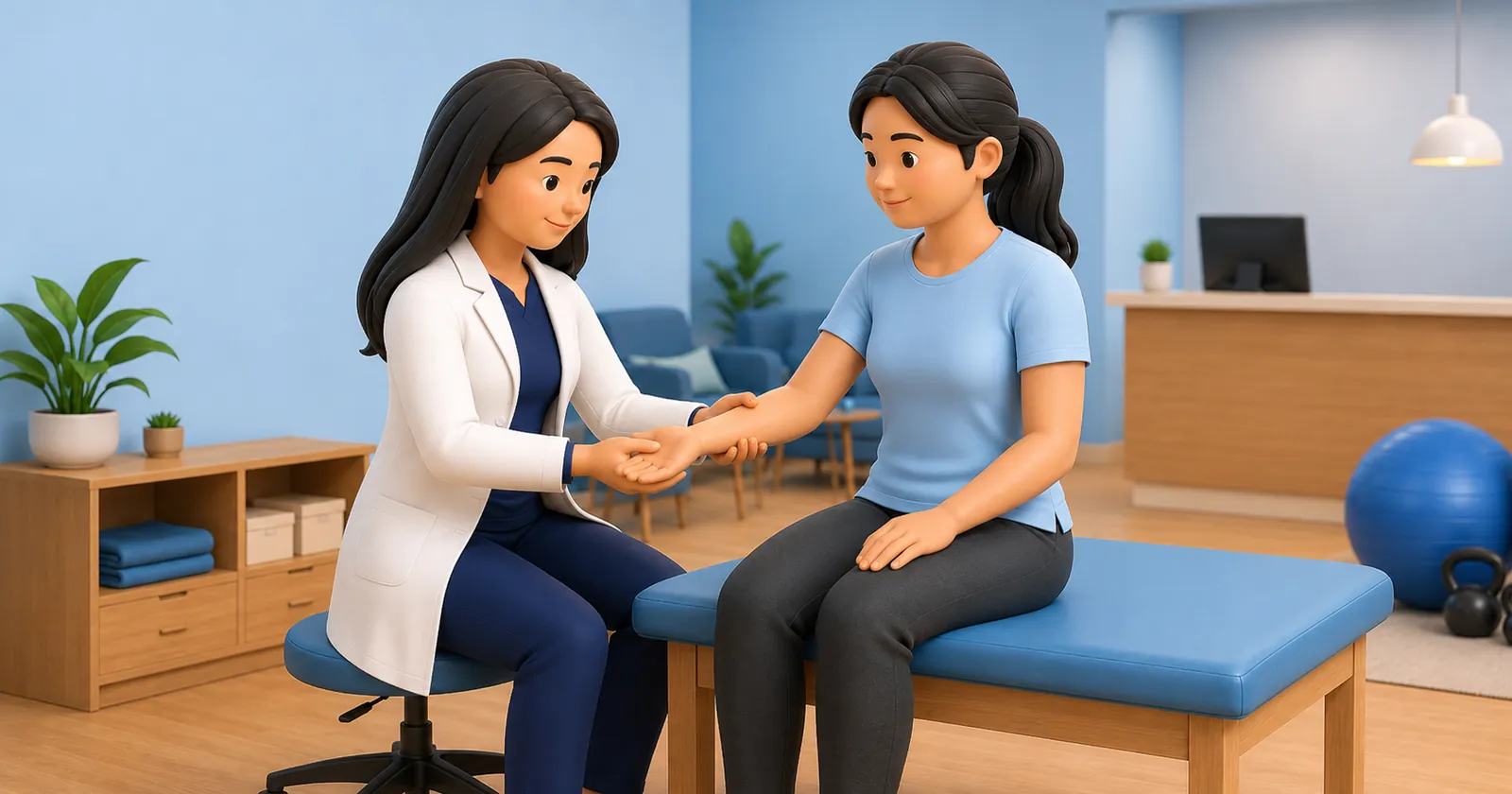
Practicing physiotherapy in India requires navigating exceptional linguistic and cultural diversity. In metropolitan cities like Mumbai, Delhi, Bengaluru, Hyderabad, and Kolkata, an outpatient physiotherapist routinely consults patients speaking Hindi, Marathi, Tamil, Telugu, Kannada, Bengali, Gujarati, Punjabi, or Indian English in a single afternoon. Communicating complex biomechanical concepts like disc hydration, rotator cuff tendinopathy, or neuroplasticity to patients who may have limited English fluency or low health literacy is one of the greatest clinical arts in modern practice.
When communication fails, clinical outcomes collapse. When patients hear frightening medical jargon like "disc degeneration", "bone-on-bone", "cartilage erosion", or "nerve impingement", they experience catastrophic fear-avoidance. They stop walking, avoid bending, demand complete bed rest, and resign themselves to permanent disability. By translating modern biomechanics and pain neuroscience into culturally resonant, reassuring, multilingual analogies, physiotherapists can dismantle fear and empower patients to engage in active rehabilitation.
1. De-Medicalizing Diagnostic Terminology: From Threat to Adaptation
The words clinicians use can either heal or harm. Frightening language (nocebo) induces measurable sympathetic nervous system activation, increases pain sensitivity, and breeds chronic disability. In Indian OPDs, patients frequently arrive clutching MRI reports, terrified by radiographic findings that are actually normal signs of healthy human ageing.
Consider the critical difference between threatening clinical jargon and empowering, evidence-based language across common musculoskeletal conditions:
- Replacing "Degeneration" and "Wear and Tear": Telling a 55-year-old patient that their spine has "severe degenerative disc disease" makes them picture crumbling bones. Instead, explain: "Just as getting grey hair or wrinkles on our skin is a completely natural sign of living a full life, these changes in your spine are normal age-related adaptations. Your spine is strong, robust, and capable of healing."
- Reframing "Bone on Bone" in Knee Osteoarthritis: Telling an Indian mother that her knee joint is "bone on bone" triggers instant fear of walking. In reality, complete absence of joint space is extraordinarily rare. Reframe: "Your joint cartilage is like a seasoned sponge that has lost some of its fluid. When we perform gentle strengthening exercises, we pump fresh lubricating fluid back into the joint, restoring smooth, comfortable movement."
- De-escalating "Slipped Disc" and "Pinched Nerve": Patients believe a disc has physically fallen out of place and will shatter if they bend forward. Clarify: "Spinal discs are securely bonded to the vertebrae by tough, woven ligaments; they never slip out. Think of your disc as a tough shock-absorber tyre that is slightly swollen right now. With targeted movement, the swelling settles and the disc naturally desensitizes."
2. Culturally Resonant Indian Analogies for Complex Biomechanics
Abstract biomechanical terminology confuses patients. Grounding explanations in familiar Indian household objects, vehicles, and daily cultural experiences creates instant clinical comprehension.
| Biomechanical Concept | Traditional Medical Explanation | Indian Cultural Analogy Script | Regional Hindi / Hinglish Phrasing |
|---|---|---|---|
| Core Stability & Intra-Abdominal Pressure | Co-contraction of transversus abdominis, multifidus, and pelvic floor diaphragm | "Your abdominal core functions exactly like a pressure cooker (prestige cooker). When the lid and rubber gasket are sealed, pressure stabilizes safely. Our core exercises strengthen the rubber seal around your spine." | "Aapka pet aur kamar ek pressure cooker ki tarah hai. Jab andar se support mazboot hoga, toh reedh ki haddi par koi pressure nahi aayega." |
| Spinal Discs as Shock Absorbers | Intervertebral disc annulus fibrosus and nucleus pulposus hydrostatic shock absorption | "Your spinal discs are like the thick rubber shock-absorber bushes in an auto-rickshaw or motorbike. When you hit a pothole, the rubber compresses and bounces back. We are training your muscles to protect those rubber bushes." | "Jaise gaadi mein shocker aur rubber bush jhatka jhelte hain, waise hi aapki gaddi (disc) jhatka jhalti hai. Exercise se hum is shocker ko oiling kar rahe hain." |
| Tendon Loading & Heavy Slow Resistance | Achilles and patellar tendon tensile collagen cross-linking through mechanotransduction | "A tendon is like the thick jute rope used in a traditional village well. If you leave a rope wet and unused, it frays. When you pull loads smoothly and slowly through it, the rope fibres twist tighter and become unbreakable." | "Nass ya tendon ek rassi ki tarah hai. Dheere-dheere vajan uthane se yeh rassi aur mazboot hoti hai, tut-ti nahi." |
| Central Sensitization & Chronic Pain | Nociceptive hypersensitivity and altered central nervous system synaptic gain | "Your brain pain system is like a sensitive car burglar alarm. If the sensor is set too high, a passing cat or light breeze sets off the siren. Your joint is safe, but the alarm system is over-sensitive. We are turning down the volume." | "Aapke shareer ka pain alarm bohot sensitive ho gaya hai. Chot theek ho chuki hai, par alarm galti se baj raha hai. Hum exercise se alarm ko reset karenge." |
3. Navigating Traditional Family Beliefs: Malish, Rest, and Desi Ghee
In Indian households, family elders hold immense healthcare influence. A physiotherapist must navigate deeply held traditional beliefs regarding vigorous oil massage (malish), bone setters (pehelwans), absolute bed rest, and consuming excessive desi ghee for joint lubrication.
Compassionate De-escalation Protocol for Traditional Beliefs
Objective: Address traditional home remedies respectfully while establishing evidence-based active rehabilitation boundaries.
- 1Never mock or dismiss traditional family advice: "I deeply respect that your family wants the best for you, and traditional oil massage has provided relaxation in Indian homes for centuries."
- 2Clarify the biological boundary regarding deep tissue manipulation: "However, for an acute disc swelling or torn tendon, vigorous forceful pressing (malish) by an untrained person creates direct tissue trauma and worsens internal inflammation. Light gentle oil application on the surface is fine, but avoid deep forceful pressing."
- 3Address the "joint lubrication" myth regarding dietary fat: "Eating extra ghee or oil does not enter the knee joint capsule; it only adds body weight that places extra mechanical pressure on your knees. Knee cartilage creates its own natural lubricating fluid (synovial fluid) only when the joint bends and straightens through active exercise."
- 4Engage the family elder as a recovery partner: Invite the spouse or elder into the consulting room, demonstrate the gentle therapeutic exercises in front of them, and ask for their active support in reminding the patient to complete their daily exercise routine.
4. Non-Verbal, Visual, and Written Communication Best Practices
Words alone are rarely enough. Combine verbal communication with multimodal clinical tools: physical anatomical spine and knee models that patients can touch and manipulate, mirror feedback during exercise execution, and smartphone video recordings of the patient performing their exact home exercises with auditory cues in their native tongue.
Ensure all home exercise prescriptions feature clear illustrated line drawings with simple bilingual annotations (e.g., Hindi and English or Tamil and English). Explicitly specify numerical parameters: repetitions, sets, hold time in seconds, and rest intervals. Clear written guidance eliminates family ambiguity and drives superior adherence.
Frequently Asked Questions
How should a physiotherapist explain that an MRI disc bulge does not require surgery?
Use reassuring epidemiological data explained simply: "Scientific studies of thousands of healthy, pain-free Indian adults show that over 60% of people over age 35 have disc bulges on their MRI without ever feeling a single day of back pain. An MRI is a black-and-white picture; it does not tell us how strong your muscles are. The disc bulge is a normal sign of age, like grey hair. Our physical examination shows that your nerves are healthy, and targeted exercise therapy will resolve your pain without risky spinal surgery."
How can clinicians overcome the belief that resting in bed is necessary for back pain?
Explain the concept of tissue stagnation: "When you rest in bed for days, your back muscles rapidly lose strength, your spinal discs become dehydrated, and the joints become stiff like a rusted gate hinge. Movement is the natural lubricant for the human body. By performing gentle, controlled walking and therapeutic stretching, we pump fresh blood, oxygen, and nutrients into your back, speeding up your natural recovery."
What are the risks of using translation apps or family members as interpreters in clinical OPDs?
While bilingual family members are helpful for basic logistics, relying entirely on relatives to translate nuanced clinical history can lead to filtered or distorted information (e.g., omitting bladder symptoms due to embarrassment). Automated translation apps often misinterpret medical terminology. Clinicians should learn basic anatomical and directional keywords in the prominent state language of their practice, use visual anatomical models, and verify patient comprehension using the teach-back method (asking the patient to explain the exercise back in their own words).
How do you handle elderly patients who believe cracking their joints (popping) releases bad air (vayu)?
Acknowledge the cultural concept respectfully: "In Ayurveda, joint stiffness is often described as vayu or air imbalance. Scientifically, when a joint pops or clicks, it is simply tiny microscopic nitrogen gas bubbles shifting in the joint fluid, like popping bubble wrap. It is harmless, but forcibly cracking your neck or back multiple times a day stretches the ligaments unnecessarily. Active muscle strengthening is what genuinely stabilizes the joint."
How does BookPhysio.in facilitate clear clinician-patient communication across India?
BookPhysio.in allows physiotherapists to showcase their spoken languages directly on their public profile (e.g., Hindi, English, Marathi, Tamil, Bengali). Patients searching for physiotherapy can filter and choose practitioners who speak their native tongue, ensuring immediate comfort, clear diagnostic understanding, and mutual trust from the very first session. Clinicians maintain 100% autonomy with transparent per-session pricing and zero platform commissions.
Related condition guides
BookPhysio.in Editorial Team
The BookPhysio.in editorial team writes and maintains this content, checking it against reliable clinical sources. Content follows our medical review policy: general information only, and no page claims a clinical review until a named registered physiotherapist has signed it off.
Read our medical review policy