
The Schroth Muscle Cylinder: Lumbar Prominence Deflection and Psoas Activation Protocols
In short
The Schroth Muscle Cylinder exercise stabilizes lumbar scoliosis in side-lying by activating the quadratus lumborum and psoas to deflect convex lumbar vertebrae.
In this guide (4 sections)
Biomechanics of the Lumbar Prominence in 4-Curve Scoliosis
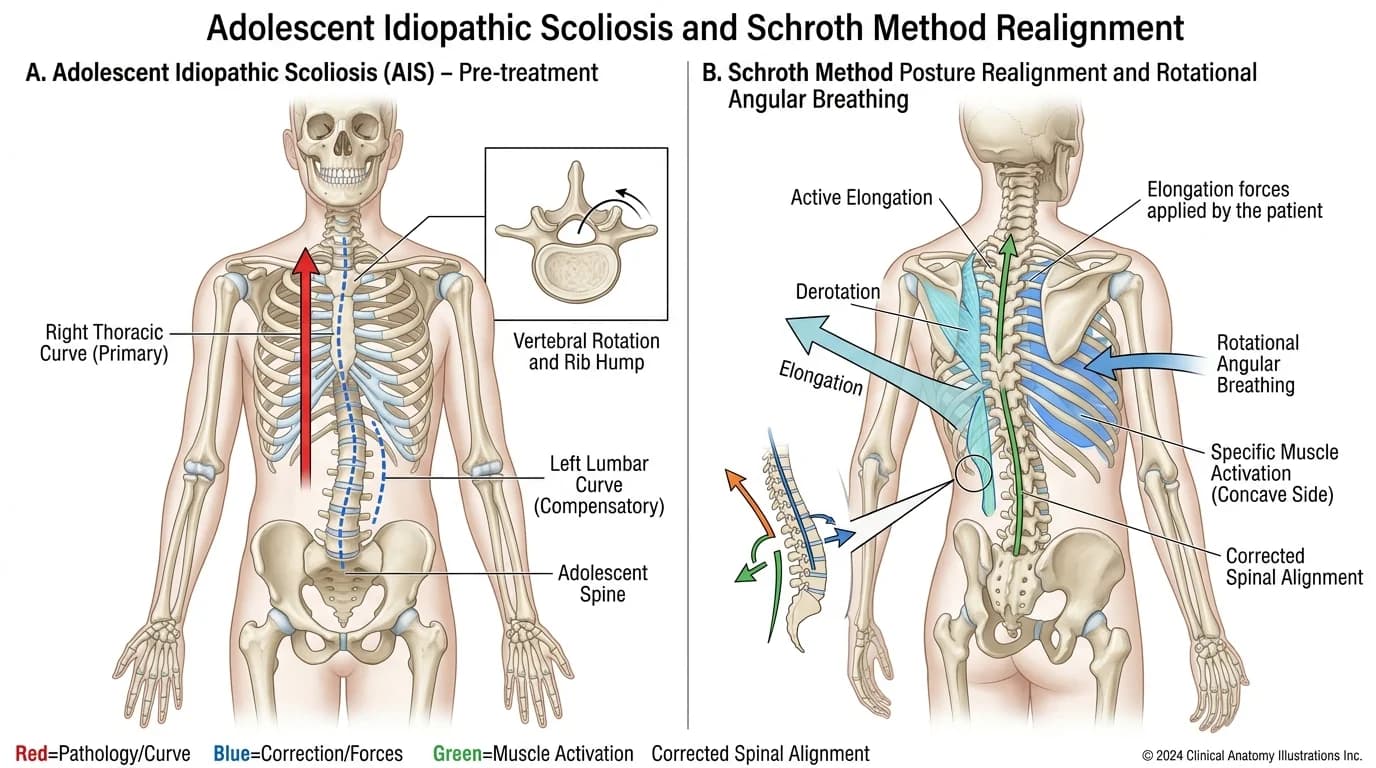
In a typical double major (4-curve) scoliosis pattern, the lumbar spine exhibits a pronounced lateral curvature (most commonly with convexity to the left) coupled with posterior axial rotation. This rotation projects the lumbar transverse processes and the overlying erector spinae musculature backward, creating a prominent dorsal 'lumbar muscle hump' on the convex side and a deep, hollow waist crease on the concave side.
The Schroth 'Muscle Cylinder' (Muskelzylinder) exercise is the premier corrective maneuver designed to de-rotate and deflect this lumbar deformity. Conducted in side-lying directly over the lumbar convexity, the exercise utilizes specialized positioning wedges and active lower-extremity lever arms to selectively activate deep stabilizing muscles, pushing the displaced lumbar vertebrae back toward the midline.
Biomechanical Setup and Corrective Force Couples
| Setup Component | Therapeutic Alignment | Biomechanical Mechanism | Patient Proprioceptive Cue | |
|---|---|---|---|---|
| Patient Posture | Side-lying directly ON the lumbar convex side | Uses gravity and floor reaction force to compress convexity | 'Lie down on your bulging lower back side' | |
| Wedge Bolster Placement | Firm rice bag / foam wedge placed under lumbar apex | Acts as an external mechanical fulcrum to deflect curve | 'Feel the wedge lifting your lower back curve straight' | |
| Top Leg Positioning | Extended straight in line with trunk; abducted 15-20 deg | Activates gluteus medius and ipsilateral quadratus lumborum | 'Push your top heel straight out like standing on a wall' | |
| Pelvic Derotation Action | Active anterior counter-rotation of the top iliac crest | Counters the posterior rotational torsion of the pelvis | 'Roll your top hip bone slightly forward and down' | |
| Rotational Breathing Focus | Inhale deeply into the upper concave waist hollow | Internal abdominal pressure fills the sunken waist crease | 'Breathe air directly into your hollow waist pocket' |
Standardized Clinical Prescription and Isometric Tension
- The 5x5 Deep Breathing Hold Protocol: Once aligned on the wedge with the top leg extended, instruct the patient to take 5 slow, deep rotational breaths, expanding the concave waist hollow on inhalation and maintaining isometric core tension on exhalation; repeat for 5 cycles.
- Axial Elongation Through Both Ends of Spine: Coach the patient to reach the crown of their head forward and push their bottom leg heel down; active axial elongation decompresses the intervertebral discs, facilitating easier lateral vertebral deflection.
- Avoiding Compensatory Thoracic Rib Flare: Ensure the patient keeps their lower rib cage relaxed and neutral; do not allow them to hyperextend the thoracic spine or flare the ribs during deep inspiration.
Frequently Asked Questions
What is the Schroth Muscle Cylinder exercise for scoliosis?
The Muscle Cylinder is a specialized Schroth exercise performed lying on your side on top of a firm wedge pillow. By lying on the bulging side of your lower back and extending your top leg, you activate deep core muscles that push the curved spine straight.
Why do you lie on a firm pillow or rice bag under your lower back?
The firm rice bag acts as a supportive pivot point (fulcrum). Gravity presses your body down over the bag, gently nudging the bulging spine bones inward toward the center line while you breathe.
Can this exercise help even out an uneven waist crease?
Yes! People with lower back scoliosis often have one deep, folded waist crease and one flat waist. The Muscle Cylinder exercise fills out the hollow, sunken side with targeted breathing and muscle activation, making your waist look symmetrical.
Related condition guides


Related recovery guides & articles
BookPhysio.in Editorial Team
The BookPhysio.in editorial team writes and maintains this content, checking it against reliable clinical sources. Content follows our medical review policy: general information only, and no page claims a clinical review until a named registered physiotherapist has signed it off.
Read our medical review policy