
Schroth Curve Classification: 3-Curve vs 4-Curve Patterns and Pelvic Counter-Shift
In short
Accurate differentiation between Schroth 3-curve (pelvis aligned with lumbar) and 4-curve (pelvis counter-deviated) patterns determines correct exercise correction.
In this guide (4 sections)
Biomechanical Concept of the Lehnert-Schroth Body Blocks
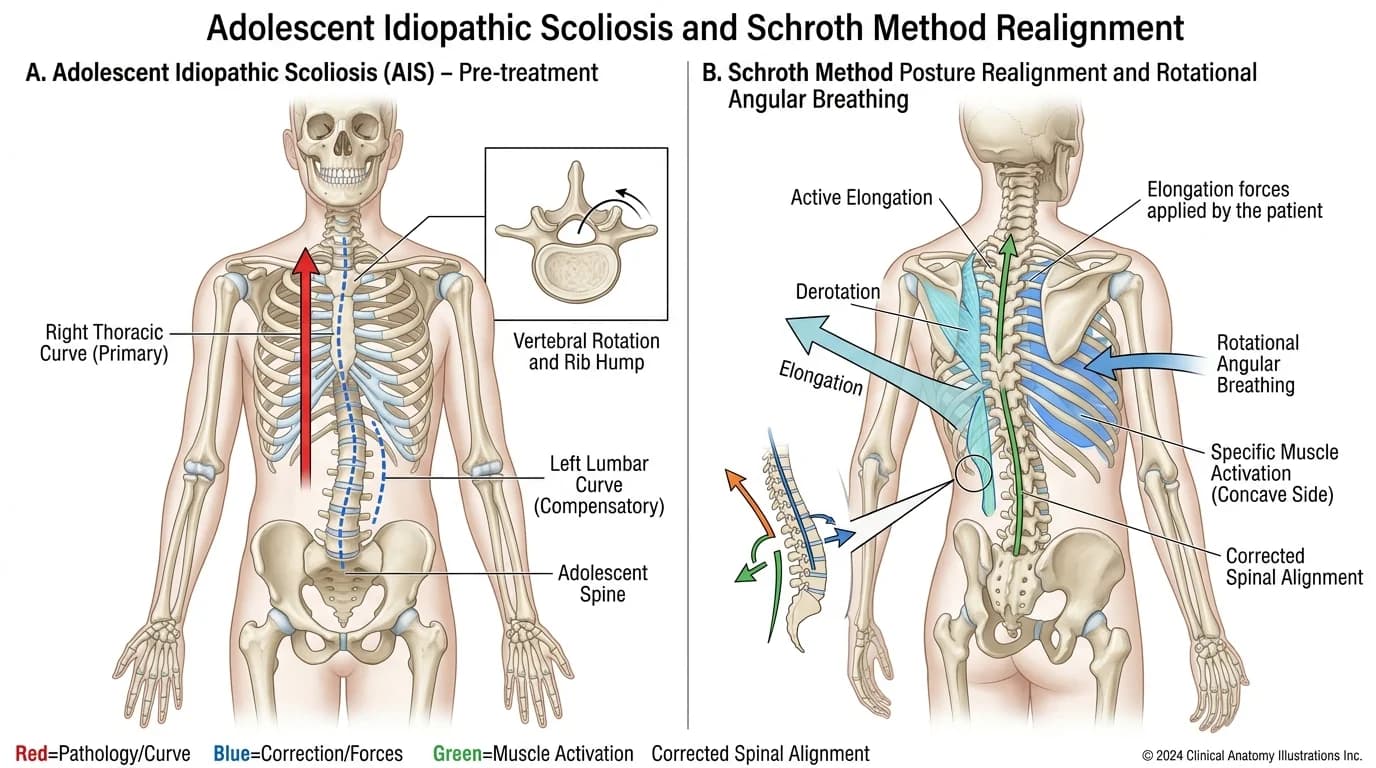
In the Schroth method, the human torso is conceptualized not as a continuous flexible rod, but as three or four superimposed geometric blocks: the Pelvic Block, the Lumbar Block, the Thoracic Block, and the Shoulder/Cervical Block. In a balanced, normal spine, these blocks sit directly stacked in gravity's center. In scoliosis, the blocks undergo coupled wedge-shaped displacement and axial rotation in opposing directions.
The defining clinical breakthrough in Schroth treatment is the distinction between a 3-Curve (3C) pattern and a 4-Curve (4C) pattern. Applying a 3-curve exercise protocol to a 4-curve patient pushes the pelvis in the wrong direction, severely exacerbating the lumbar curve and throwing the entire spine out of coronal balance.
Schroth 3-Curve (3C) vs 4-Curve (4C) Diagnostic Matrix
| Classification Feature | Schroth 3-Curve Pattern (3C) | Schroth 4-Curve Pattern (4C) | Clinical Consequence / Pitfall | |
|---|---|---|---|---|
| Dominant Curve Pattern | Major Thoracic curve (typically Right Thoracic) | Double Major S-curve (Right Thoracic + Left Lumbar) | Determines number of active spinal deformities | |
| Pelvic Block Behavior | Pelvis shifts in SAME direction as lumbar curve (part of lumbar block) | Pelvis shifts OPPOSITE to lumbar curve (acts as independent 4th block) | vital diagnostic distinction for exercise setup | |
| Prominent Hip / Waist Asymmetry | Prominence of hip opposite to thoracic curve (concave side hip) | Prominence of hip on the SAME side as thoracic curve | Checking hip protrusion identifies pelvic block orientation | |
| Pelvic Correction Direction | Shift pelvis toward the thoracic convexity | Shift pelvis toward the lumbar convexity (counter-shift) | Wrong shift worsens lumbar curve and pelvic obliquity | |
| Schroth Specific Exercises | 'Between Two Poles', 'Doorframe Exercise for 3C' | 'Muscle Cylinder', 'Side-Hitch for 4C' | Prescription must strictly match curve classification |
Standardized Clinical Prescription and Pelvic Correction Drills
- Checking Hip Prominence (The 'Weak Hip' Sign): Observe the patient from behind in relaxed standing; identify which hip bone flares out laterally and where the waist crease indents; in a typical 4C (right thoracic, left lumbar), the left hip protrudes, requiring active pelvic shift to the right.
- The Pelvic Counter-Shift and Derotation Protocol: Coach the patient to actively glide their pelvis back to the midline while derotating the pelvic block; the pelvis must be firmly locked in correction before initiating thoracic rotational angular breathing.
- The Lumbar 'Muscle Cylinder' Exercise for 4C Patterns: In side-lying on the lumbar convex side, position a wedge bolster under the lumbar hump; actively extend and abduct the top leg to activate the quadratus lumborum and psoas, deflecting the lumbar curve straight.
Frequently Asked Questions
What is the difference between a 3-curve and a 4-curve scoliosis in Schroth therapy?
In Schroth therapy, your body is divided into blocks (pelvis, lower back, ribcage, shoulders). In a 3-curve pattern, your pelvis moves together with your lower back. In a 4-curve pattern, your pelvis twists in the opposite direction, acting as an extra fourth crooked block.
Why is it dangerous to do the wrong scoliosis exercise?
If you have a 4-curve spine and perform an exercise designed for a 3-curve spine, you will push your pelvis in the wrong direction, which accidentally makes your lower back curve worse instead of better. A certified Schroth therapist must classify your curve first.
What does a prominent hip have to do with scoliosis?
Many people with scoliosis notice that one hip sticks out more or their waist looks uneven in the mirror. That sticking-out hip tells the therapist exactly how your pelvis has shifted out of place, guiding how to shift it back straight.
Related condition guides


Related recovery guides & articles
BookPhysio.in Editorial Team
The BookPhysio.in editorial team writes and maintains this content, checking it against reliable clinical sources. Content follows our medical review policy: general information only, and no page claims a clinical review until a named registered physiotherapist has signed it off.
Read our medical review policy