
The Chêneau Brace for Scoliosis: In-Brace Correction, Derotation Pads, and Wear Compliance
In short
A well-crafted Chêneau brace achieves over 30% to 50% in-brace Cobb angle correction by combining localized pressure pads with spacious breathing expansion zones.
In this guide (4 sections)
Biomechanical Philosophy of the Chêneau Derotation Orthosis
Developed by Dr. Jacques Chêneau in France and refined with CAD/CAM technology, the Chêneau brace is a custom-molded rigid thermoplastic thoracolumbosacral orthosis (TLSO) engineered specifically for 3D correction of idiopathic scoliosis. Unlike symmetrical 'squeezer' braces (like the Boston brace, which applies three-point planar bending that flattens the thoracic sagittal profile), the Chêneau brace operates on a derotational push-and-expand principle.
The Chêneau design pairs precise localized pressure pads (applying forces over the convex rib prominence and transverse processes) with generous opposite expansion chambers (voids). This allows the spine and rib cage to migrate into the open spaces during respiration, preserving physiological thoracic kyphosis while untwisting the vertebral column.
In-Brace Correction Benchmarks and Wear Compliance Matrix
| Clinical Parameter | Optimal Target Benchmark | Sub-Therapeutic Threshold | Clinical Consequence | |
|---|---|---|---|---|
| In-Brace Cobb Angle Correction | >= 30% to 50% reduction from out-of-brace Cobb | < 25% in-brace correction | In-brace correction < 30% fails to halt curve progression; requires brace rebuild | |
| In-Brace Apical Vertebral Derotation | >= 1 Nash-Moe rotation grade reduction | Zero rotational change | True 3D derotation prevents progressive thoracic lordosis | |
| Daily Wear Compliance | 18 to 23 hours per day (full-time protocol) | < 12 to 14 hours per day | Brace success is dose-dependent: 20+ hrs/day yields > 90% success rate | |
| Skin Pressure Mark Recovery | Mild pink redness fading within 30 to 45 mins | Blistering, open skin breakdown, ulceration | Excessive focal pressure; requires immediate orthotist relief beveling | |
| Growth-Related Fit Review | Re-evaluation every 4 to 6 months | Ignored fit as child grows | Children outgrow braces rapidly; ill-fitting pads apply forces to wrong vertebrae |
Standardized Clinical Adaptation and Skin Care Protocol
- The Stepwise 2-Week Break-In Schedule: Ease into brace wear gradually: Day 1-3: 2 hours daytime; Day 4-7: 4 to 6 hours daytime; Week 2: add sleeping overnight; Day 14 onward: achieve full target of 20 to 22 hours daily.
- smooth Undershirt and Friction Prevention: Always wear a 100% smooth cotton or silver-infused snug-fitting undershirt beneath the brace; avoid seams, wrinkles, or loose fabric folds that create focal friction blisters under high-pressure pads.
- Rubbing Alcohol Skin Toughening Technique: Apply 70% rubbing alcohol twice daily to pink pressure areas on the skin for the first 2 weeks; alcohol toughens the keratin layer without softening the epidermis, preventing skin tears under thermoplastic pads.
Frequently Asked Questions
How many hours a day does a teenager have to wear a scoliosis brace?
For best results, doctors recommend wearing a rigid scoliosis brace for 18 to 22 hours every single day, including during sleep. You take it off only for showering, swimming, and competitive sports sessions.
What is an in-brace X-ray and why is it important?
An in-brace X-ray is taken while wearing the brace to prove that it is actually straightening the spine. A well-made Chêneau brace should straighten the curve by at least 30% to 50% while it is strapped on.
Can wearing a scoliosis brace cause weak back muscles?
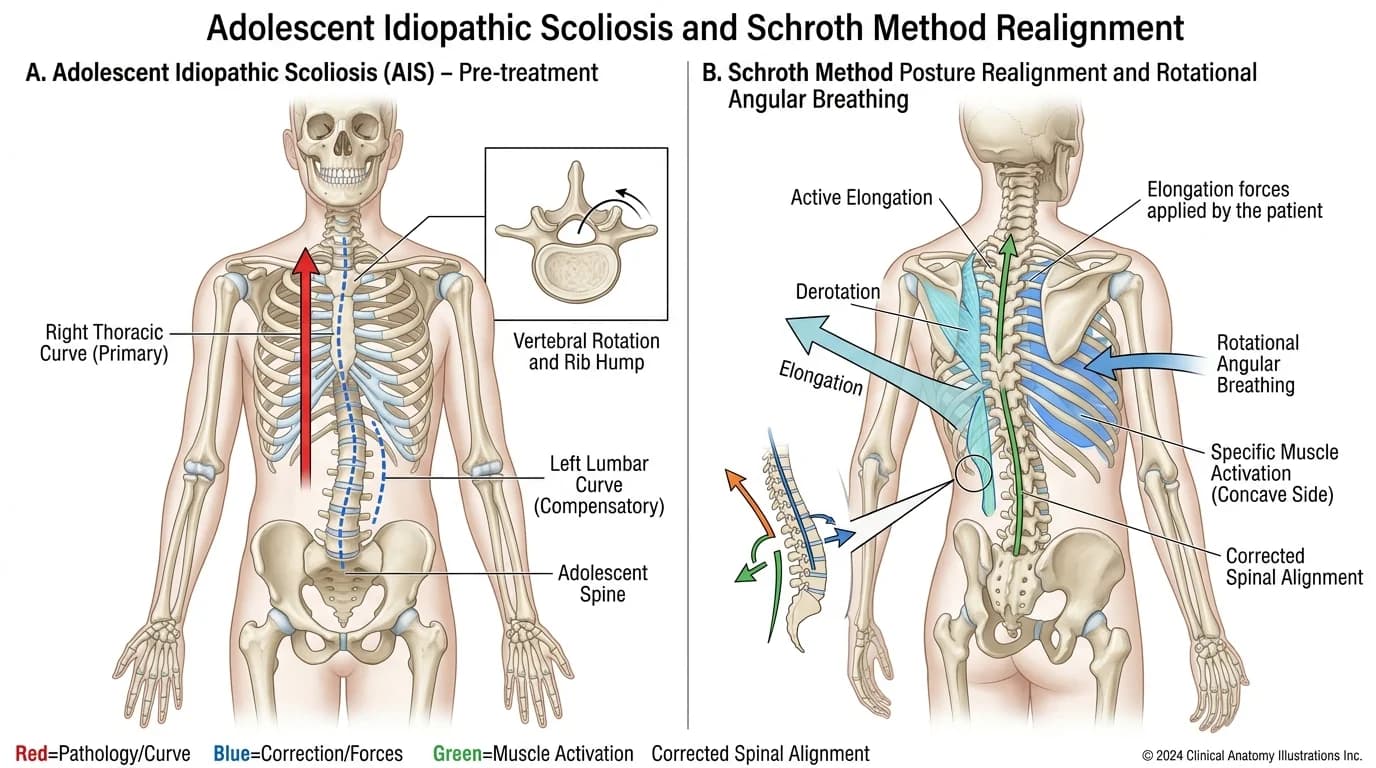
Wearing a brace full-time can lead to mild core weakness if you stay completely inactive. That is why patients must take the brace off for 1 hour every day to perform active Schroth scoliosis exercises that keep back muscles strong.
Related condition guides


Related recovery guides & articles
BookPhysio.in Editorial Team
The BookPhysio.in editorial team writes and maintains this content, checking it against reliable clinical sources. Content follows our medical review policy: general information only, and no page claims a clinical review until a named registered physiotherapist has signed it off.
Read our medical review policy