
The SEAS Approach: Active Self-Correction and Neuromuscular Stabilization for Scoliosis
In short
The SEAS approach utilizes patient-driven 3D active self-correction integrated into challenging balance and functional motor tasks to stabilize idiopathic scoliosis.
In this guide (4 sections)
Neurocognitive Foundations of the SEAS Approach
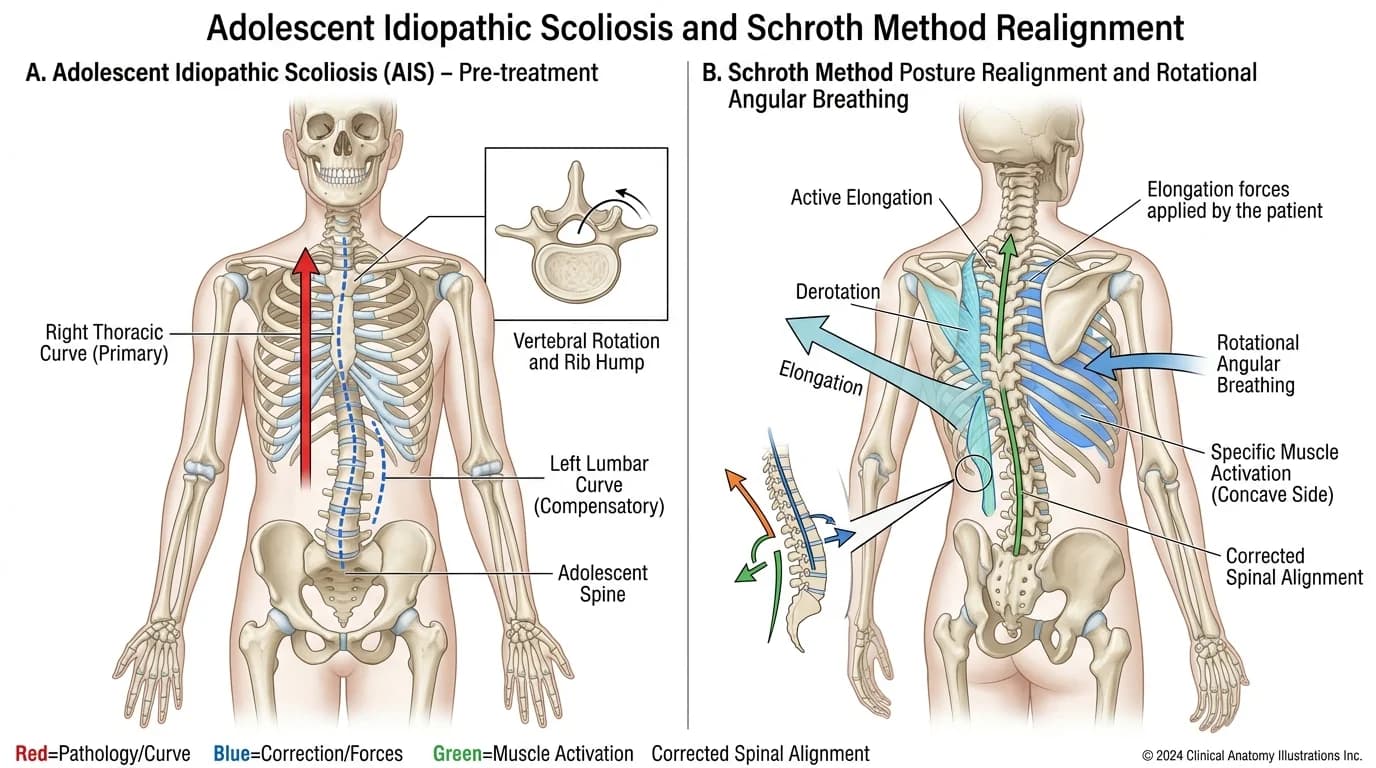
Developed by the Italian Scientific Spine Institute (ISICO), the Scientific Exercise Approach to Scoliosis (SEAS) is an evidence-based Physiotherapeutic Scoliosis-Specific Exercise (PSSE) method. Unlike passive treatments or rigid static postures, SEAS is built on neurocognitive motor control principles, focusing on changing the patient's internal postural motor schema.
The primary foundation of SEAS is Active Self-Correction (ASC). Under therapist guidance, the patient learns to actively align their spine into the best possible 3D correction without external mechanical props. Once self-correction is mastered, the patient must maintain this corrected alignment while performing progressively complex, distracting motor and balance tasks.
Active Self-Correction (ASC) Maneuver Matrix by Curve Type
| Curve Pattern | Sagittal Plane Correction | Frontal Plane Correction | Transverse Plane Derotation | |
|---|---|---|---|---|
| Thoracic Dominant Curve | Restore physiological thoracic kyphosis | Active lateral shift toward concavity | Derotate prominent rib hump forward | |
| Lumbar / Thoracolumbar Curve | Restore physiological lumbar lordosis | Active lateral pelvis and waist shift | Derotate lumbar paraspinal fullness | |
| Double Major (S-Curve) | Global axial spinal auto-elongation | Dual counter-shift of thorax and waist | Simultaneous counter-rotation of both blocks | |
| Postural Challenge Integration | Static standing or sitting baseline | Perform on wobble boards, foam pads, or single-leg | Maintain correction against destabilizing perturbations | |
| Evidence-Based Impact | Halts progression in mild curves (10-25 deg) | Significantly boosts in-brace correction coupling | Cuts brace weaning rebound progression in half |
Standardized Clinical Prescription and Functional Drills
- The 3D Auto-Correction Learning Hierarchy: Teach self-correction step-by-step: first establish sagittal plane alignment (lordosis/kyphosis), next shift the frontal plane lateral displacement, and finally execute transverse axial derotation; never proceed to balance challenges until 3D form is clean.
- Unstable Surface Balance Perturbations: Have the patient achieve their full active self-correction, then challenge them on a balance rocker board or Airex foam pad while catching a weighted ball; reacting to destabilizing forces burns the corrected posture into automated cerebellar memory.
- Daily Micro-Dose Home Prescription: Prescribe 15 to 20 minutes of SEAS exercises performed 4 to 5 days weekly; frequent short sessions provide superior neuroplastic motor learning compared to infrequent 60-minute workouts.
Frequently Asked Questions
How does the SEAS exercise method work for scoliosis?
SEAS is a modern exercise approach from Italy. Instead of lying on mats with pillows, you learn how to actively pull your own spine into the straightest possible position using your own muscles, and then hold that straight posture while balancing, squatting, or moving.
Can SEAS exercises prevent a teenager from needing a back brace?
For mild curves between 10 and 25 degrees, high-quality clinical studies show that SEAS exercises can stop the curve from getting worse in over 70% of teenagers, helping them avoid needing a rigid back brace.
Why does SEAS use balance boards and catching balls?
When you have to catch a ball while standing on a wobble board, your brain has to work quickly. Doing this while holding your spine straight trains your subconscious brain reflexes so you stay straight automatically throughout the day without thinking about it.
Related condition guides


Related recovery guides & articles
BookPhysio.in Editorial Team
The BookPhysio.in editorial team writes and maintains this content, checking it against reliable clinical sources. Content follows our medical review policy: general information only, and no page claims a clinical review until a named registered physiotherapist has signed it off.
Read our medical review policy