
Tennis Elbow and Golfer Elbow: Heavy Slow Resistance, Tendon Remodelling, and Forearm Bracing
In short
Repetitive wrist extension and gripping overload the common extensor tendon, causing chronic epicondylalgia. Learn how Heavy Slow Resistance (HSR) loading, Tyler twist drills, and counterforce bracing remodel degenerate tendon fibers.
In this guide (5 sections)
Pain on the outer or inner prominence of the elbow, clinically diagnosed as Lateral Epicondylalgia (Tennis Elbow) and Medial Epicondylalgia (Golfer Elbow), is one of the most stubborn and recurrent soft tissue conditions encountered in Indian outpatient physiotherapy clinics. Despite their sports-centric nicknames, over 90% of individuals suffering from epicondylalgia have never held a tennis racket or golf club. In India, the primary sufferers are desk workers typing on unergonomic keyboards, kitchen cooks lifting heavy cast-iron kadais and rolling rotis, plumbers, electricians, gym enthusiasts performing heavy deadlifts, and cricket batsmen.
A profound misunderstanding surrounding epicondylalgia is the assumption that it is an inflammatory condition ("tendinitis") requiring rest and ice. Histopathological studies have consistently proven that chronic elbow pain is an angiofibroblastic tendinosis: a non-inflammatory degenerative failure of collagen repair characterized by disorganised collagen fibers, hypervascular ingrowth, and high concentrations of neurochemicals like glutamate and substance P. Cortisone injections provide short-term relief but significantly worsen long-term recurrence rates. True biological healing requires Heavy Slow Resistance (HSR) training to stimulate mechanotransduction and collagen synthesis.
1. Anatomy: ECRB vs Common Flexor Tendon Microtrauma
Tennis elbow specifically targets the origin of the Common Extensor Tendon at the lateral epicondyle of the humerus. The specific anatomical structure responsible for over 90% of pathology is the Extensor Carpi Radialis Brevis (ECRB) tendon. The ECRB functions to stabilize the wrist in extension during gripping tasks (such as holding a mouse, screwdriver, or cooking pan). Because the tendon passes directly over the lateral capitellum, it is subjected to continuous mechanical abrasion and tensile stretch during repetitive forearm pronation and wrist extension.
Conversely, Golfer elbow affects the Common Flexor Tendon at the medial epicondyle, specifically the Pronator Teres and Flexor Carpi Radialis (FCR) origins. Medial epicondylalgia is triggered by repetitive forceful wrist flexion and forearm pronation, common during cricket bowling, golf swings, or manual wrenching. When load exceeds tendon capacity, micro-tears develop, and the tendon matrix degenerates, becoming thickened, hypoechoic, and painfully tender to touch.
2. Clinical Provocative Diagnostic Tests
Physiotherapists utilize validated physical examination tests to isolate epicondylalgia and rule out radial tunnel syndrome or cervical radiculopathy:
| Diagnostic Test | Testing Procedure | Positive Clinical Finding | Targeted Anatomical Structure |
|---|---|---|---|
| Cozen's Test (Lateral) | Patient extends and radially deviates wrist against therapist resistance with elbow in 90° flexion | Sudden sharp, familiar pain reproduced at the lateral epicondyle | Extensor Carpi Radialis Brevis (ECRB) origin |
| Mill's Test (Lateral) | Therapist passively pronates forearm, fully flexes wrist, and extends elbow completely | Sharp tensile pulling pain over the lateral epicondyle | Passive stretch of common extensor tendon origin |
| Maudsley's Test (Lateral) | Therapist resists active extension of the 3rd digit (middle finger) distal to the PIP joint | Exquisite pain localized strictly to the lateral epicondyle | Extensor Digitorum / ECRB tendon slip |
| Reverse Cozen’s Test (Medial) | Patient flexes wrist and supinates forearm against therapist resistance with elbow extended | Acute pain reproduced at the medial epicondyle | Common flexor tendon / Pronator Teres origin |
3. Three-Phase Heavy Slow Resistance (HSR) Loading Protocol
Tendons crave mechanical tension to synthesize new collagen. The following 3-phase loading protocol transitions patients from pain-relieving isometrics to eccentric-concentric heavy loading.
Three-Phase Heavy Slow Resistance (HSR) Tendon Remodeling Protocol
Objective: Inhibit cortical pain signaling via isometrics, stimulate collagen synthesis through eccentric tempo, and rebuild forearm grip capacity.
- 1Phase 1 (Analgesic Isometric Wrist Extension): Rest your forearm on a table with your wrist extending off the edge. Hold a light 1 to 2 kg dumbbell in a 30-degree extended position. Hold motionless for 30 to 45 seconds; complete 4 repetitions with 1-minute rest intervals. Isometric holds reduce cortical tendon inhibition and provide immediate analgesia lasting several hours.
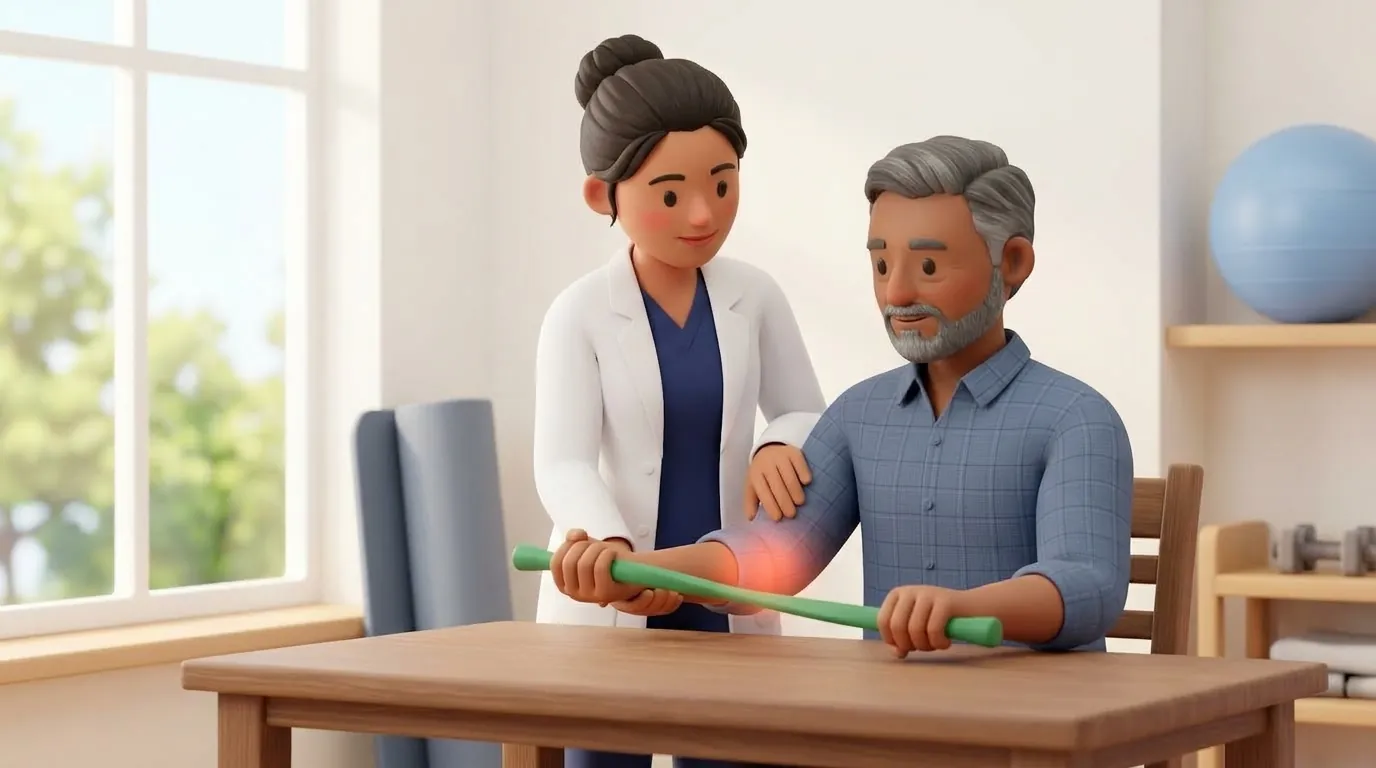
- 2Phase 2 (Heavy Slow Resistance / The Tyler Twist): Using a flexible rubber resistance bar, grasp the bottom with the affected hand in wrist extension. Grasp the top with your healthy hand, twist the bar into flexion, extend both elbows, and slowly release the twist over a controlled 4-second eccentric tempo using only the affected wrist. Complete 3 sets of 10 repetitions every other day.
- 3Phase 3 (Kinetic Chain and Scapular Retraction): In chronic elbow tendinopathy, weak rotator cuff and scapular stabilizers force the forearm to overcompensate. Integrate prone W-raises and resisted external rotations to strengthen the shoulder girdle, dissipating mechanical load during manual tasks.
- 4Counterforce Bracing Rule: Wear an inelastic forearm counterforce strap placed exactly 2 to 3 cm below the epicondyle during heavy lifting or computer typing. The strap creates a new functional origin for the muscle, reducing peak tensile strain at the bony attachment.
4. Corticosteroid Injections: Why Guidelines Advise Against Them
In Indian medical practice, corticosteroid injections into the lateral epicondyle remain widespread because they provide dramatic pain relief within 48 hours. However, landmark randomized controlled trials have demonstrated that by 6 to 12 months, patients receiving cortisone have a recurrence rate exceeding 72%, compared to less than 15% in those treated with physiotherapy and HSR.
Cortisone inhibits fibroblast proliferation and collagen synthesis, leaving the tendon structurally weaker and predisposed to chronic rupture. Platelet-Rich Plasma (PRP) injections or structured exercise therapy provide vastly superior long-term tissue remodeling.
Frequently Asked Questions
Why does tennis elbow take so long (6 to 12 months) to heal completely in India?
Tendons have an extraordinarily low metabolic rate and poor vascular blood supply compared to muscle tissue. While a muscle tear heals within 4 to 6 weeks, degenerate collagen in an avascular tendon requires continuous, progressive mechanical tensile loading over 3 to 6 months to stimulate fibroblasts, align collagen fibers, and remodel tissue matrix.
Can computer mouse usage cause severe lateral epicondylalgia (tennis elbow)?
Yes. Gripping a flat computer mouse with your wrist cocked upward in continuous extension keeps the Extensor Carpi Radialis Brevis (ECRB) in a state of continuous low-grade isometric tension for hours. Over time, this chronic static contraction impairs capillary blood flow and triggers degenerative tendinopathy. Switching to a vertical ergonomic mouse and taking regular micro-breaks eliminates this mechanical overload.
What is the difference between tennis elbow and radial tunnel syndrome?
While tennis elbow involves tendon degeneration directly at the lateral epicondyle, Radial Tunnel Syndrome involves compression of the posterior interosseous nerve (a deep branch of the radial nerve) within the arcade of Frohse, located approximately 3 to 4 cm distal (downward) into the forearm muscle belly. Radial tunnel syndrome causes deep, diffuse forearm aching without local bony tenderness at the epicondyle.
Is it safe to continue lifting weights at the gym with tennis elbow?
Yes, provided exercises are modified to eliminate wrist extension under heavy load. Avoid heavy bicep curls with straight barbells (use an EZ-curl bar with neutral grip instead), avoid heavy pulling without wrist straps, and wear a counterforce elbow strap. Incorporate isometric wrist holds at the end of each workout to stimulate tendon remodeling without provoking acute flare-ups.
How does BookPhysio.in connect patients with elbow tendinopathy specialists?
BookPhysio.in connects individuals across India with verified sports and musculoskeletal physiotherapists specializing in Heavy Slow Resistance training, tendon dry needling, and ergonomic rehabilitation. Book clinic consultations or convenient home visits with transparent per-session pricing (₹400 to ₹1,500 clinic, ₹600 to ₹2,000 home visits) and zero platform commission.
Related condition guides

BookPhysio.in Editorial Team
The BookPhysio.in editorial team writes and maintains this content, checking it against reliable clinical sources. Content follows our medical review policy: general information only, and no page claims a clinical review until a named registered physiotherapist has signed it off.
Read our medical review policy