
Total Knee Arthroplasty: Day 1 to Day 90 Recovery Milestones and Home Protocols
In short
Total knee replacement recovery requires meeting strict timeline milestones. Learn swelling control, how to eliminate extension lag, and regain 120° knee flexion.
In this guide (4 sections)
Understanding Total Knee Arthroplasty (TKA) Rehabilitation
Total Knee Arthroplasty (TKA) replaces worn articular cartilage of the distal femur and proximal tibia with metal alloy components separated by an ultra-high-molecular-weight polyethylene spacer.
Surgical success depends equally on intra-operative component alignment and disciplined post-operative physiotherapy. A beautifully placed prosthesis that is allowed to stiffen into flexion contracture results in an unsatisfactory, limping outcome.
Day 1 to Day 90 Recovery Milestones Roadmap
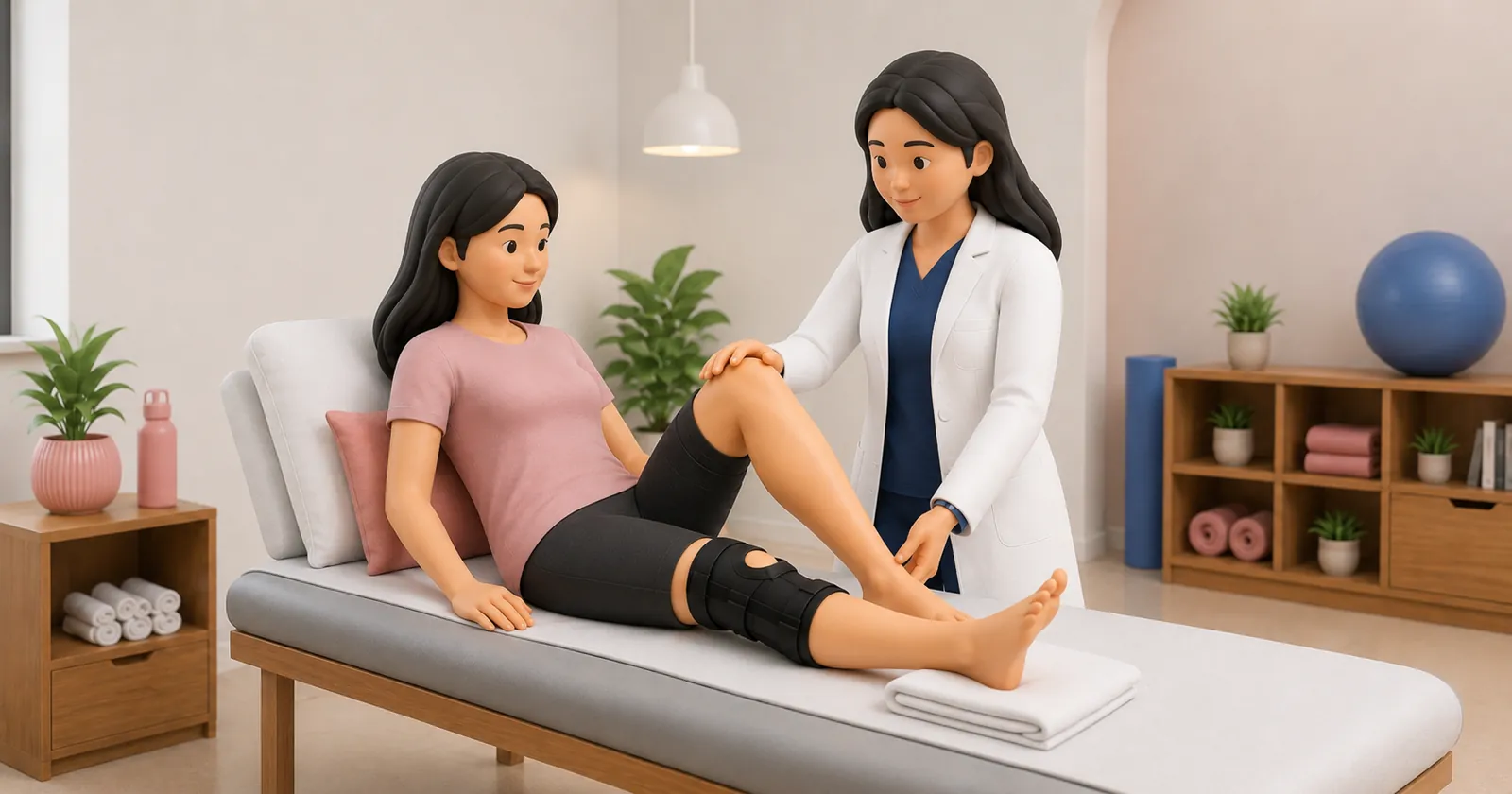
Rehabilitation follows a milestone-driven progression focused on achieving full extension early, managing joint effusion, and systematically restoring quadriceps active control.
| Post-Op Phase | Range of Motion Target | Functional Mobility Milestone | Core Therapeutic Exercises | |
|---|---|---|---|---|
| Phase 1: Days 1 to 14 (Acute) | Extension: 0° (neutral); Flexion: 90° | Independent bed transfers; walking 30m with walker. | Ankle pumps, isometric quad sets, heel slides, straight leg raises without extension lag. | |
| Phase 2: Weeks 2 to 6 (Subacute) | Extension: 0°; Flexion: 105° to 115° | Transition from walker to single-point cane; climb stairs step-over-step. | Mini-squats (0-45°), stationary cycling (high saddle), step-ups, hamstring curls. | |
| Phase 3: Weeks 6 to 12 (Functional) | Extension: 0°; Flexion: 120° or more | Independent walking without aids; walking outdoors on uneven ground. | Leg press, balance wobble board, terminal knee extensions with elastic band, brisk walking. | |
| Phase 4: Month 3 to 12 (Maintenance) | Full functional active range maintained | Return to low-impact sports (swimming, golf, doubles tennis). | Lifelong quadriceps and hip abductor maintenance training. |
The Cardinal Invariant: Full Knee Extension First
Achieving full zero-degree knee extension is far more critical than rapid flexion. A 5-degree flexion contracture (inability to straighten the knee flat) forces the quadriceps to work 3 times harder during standing, producing abnormal energy expenditure and an asymmetrical limp.
Rule: Never place a pillow directly under the knee in bed, as this positions the joint in comfortable 20-degree flexion, cementing a flexion contracture. Place pillows under the ankle/heel to encourage gravity-assisted full extension.
- Cryotherapy and Effusion Control: Apply crushed ice packs for 20 minutes every 2 hours following exercise. Controlling joint effusion is essential, as 20ml of fluid in the knee joint causes arthrogenic muscle inhibition, shutting down the vastus medialis.
- Eliminating Straight Leg Extension Lag: An extension lag occurs when a patient can passively straighten the knee but cannot keep it straight when lifting the leg. Perform isometric quad sets pushing the back of the knee down firmly into a rolled towel before lifting.
- Stationary Cycling Rocking Technique: Begin on a stationary exercise bike with zero resistance and seat raised high. Rock pedals gently back and forth until the knee tolerates a full 360-degree pedal revolution (typically achieved at 105 degrees flexion).
Frequently Asked Questions
Is clicking or clunking in a knee replacement normal?
Yes. Mild metallic clicking occurs in up to 80 percent of knee replacement patients as the metal and polyethylene components contact during movement. If painless and unaccompanied by swelling, it is completely benign.
How long does post-operative knee swelling persist?
Mild-to-moderate warmth and swelling around the knee joint is a normal physiological healing response that typically persists for 3 to 6 months post-surgery, gradually improving with elevation and compression.
Can Indian patients sit cross-legged after total knee replacement?
Traditional knee implants permit 115 to 125 degrees of flexion. High-flexion implants can achieve 135 to 140 degrees in selected patients, but routine deep floor squatting and sitting cross-legged (Sukhasana) are generally discouraged by surgeons to prevent premature poly spacer wear.
Related condition guides


Related recovery guides & articles
BookPhysio.in Editorial Team
The BookPhysio.in editorial team writes and maintains this content, checking it against reliable clinical sources. Content follows our medical review policy: general information only, and no page claims a clinical review until a named registered physiotherapist has signed it off.
Read our medical review policy