
Badminton Achilles Tendinopathy: Push-Off Biomechanics and HSR Protocol
In short
Explosive backward hops and push-offs in badminton demand maximal Achilles elastic energy storage. Heavy Slow Resistance training restores tendon load tolerance.
In this guide (7 sections)
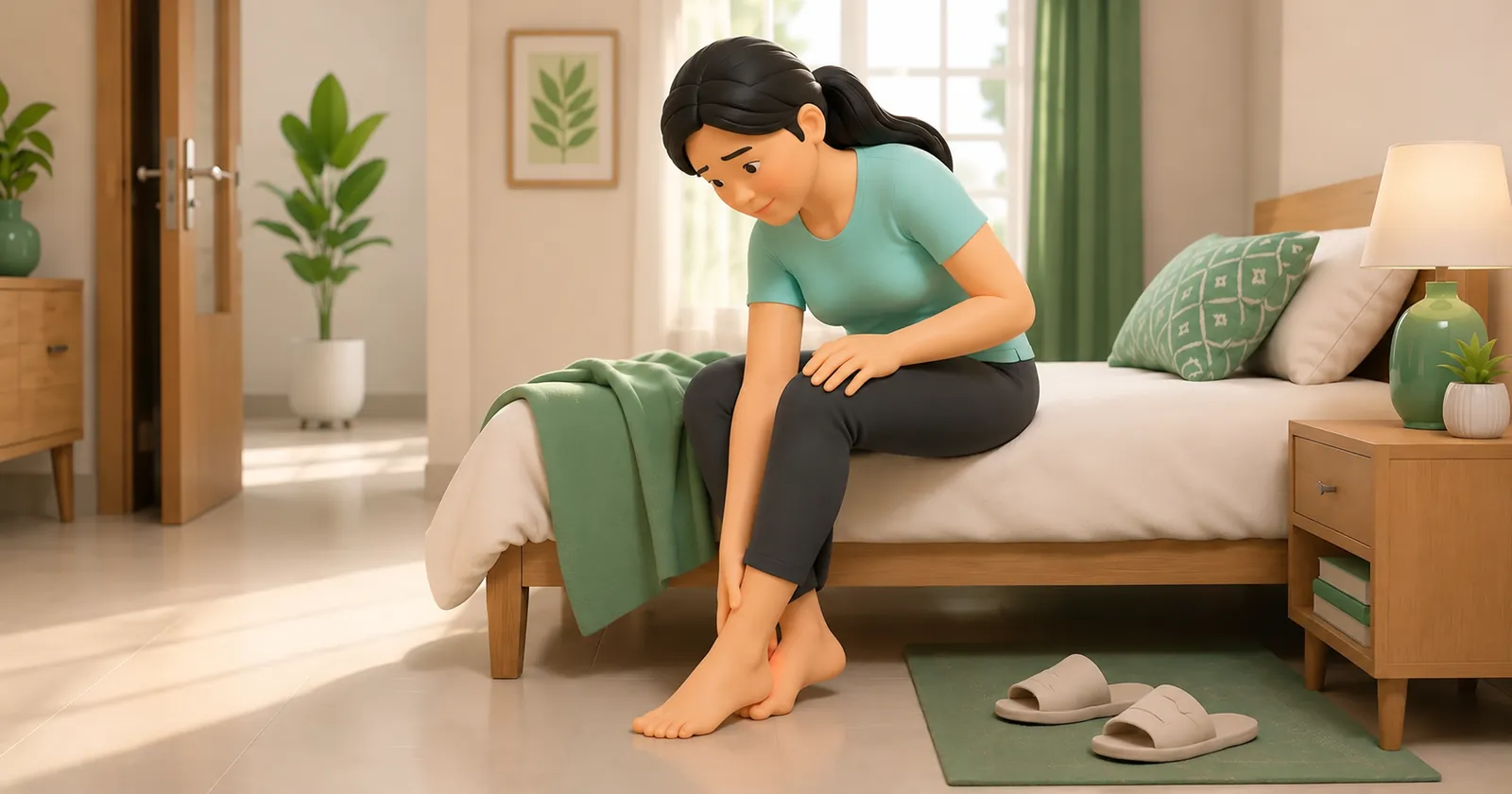
Badminton places some of the highest cyclical stretch-shortening demands on the Achilles tendon of any racket sport. During high-tempo rallies, players execute rapid backward hops, split-step jumps, and explosive lunges, loading the Achilles tendon with peak forces between 8 and 10 times body weight. Achilles tendinopathy develops primarily in the mid-substance (2 to 6 cm proximal to the calcaneal insertion), a region known for localized relative hypovascularity. Unmanaged chronic microtrauma leads to tenocyte proliferation, hypervascularity, ground substance swelling, and loss of tensile stiffness.
Domestic Indian Sports Reality and Field Conditions
Across Indian academies and training centers, badminton players frequently log 20 to 30 hours of court time weekly across multiple singles and doubles sessions. Unforgiving court flooring - such as synthetic mats laid directly onto concrete foundations - significantly reduces shock attenuation. When combined with worn-out court shoes whose midsole EVA cushioning has hardened, the Achilles tendon must absorb unattenuated impact shocks during every split-step landing. In regional training setups, early morning stiffness is often ignored as simple soreness, leading to chronic degenerative changes.
Biomechanics and Pathomechanics of Injury
The Achilles tendon functions as a powerful biological spring that stores potential energy during ankle dorsiflexion and releases it during plantarflexion push-off. In badminton, a rapid backward lunge followed by a split-second forecourt spring requires rapid eccentric lengthening of the gastrocnemius-soleus complex followed by explosive concentric recoil. If the rate of loading exceeds the structural capacity of the tendon matrix, non-inflammatory tendon disrepair ensues. Tendon thickening and fluid accumulation separate collagen fibrils, impairing force transmission and producing characteristic morning stiffness and localized nodular thickening.
Clinical Assessment and Provocative Special Tests
- Royal London Hospital Test: The examiner palpates the tender mid-substance nodule with the ankle in relaxed plantarflexion, then re-palpates during maximal active dorsiflexion. Significant reduction or disappearance of tenderness in dorsiflexion confirms mid-substance Achilles tendinopathy.
- Single-Leg Heel Raise Capacity and Hop Test: Assesses maximum unilateral concentric and eccentric endurance. A normal athletic baseline is 30 or more smooth repetitions. Rapid hopping reproduces localized tendon pain.
- VISA-A Clinical Score: A validated questionnaire assessing Achilles tendon stiffness, morning pain duration, and functional court tolerance, used to monitor objective clinical recovery.
Stage-by-Stage Functional Return Protocol
- Phase 1: Isometric Analgesia and Load Modification (Weeks 0 to 2): Pause high-velocity jumping and match play. Perform 5 sets of 45-second heavy isometric heel-raise holds in neutral dorsiflexion against resistance, which induces cortical inhibition and settles resting pain.
- Phase 2: Heavy Slow Resistance (HSR) Protocol (Weeks 2 to 8): Perform both seated (soleus bias) and standing (gastrocnemius bias) calf raises using heavy loads (70% to 85% 1RM) with a strict 3-second concentric and 3-second eccentric tempo, 3 days per week.
- Phase 3: Stretch-Shortening Cycle and Plyometric Reconditioning (Weeks 8 to 12): Gradually introduce fast-velocity elastic loading: low-amplitude rope skipping, continuous ankle pogo hops, and lateral bounding drills on sprung surfaces.
- Phase 4: Sport-Specific Footwork and Return to Competition (Weeks 12 to 16): Resume full-court shadow footwork and progressive match play. Continue maintenance HSR training once or twice weekly to preserve tendon collagen turnover and prevent relapse.
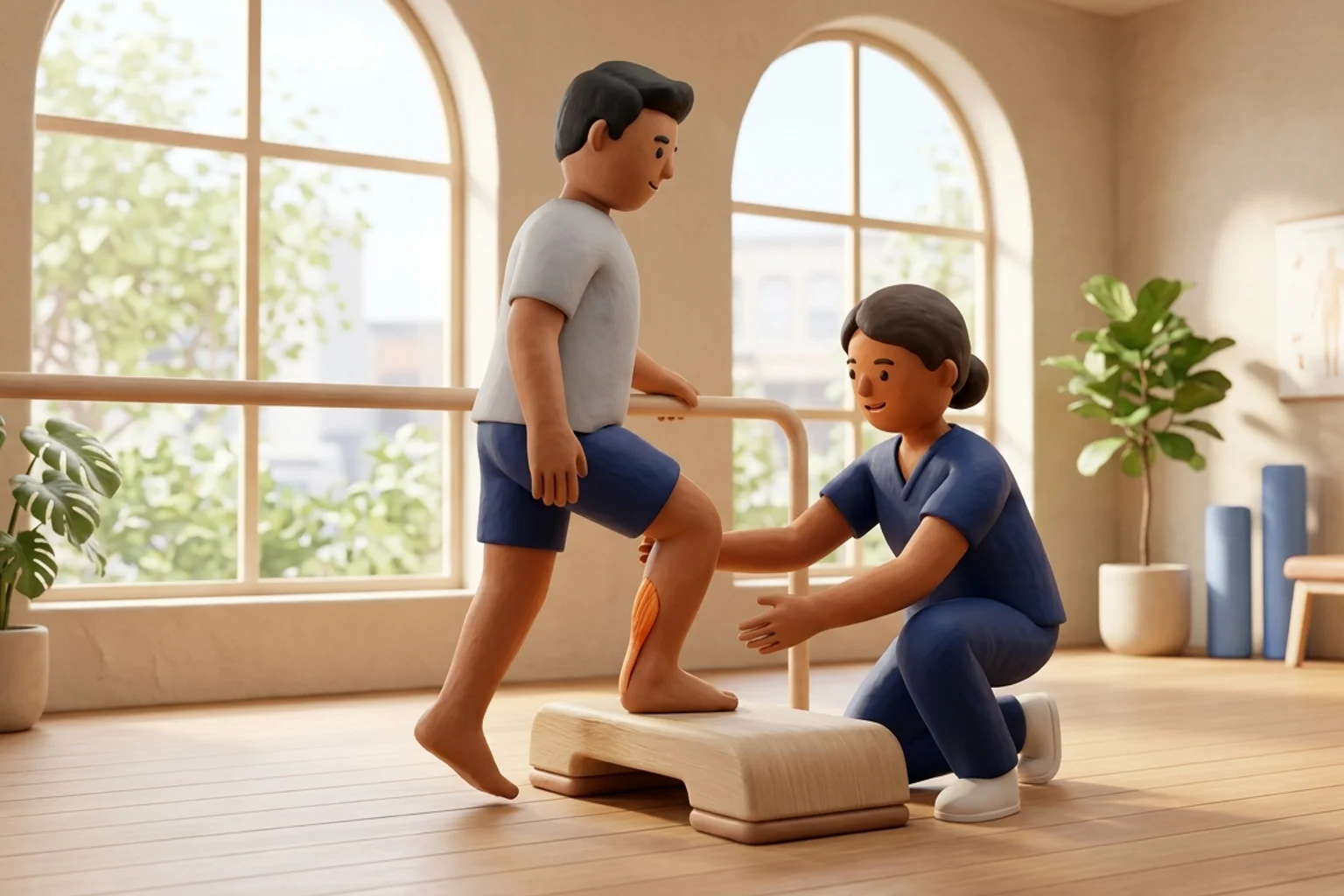
Heavy Slow Resistance Standing Calf Raise on Step
Objective: Stimulates collagen matrix remodeling, increases tendon cross-sectional area, and restores high-load tensile capacity.
- 1Stand on the edge of a sturdy step with the balls of your feet supported and heels hanging freely off the edge, holding a heavy dumbbell or barbell.
- 2Slowly lower your heels below the step level over a 3-second count until a deep calf stretch is achieved.
- 3Drive through the big toe to raise up onto your toes over a 3-second count to maximal plantarflexion.
- 4Pause at the peak contraction for 1 second before beginning the slow 3-second lowering.
- 5Maintain strict knee extension throughout to emphasize the gastrocnemius.
HSR Protocol vs Traditional Eccentric Loading
| Protocol Feature | Alfredson Eccentric Protocol | Heavy Slow Resistance (HSR) | Clinical Advantage in Badminton | |
|---|---|---|---|---|
| Contraction Type | Isolated eccentric lowering | Combined concentric and eccentric | HSR trains both push-off and landing phases | |
| Weekly Frequency | Twice daily (14 sessions/week) | 3 sessions per week (alternate days) | HSR provides superior patient compliance | |
| Loading Intensity | Bodyweight to light backpack | Heavy load (70% - 85% 1RM) | HSR induces greater collagen remodeling |
Red Flag Signs Requiring Immediate Medical Referral
A sudden audible 'crack' or feeling of being kicked in the back of the calf, immediate inability to perform a single-leg heel raise, a palpable gap in the tendon substance, or a positive Thompson squeeze test (lack of passive plantarflexion when squeezing the calf) indicates an acute complete Achilles tendon rupture requiring urgent surgical consultation.
Frequently Asked Questions
Can I use heel lifts in my badminton shoes during rehabilitation?
Yes. A temporary 6-mm to 10-mm heel wedge placed inside both court shoes reduces peak dorsiflexion strain and shortens the moment arm at the ankle, significantly decreasing tensile stress on the healing Achilles tendon.
Why is stretching the Achilles tendon often counterproductive in insertional tendinopathy?
In insertional tendinopathy, aggressive dorsiflexion stretching compresses the tendon insertion directly against the posterior calcaneal bone. This compressive shear worsens tissue pathology; isometric and HSR loading in neutral dorsiflexion is vastly superior.
Related condition guides
Related recovery guides & articles
BookPhysio.in Editorial Team
The BookPhysio.in editorial team writes and maintains this content, checking it against reliable clinical sources. Content follows our medical review policy: general information only, and no page claims a clinical review until a named registered physiotherapist has signed it off.
Read our medical review policy