
Barefoot Walking on Flat Hard Floors: Impact Shock and Insertional Achilles Tendinopathy
In short
Discover how barefoot walking on cold marble and granite floors exacerbates insertional Achilles tendinopathy, and learn essential indoor footwear strategies.

In this guide (4 sections)
In Indian cultural tradition, removing footwear before entering a home, temple, or sacred space is a universal, deeply ingrained custom that signifies cleanliness and spiritual respect. Consequently, the vast majority of Indians spend multiple hours every day walking completely barefoot indoors. While barefoot locomotion on compliant, natural surfaces (such as soft sand, grass, or yielding earth) can strengthen intrinsic foot musculature, walking barefoot on modern unyielding architectural flooring (such as polished Italian marble, granite, Kota stone, and vitrified tiles) is catastrophic for an individual with insertional Achilles tendinopathy. Devoid of any external shock attenuation or heel elevation, barefoot walking subjects the sensitized calcaneal enthesis to unfiltered ground reaction force spikes and drives the talocrural joint into maximal dorsiflexion with every single step, perpetuating chronic tissue dysrepair.
The Marble Floor Reality of Indian Apartments and Extended Family Homes
Across residential housing developments in urban India, sleek marble and vitrified tiles have completely replaced traditional earthen and wooden floorings. These surfaces possess an elastic modulus virtually identical to concrete, offering zero mechanical compliance. Homemakers, retired seniors, and remote tech workers habitually log five to ten thousand steps daily entirely barefoot inside their apartments, walking back and forth between kitchens, bedrooms, and balconies. In extended multi-generational families, attending to children and elderly relatives involves constant standing, pivoting, and pacing across these rock-hard floors. When someone with an inflamed Achilles insertion walks barefoot on these surfaces, each heel strike delivers an unattenuated acoustic shockwave directly into the calcaneus. The lack of heel-to-toe drop forces the ankle into deep plantigrade dorsiflexion, crushing the retrocalcaneal bursa with every step and provoking excruciating evening heel throbbing.
Ground Reaction Transient Peaks, Calcaneal Impact Shock, and Retrocalcaneal Crushing
The biomechanics of barefoot gait on rigid flooring illustrate the severe physical stresses placed upon the insertional Achilles complex. At initial contact, the barefoot heel strike generates a rapid, high-frequency ground reaction impact transient that travels through the calcaneus in less than twenty milliseconds, completely bypassing the dampening effect of leg musculature. While a healthy subcalcaneal fat pad dissipates a portion of this energy, age-related fat pad atrophy and repetitive trauma diminish this natural cushioning. As the gait cycle advances into midstance, the tibia advances forward over the planted foot. In zero-drop barefoot conditions, the ankle must dorsiflex ten to fifteen degrees to permit forward body progression. In insertional tendinopathy, this dorsiflexion angle wedges the deep anterior fibers of the tendon directly against the posterosuperior calcaneal tuberosity. This mechanical crush generates high hydrostatic pressure, impairs local capillary microcirculation, and accelerates tenocyte chondroid metaplasia.
Indoor Footwear Protocols: Recovery Slides, Anti-Fatigue Mats, and Graduated Cushioning
The clinical solution does not require violating cultural hygiene norms; rather, it involves establishing dedicated indoor footwear protocols. Patients must designate a pair of clean, supportive indoor-only recovery sandals or specialized orthopedic slides that never touch outdoor streets. The optimal indoor house shoe features a thick, energy-absorbing EVA or polyurethane midsole with a built-in heel-to-toe drop of ten to twelve millimetres and a contoured anatomical arch. The elevated heel instantly reduces the dorsiflexion excursion required during walking, keeping the Achilles insertion out of the critical impingement zone. Furthermore, high-density anti-fatigue gel mats should be installed in front of kitchen counters and sinks where prolonged standing is unavoidable. As symptoms stabilize over eight to twelve weeks, short bouts of barefoot walking on soft yoga mats can be cautiously introduced to rebuild intrinsic foot strength and restore natural foot sensory feedback and proprioceptive motor control.
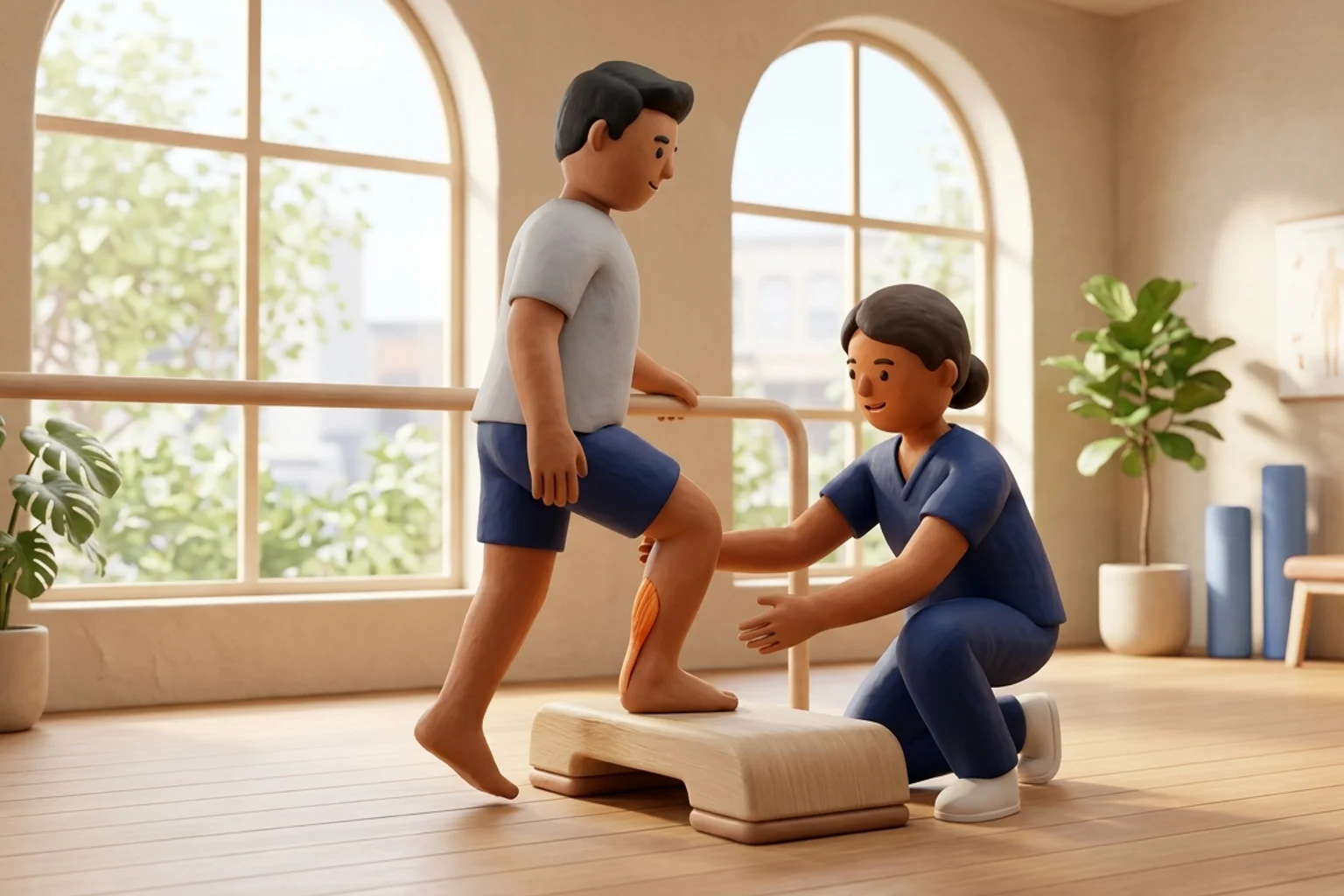
Supported Indoor Heel-Rise and Controlled Drop in Cushioned Slides
Objective: Build triceps surae capacity and gait shock tolerance using indoor cushioned footwear support
- 1Put on your designated clean indoor orthopedic slides or cushioned athletic recovery shoes with a 10 mm heel drop.
- 2Stand tall on your living room floor, placing fingertips lightly against a sturdy wall for balance equilibrium.
- 3Distribute your bodyweight evenly across the forefoot of both feet, keeping your spine straight and core lightly braced.
- 4Smoothly elevate onto the balls of both feet over two seconds, lifting your heels two inches into a mid-range calf raise.
- 5Pause for one second at the top, then lower your heels slowly back onto the cushioned footbed over three full seconds.
| Gait Characteristic | Barefoot on Marble / Granite | 10-12 mm Cushioned Indoor Slides | Clinical Impact on Achilles Enthesis |
|---|---|---|---|
| Heel Strike Shock Absorption | Zero external cushioning; full shock enters calcaneus | High shock attenuation; 40% reduction in peak impact | Protects retrocalcaneal bursa from acoustic microtrauma |
| Midstance Dorsiflexion Demand | Maximal dorsiflexion (12 to 15 degrees) on flat tile | Reduced dorsiflexion (sub-neutral to 5 degrees) | Physically prevents tendon impingement against bone |
| Achilles Peak Tensile Strain | High continuous tensile strain across entire stance | 15% reduction in peak tendon tensile strain | Alleviates tensile overload on reactive collagen fibrils |
| Morning & Evening Symptom Flare | Severe evening throbbing and severe morning stiffness | Minimal evening aching; rapid morning resolution | Dramatically improves overall patient recovery trajectory |
Patients recovering from insertional Achilles tendinopathy must observe a strict clinical rule: zero barefoot steps on hard flooring. Even taking five paces from the bed to the en-suite bathroom in the morning without footwear subjects the cold, stiff tendon to acute compressive shear that can reset days of healing. A supportive pair of cushioned recovery slides must be placed immediately adjacent to the bed so the feet never touch cold tiles barefoot.
Frequently Asked Questions
In our culture, wearing shoes inside the home is considered unclean. What can I do?
You do not need to wear outdoor street shoes inside your home. Purchase a brand-new, dedicated pair of supportive orthopedic slides or recovery sandals that are used exclusively inside your house and never worn outside. You can wash and sanitize them thoroughly, or keep them right at your bedroom threshold. Explain to your family that this is a medical orthotic device prescribed by your physiotherapist to prevent permanent heel bone and tendon damage. Dedicated indoor footwear respects your home's cleanliness while protecting your healing Achilles tendon.
Do I need a doctor referral to treat Achilles tendinopathy on BookPhysio.in?
BookPhysio.in does not require a doctor referral. Under the National Commission for Allied and Healthcare Professions (NCAHP) Act 2021, patients across India enjoy direct access to autonomous registered physiotherapists. Through BookPhysio.in, you connect directly with verified clinicians and pay per session with transparent fees, completely free from advance package commitments, commission markups, or platform subscription charges.
Related condition guides
Related recovery guides & articles
BookPhysio.in Editorial Team
The BookPhysio.in editorial team writes and maintains this content, checking it against reliable clinical sources. Content follows our medical review policy: general information only, and no page claims a clinical review until a named registered physiotherapist has signed it off.
Read our medical review policy