
Fast Bowler Cricket Pars Stress Fracture Rehabilitation Timeline
In short
Fast bowlers in cricket face exceptional risk for lumbar pars stress fractures. Explore biomechanical causes, rehabilitation stages, and safe bowling return.
In this guide (4 sections)
Lumbar pars interarticularis stress fractures represent the single most impactful overuse injury affecting cricket fast bowlers, predominantly striking young pace bowlers between the ages of sixteen and twenty-two. The injury occurs with striking anatomical predilection on the non-bowling arm side (contralateral pars) of the fourth or fifth lumbar vertebra. During the delivery stride, the bowler absorbs tremendous ground reaction forces while simultaneously executing explosive lumbar hyperextension, lateral flexion, and trunk counter-rotation. In competitive cricket, where fast bowlers deliver hundreds of overs across long seasons, micro-damage outpaces osteoblastic repair. Structuring an evidence-based, phased rehabilitation timeline is essential to heal the bone, correct hazardous bowling mechanics, and prevent career-threatening recurrent stress fractures.
Indian Pace Academies, Concrete Practice Wickets, and Heavy Over Loads
In cricket academies across India, aspiring pace bowlers routinely bowl on unforgiving concrete practice pitches or rock-hard baked clay wickets. These surfaces transmit extreme impact forces through the front foot during delivery, generating ground reaction forces five to nine times the athlete body weight. Young bowlers frequently bowl excessive spells exceeding ten to fifteen overs daily in practice sessions without structured bowling workload monitoring. Furthermore, aspiring pacers often adopt a mixed bowling action, rotating their shoulders into a side-on position while their hips remain front-on at back foot impact. This dangerous rotational conflict twists the lumbar spine under massive compressive load, funneling tremendous mechanical shear directly into the contralateral pars.
Front Foot Ground Reaction, Contralateral Shear, and Mixed Action Physics
The biomechanical genesis of pars stress fractures in cricket fast bowlers involves a complex interaction of ground reaction forces, trunk kinematics, and cyclical fatigue. At front foot contact, the leading leg acts as a rigid strut to convert horizontal momentum into rotational velocity. If the front knee collapses into flexion, braking forces dissipate; however, if the bowler maintains an extended front knee, massive shock waves travel up through the kinetic chain into the pelvis. Concurrently, if the bowler exhibits a mixed action, characterized by shoulder counter-rotation greater than thirty degrees relative to the pelvis, the posterior facet joints of L4 and L5 collide violently. The inferior articular process repeatedly impacts the pars interarticularis, driving micro-trabecular failure, cortical stress fracture, and potential spondylolytic separation.
Phased Workload Progression, Hip Mobility, and Safe Action Remodeling
Rehabilitation for cricket fast bowlers demands a disciplined timeline spanning four to six months. Phase one enforces complete bowling cessation, offloading the bone until resting and extension pain fully resolve. Phase two introduces progressive core endurance training, thoracic spine rotational mobility, and hip internal rotation restoration, ensuring that rotational torque is generated through the hips and mid-back rather than the lumbar spine. Phase three progresses to dynamic plyometrics, medicine ball rotational throws, and walking-through bowling actions. The final phase implements a strict, gradual return-to-bowling program, beginning with off-spin or walk-in deliveries from half run-up before progressing to full-tilt pace bowling under the supervision of a biomechanics specialist.
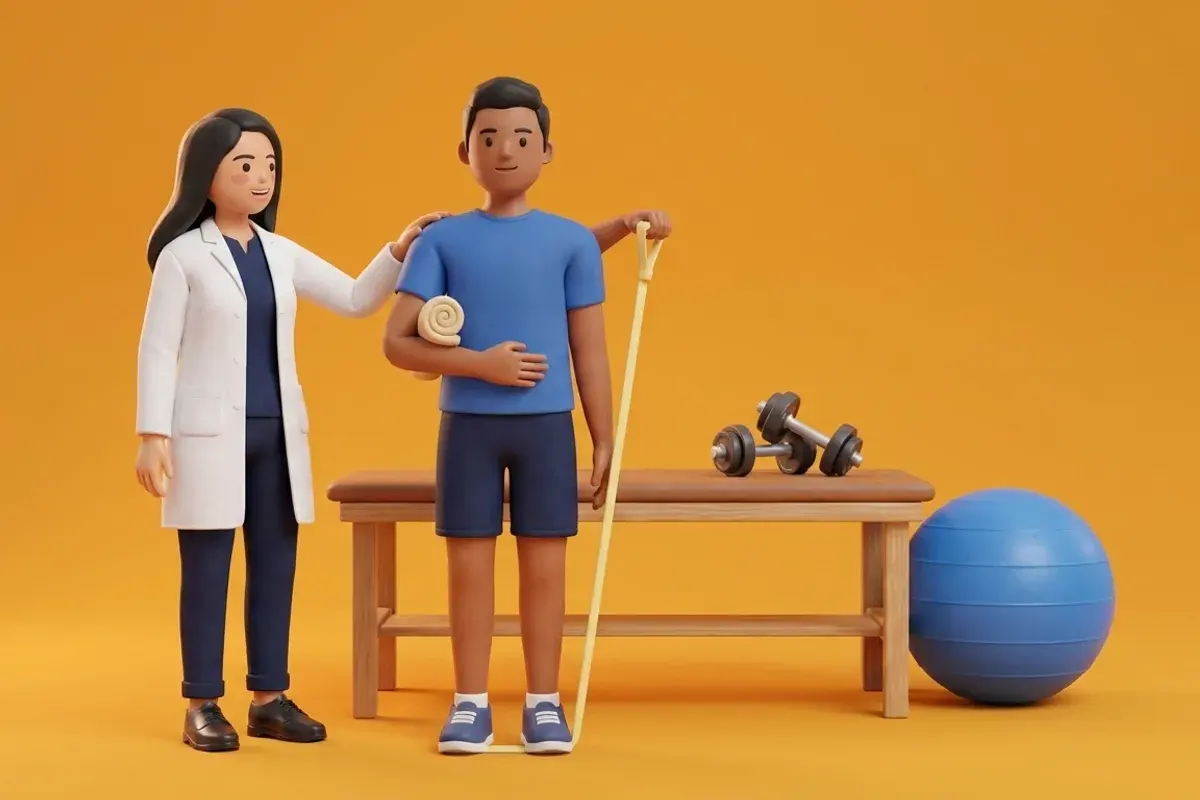
Half-Kneeling Cable or Resistance Band Rotational Chop
Objective: Develop thoracic and hip rotational power while stabilizing the lumbar spine in neutral alignment
- 1Adopt a half-kneeling position with your right knee on a padded mat and your left foot planted firmly in front of you.
- 2Anchor a resistance band securely above shoulder height to your right side, holding the handles with both hands.
- 3Maintain a tall, upright posture with your pelvis tucked slightly into neutral, bracing your abdominal core firmly.
- 4Without allowing your lower back to arch or twist, pull the band diagonally across your body down toward your left hip.
- 5Control the return movement slowly over 3 seconds back to the starting position, resisting any sudden twisting pull.
| Phase & Duration | Primary Clinical Focus | Exit Criteria for Advancement |
|---|---|---|
| Phase 1: Bone Offloading (Weeks 0-6) | Active rest from bowling, swimming with kickboard, antilordotic core bracing | Zero pain on lumbar hyperextension, negative single-leg Stork test, normal walking gait |
| Phase 2: Kinetic Chain Prep (Weeks 6-12) | Thoracic mobility, hip internal rotation, McGill Big 3 stability drills, gluteal strengthening | Symmetrical 45-degree thoracic rotation, full pain-free hip range of motion, stable plank |
| Phase 3: Run-up & Power (Weeks 12-16) | Straight line sprinting, medicine ball throws, walk-through bowling action on grass | Pain-free completion of high-speed deceleration drills, normal repeat MRI showing healing |
| Phase 4: Return to Crease (Weeks 16-24) | Graduated bowling program: 18 balls twice weekly at 60% effort, building to full match overs | Zero post-bowling soreness, validated pure side-on or front-on action without counter-rotation |
If a fast bowler experiences sharp shooting pain, electrical burning, or numbness traveling past the buttock down the back of the leg during or after bowling, this indicates neural involvement. Rather than a simple muscular spasm, this radicular symptom frequently signals that an unhealed pars defect has permitted acute vertebral slippage, compressing the exiting L5 or S1 nerve root. Immediate bowling cessation and urgent neurological evaluation are mandatory.
Frequently Asked Questions
Why do fast bowlers almost always fracture the pars on the side opposite to their bowling arm?
Fast bowlers almost exclusively fracture the pars interarticularis on the contralateral (opposite) side of their bowling arm due to the asymmetric rotational mechanics of the delivery stride. For example, a right-arm fast bowler plants their left front foot firmly on the crease, halting forward momentum. As the trunk rapidly rotates and flexes to propel the ball forward, the left side of the spine acts as the rotational axis while the right pelvis drives through. This combination of lateral flexion toward the left and hyperextension generates massive compressive shear forces concentrated directly onto the left L4 or L5 pars interarticularis.
Do I need a doctor referral to consult a spondylolisthesis physiotherapist on BookPhysio.in?
BookPhysio.in does not require a doctor referral. Under the National Commission for Allied and Healthcare Professions (NCAHP) Act 2021, patients across India enjoy direct access to autonomous registered physiotherapists. Through BookPhysio.in, you connect directly with verified clinicians and pay per session with transparent fees, completely free from advance package commitments, commission markups, or platform subscription charges.
Related condition guides

Related recovery guides & articles
BookPhysio.in Editorial Team
The BookPhysio.in editorial team writes and maintains this content, checking it against reliable clinical sources. Content follows our medical review policy: general information only, and no page claims a clinical review until a named registered physiotherapist has signed it off.
Read our medical review policy