
Post-Intensive Care Syndrome (PICS) and ICU-Acquired Weakness: Bedside Mobility and Recovery
In short
Survivors of critical illness face profound physical, cognitive, and emotional impairments. Learn ICU-acquired weakness pathophysiology, MRC sum score, and bedside mobilization.

In this guide (5 sections)
Understanding Post-Intensive Care Syndrome (PICS)
Advancements in critical care medicine have dramatically improved survival rates from sepsis, acute respiratory distress syndrome (ARDS), and multi-organ failure. However, up to 50 percent of ICU survivors develop Post-Intensive Care Syndrome (PICS).
PICS is defined as new or worsening impairment in physical, cognitive, or mental health status arising after critical illness and persisting beyond acute hospitalization.
The cornerstone physical manifestation is ICU-Acquired Weakness (ICUAW), which encompasses critical illness polyneuropathy (CIP), critical illness myopathy (CIM), and muscle disuse atrophy, causing profound symmetrical flaccid limb weakness.
Pathophysiology and the MRC Sum Score
Critical illness triggers a systemic hypercatabolic storm: elevated circulating inflammatory cytokines (IL-1, IL-6, TNF-alpha), massive muscle proteolysis via the ubiquitin-proteasome pathway, microvascular ischemia, and sodium channel inactivation.
Skeletal muscle wasting occurs at an alarming rate of up to 2 to 3 percent per day during the first week of mechanical ventilation. The Medical Research Council (MRC) sum score assesses muscle strength across 6 bilateral muscle groups (shoulder abductors, elbow flexors, wrist extensors, hip flexors, knee extensors, ankle dorsiflexors).
| Clinical Entity | Primary Tissue Pathology | Diagnostic Electrophysiology / Scoring | Functional Impact | |
|---|---|---|---|---|
| 1. ICUAW Consensus | Generalized symmetrical muscle weakness | MRC Sum Score < 48 / 60 points | Inability to sit unassisted or stand; ventilator weaning delay. | |
| 2. Critical Illness Myopathy | Loss of myosin thick filaments and muscle necrosis | Normal nerve conduction; low compound muscle action potential | Profound proximal limb weakness; preserved distal sensation. | |
| 3. Critical Illness Polyneuropathy | Axonal motor and sensory peripheral neuropathy | Reduced sensory and motor nerve action potentials | Distal flaccidity, absent tendon reflexes, prolonged paresis. | |
| 4. Disuse Muscle Atrophy | Type II fast-twitch muscle fiber shrinkage | Normal nerve and muscle electrical excitability | Rapidly reversible with progressive mechanical loading and protein. |
The ABCDEF Bundle and Early Mobilization Protocol
Early progressive mobility within the ICU and immediately post-discharge counteracts neuromuscular degradation and reduces delirium duration.
Rehabilitation follows a phased hierarchy advancing from in-bed passive-assisted cycling to full upright functional ambulation.
- Level 1: Passive in-bed Range of Motion: Gentle full-arc passive movements and in-bed cycle ergometry while intubated to preserve joint capsular compliance.
- Level 2: Edge-of-Bed Sitting Balance: Trunk control training, static upright sitting, and dynamic weight shifts to stimulate vestibular-proprioceptive reflexes.
- Level 3: Active Assisted Transfers and Standing: Sit-to-stand transitions using a standing frame or tilt table, stimulating weight-bearing bone remineralization.
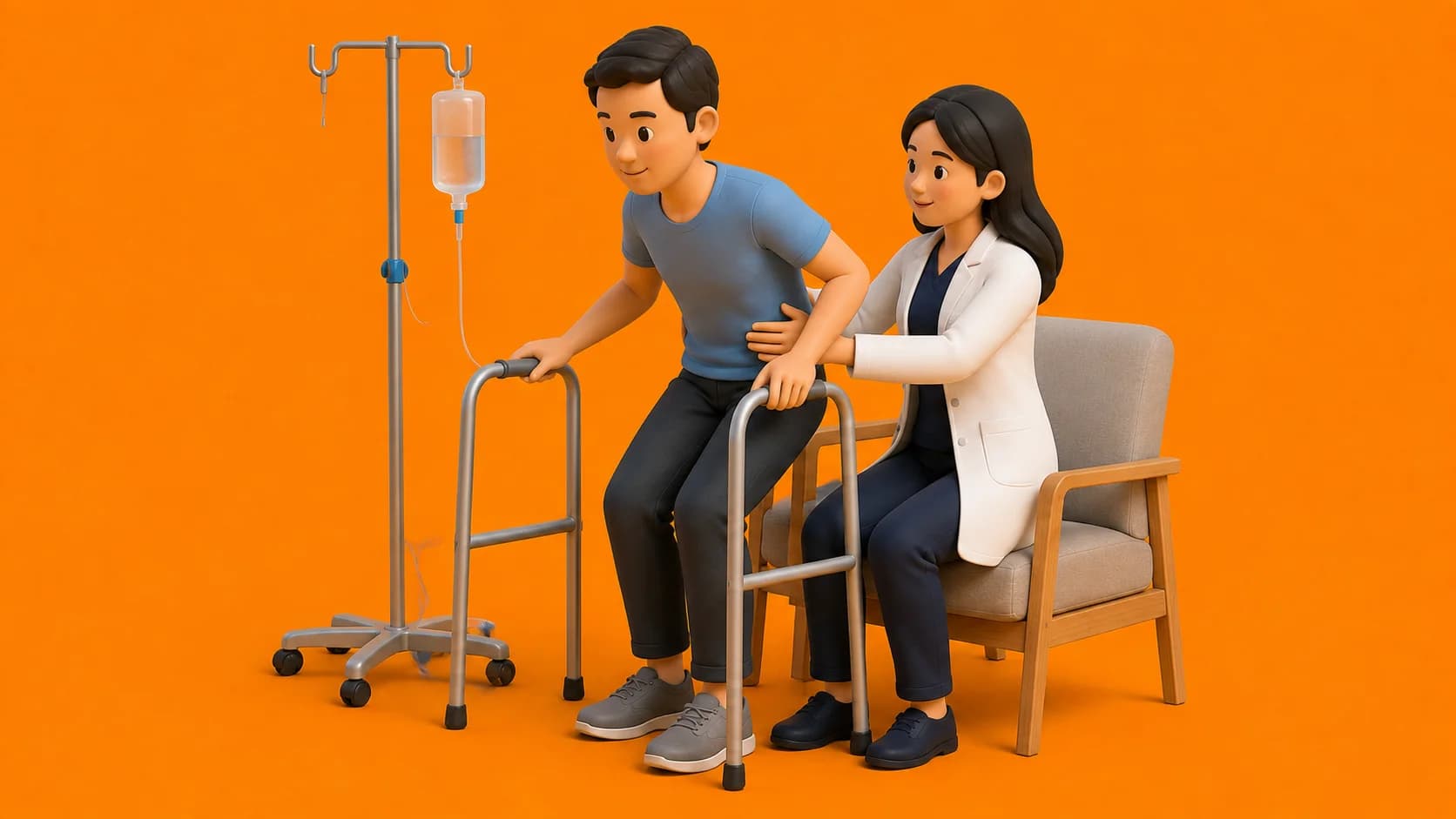
- Level 4: Stepping and Supervised Ambulation: Short-distance corridor walking with a front-wheeled walker, continuous pulse oximetry, and portable oxygen support.
Indian Family Caregiver Transition and Nutrition
In Indian homes, patients discharged from prolonged ICU stays are often kept bedridden by anxious relatives fearing exertion or fall risks. This well-meaning overprotection exacerbates joint contractures and deconditioning.
Visiting physiotherapists educate families on graded functional activity, bedside commode transfers, and coordinating high-protein dietary intake (paneer, egg whites, sattu, whey) to promote myofibrillar re-synthesis.
Frequently Asked Questions
How long does recovery from ICU-acquired weakness take?
Mild muscle disuse atrophy improves within 6 to 12 weeks of structured physiotherapy. Severe critical illness polyneuropathy with axonal degeneration can require 12 to 24 months of persistent neuro-rehabilitation.
What are the vital sign safety cut-offs for starting post-ICU exercise?
Exercise should be paused if heart rate is below 50 or above 130 bpm, resting systolic blood pressure is above 180 mmHg or below 90 mmHg, or oxygen saturation (SpO2) drops below 88 percent.
Can neuromuscular electrical stimulation (NMES) prevent muscle loss in bedridden ICU patients?
Yes. Applying NMES to the quadriceps and calf muscles during the acute bedridden phase induces muscle contractions, reducing muscle fiber cross-sectional area loss even when active voluntary participation is not yet possible.
Related condition guides

Related recovery guides & articles
BookPhysio.in Editorial Team
The BookPhysio.in editorial team writes and maintains this content, checking it against reliable clinical sources. Content follows our medical review policy: general information only, and no page claims a clinical review until a named registered physiotherapist has signed it off.
Read our medical review policy