
Transparent Pay-Per-Session Achilles Tendinopathy Physiotherapy Fees
In short
Understand BookPhysio.in's transparent pay-per-session fee model and why advance treatment packages harm clinical outcomes in tendon rehabilitation.

In this guide (4 sections)
In the private healthcare and physical rehabilitation sector across India, commercial clinic chains and corporate wellness centers frequently utilize exploitative sales tactics to maximize upfront revenue. When patients seek care for chronic Achilles tendinopathy, they are routinely subjected to aggressive sales pitches urging them to purchase costly advance packages, such as 'Twenty-Session Tendon Recovery Plans' costing ₹15,000 to ₹30,000 upfront. These commercial packages are designed for clinic cash flow, not clinical efficacy, locking patients into prolonged schedules of daily passive treatments that promote dependency rather than tissue capacity. BookPhysio.in was founded upon an uncompromising ethical foundation: transparent, pay-per-session pricing with zero advance package commitments, zero platform markups, and zero commission cuts taken from clinician fees.
Commercial Clinic Sales Tactics and Advance Package Traps in India
For middle-class families and working professionals in Indian cities, upfront healthcare expenses represent a significant financial decision. When an individual dealing with heel pain visits a high-street physiotherapy chain, clinic coordinators frequently offer 'exclusive discounts' if the patient swipes their credit card for a multi-week package on day one. Once committed, patients find themselves attending daily forty-five-minute sessions dominated by passive ultrasound wands, vibrating heat pads, or electrical stimulation units that cost pennies to operate but yield zero long-term tendon remodeling. Furthermore, if the patient recovers faster than anticipated or wishes to discontinue due to poor treatment quality, refund requests are routinely refused under strict contract clauses. A pay-per-session model completely eliminates this financial trap, keeping the patient in total control of their care, financial expenditure, and rehabilitation timeline. In addition, family elders, colleagues, and athletic peers across Indian domestic and work environments regularly share practical tips, while adjusting daily household expectations to support steady, patient recovery.
Why High-Frequency Daily Clinic Sessions Violate Tendon Biology
The fundamental clinical flaw of multi-session clinic packages is that they directly contradict the biological timelines of tendon tissue remodeling. Unlike muscle tissue, which has rich vascularity and can tolerate frequent light stimuli, degenerative tendons require high-magnitude tensile strain followed by forty-eight to seventy-two hours of cellular recovery. When a tenocyte is subjected to an optimal heavy slow resistance stimulus, it synthesizes new procollagen over the subsequent two to three days. Forcing an Achilles patient to attend the clinic daily for twenty consecutive days violates this recovery cycle. Daily passive modalities do nothing to stimulate collagen, while daily exercise loading without rest leads to cellular exhaustion and matrix breakdown. Evidence-based tendon rehabilitation requires only one clinic review every one to two weeks to assess progress and calibrate home loading, making daily clinic packages medically unnecessary and counterproductive to long-term collagen remodeling. Furthermore, histopathological studies confirm that continuous mechanical strain stimulates intracellular signaling cascades, encouraging robust tenocyte activity, collagen fascicle reorganization, and long-term biological resilience across the entire tendon matrix.
The BookPhysio.in Ethical Model: Pay Direct at the Session
BookPhysio.in operates on a transparent, patient-centric marketplace model designed to promote clinical excellence and absolute financial clarity. Patients browse comprehensive verified profiles of autonomous physiotherapists, view their exact per-session consultation fees upfront in integer Indian Rupees (typically ranging from ₹600 to ₹1,500 depending on city and clinic versus home-visit setting), and book appointments with zero advance platform fees. Patients pay their clinician directly at the end of each session, exactly as one would pay an autonomous specialist consultant. Because clinicians on BookPhysio.in retain one hundred percent of their professional earnings without platform commission deductions, they are motivated to deliver focused, high-value consultations that empower patients with durable home exercise strategies, aiming to discharge them as quickly and safely as possible once self-management benchmarks are achieved. Clinicians emphasize that gradual resistance titration, consistent adherence to home exercise protocols, and structured objective benchmarks ensure that patients regain full functional capacity, athletic performance, and lasting confidence in their daily movements.
Home-Based Self-Calibrated Heel Drop Progression
Objective: Build independent calf strength at home without requiring daily commercial clinic visits
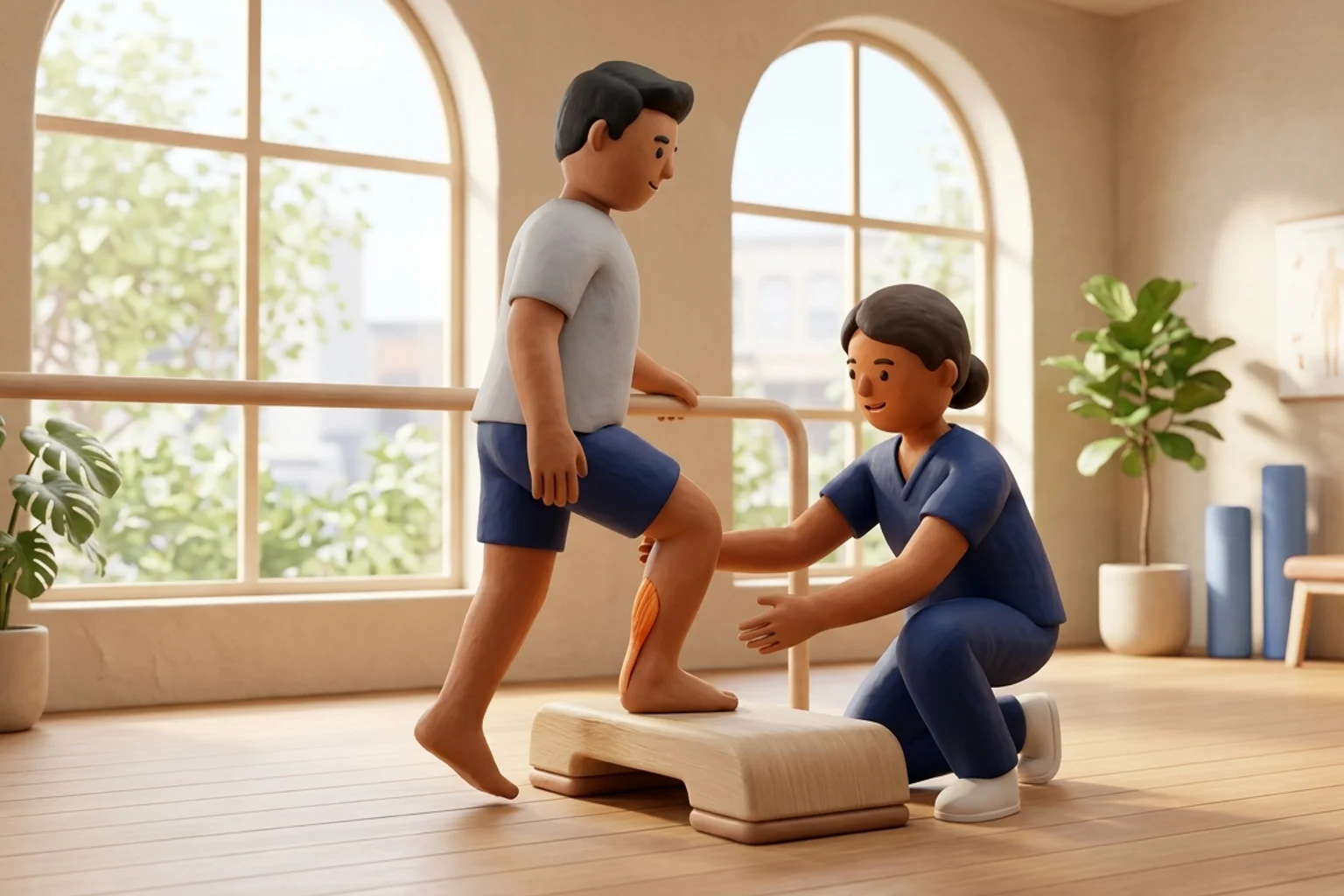
- 1Set up a secure wooden aerobic step or sturdy doorstep in your home, ensuring a solid handrail or wall is within arm's reach.
- 2Perform your supervised heavy slow resistance exercises at home 3 times per week, allowing 48 hours of biological rest between sessions.
- 3Wear a backpack loaded with household items (books or water bottles) to progressively add 2 to 5 kg of resistance as strength improves.
- 4Track your sets, repetitions, and next-morning stiffness in a rehabilitation notebook rather than relying on daily clinic visits.
- 5Schedule a follow-up consultation with your BookPhysio.in physiotherapist once every 2 to 3 weeks solely to evaluate capacity and advance load.
| Feature & Outcome Metric | Advance Package Plans (Commercial Chains) | Transparent Pay-Per-Session (BookPhysio.in) | Clinical & Financial Benefit |
|---|---|---|---|
| Upfront Financial Commitment | ₹15,000 to ₹35,000 paid on day one | ₹0 upfront; pay exact fee per session directly | Zero financial lock-in; complete patient autonomy |
| Session Frequency & Content | Daily visits dominated by passive modalities | 1 visit every 1-2 weeks; active home loading | Respects 48-hour tendon recovery biology and saves patient time |
| Clinician Incentives | Retain patient for maximum package renewals | Educate and discharge patient as rapidly as safe | Aligns practitioner goals with patient independence and recovery |
On BookPhysio.in, you will never be pressured to buy multi-week packages or commit to advance treatment blocks. You pay your verified clinician directly per session in integer Indian Rupees (₹), completely free from platform subscription fees, middleman commissions, or commercial clinic sales quotas that have no place in ethical healthcare delivery. Always prioritize comprehensive clinical evaluation by an autonomous registered physiotherapist to protect your tendon health.
Frequently Asked Questions
How many total physiotherapy sessions will I realistically need to recover from Achilles tendinopathy?
Most patients with midportion or insertional Achilles tendinopathy require only four to six consultations spread across an eight to twelve-week period. The initial session establishes the diagnosis and exercise baseline, followed by bi-weekly or monthly reviews to measure strength gains, adjust resistance, and clear return to athletic activities. Between sessions, you perform your calibrated loading independently at home. Consistently consulting your registered physiotherapist ensures that your exercise parameters are tailored precisely to your tissue capacity.
Do I need a doctor referral to treat Achilles tendinopathy on BookPhysio.in?
BookPhysio.in does not require a doctor referral. Under the National Commission for Allied and Healthcare Professions (NCAHP) Act 2021, patients across India enjoy direct access to autonomous registered physiotherapists. Through BookPhysio.in, you connect directly with verified clinicians and pay per session with transparent fees, completely free from advance package commitments, commission markups, or platform subscription charges.
Related condition guides
Related recovery guides & articles
BookPhysio.in Editorial Team
The BookPhysio.in editorial team writes and maintains this content, checking it against reliable clinical sources. Content follows our medical review policy: general information only, and no page claims a clinical review until a named registered physiotherapist has signed it off.
Read our medical review policy