
Two-Wheeler Kick-Start Impact Strains and Sudden Foot-Downs in Achilles Tendinopathy
In short
Examine the high-velocity impact forces of two-wheeler kick-starts and sudden foot-downs in Indian traffic, and learn how to protect your Achilles tendon.
In this guide (4 sections)
Two-wheeled motor vehicles, ranging from lightweight gearless scooters (such as the Honda Activa or TVS Jupiter) to heavy geared motorcycles (such as the Royal Enfield Classic or Bajaj Pulsar), constitute the primary mode of personal daily transportation for hundreds of millions of people across India. However, the physical mechanics of operating a two-wheeler introduce unique, high-velocity biomechanical hazards that frequently trigger or severely exacerbate Achilles tendinopathy. Two specific operational maneuvers impose intense mechanical stress upon the triceps surae complex: the explosive downward stomp required to kick-start a cold internal combustion engine, and the abrupt, reactive 'foot-down' planting maneuver executed to stabilize a heavy vehicle in stop-and-go urban traffic. Both actions generate violent eccentric impact loading that can provoke acute tendon microtearing and catastrophic re-injury in compromised tissue.
Metropolitan Congestion, Monsoon Puddles, and Pothole Traps
Navigating daily rush-hour commutes in major Indian cities like Bengaluru, Pune, Delhi, Mumbai, and Hyderabad is an arduous physical trial for the lower extremities. In congested traffic crawling along outer ring roads, a rider must repeatedly plant their foot down onto uneven, broken asphalt every few seconds while balancing a vehicle weighing between 110 and 195 kilograms. During the monsoon season, waterlogged roads conceal deep potholes; when a rider's foot unexpectedly plunges into a submerged depression while supporting vehicle momentum, the ankle is forced into sudden, violent dorsiflexion. Furthermore, many older motorcycles and scooters suffer from worn self-starters or dead batteries, forcing riders to kick-start the engine repeatedly in cold morning weather. Kick-starting in flimsy slippers or thin flat shoes on wet pavement creates a perilous environment where a single slipped kick can snap the Achilles tendon.
Peak Rate of Force Development, Kickback Rebound, and Eccentric Overload
The biomechanics of kick-starting an internal combustion engine involve an explosive closed-chain kinetic impulse. The rider stands on the left foot, balances their bodyweight, and forcefully stomps the right foot downward onto the kick-lever against engine cylinder compression. This action demands near-maximal concentric recruitment of the quadriceps and calf musculature, generating ground reaction forces exceeding six to eight times body weight. If the engine experiences high-compression kickback or misfires, the kick-lever violently snaps upward against the descending foot. This abrupt upward impact forces the ankle into instantaneous, violent eccentric dorsiflexion at an angular velocity exceeding 400 degrees per second. In a degenerated tendon with compromised viscoelastic compliance, this massive rate of force development (RFD) easily exceeds the tensile failure threshold of collagen fibrils, precipitating acute structural tears or complete macroscopic tendon rupture during mundane daily activities such as climbing domestic stairs.
Electric Starter Utilization, Rigid Riding Footwear, and Kinetic Progression
For any patient diagnosed with Achilles tendinopathy, modifying motorcycle and scooter operation is an absolute clinical necessity. First, patients must strictly avoid kick-starting vehicles; battery maintenance or starter-motor repairs must be prioritized to ensure reliable push-button electric starting. Second, footwear during daily commutes must be upgraded: riders must never operate two-wheelers in hawai chappals, flat sandals, or flexible running shoes. Instead, sturdy riding boots or high-top work boots featuring a rigid steel or composite shank and a firm heel counter must be worn, which mechanically disperses foot-plant impact forces across the midfoot rather than concentrating stress on the Achilles tendon. Rehabilitation incorporates progressive rapid eccentric deceleration drills and plyometric hopping to rebuild tissue tolerance, eccentric deceleration capacity, and dynamic ankle stability before unrestricted two-wheeler commuting is safely resumed, preventing sudden mechanical relapses in congested metropolitan traffic conditions and eliminating unexpected eccentric spikes during daily riding.
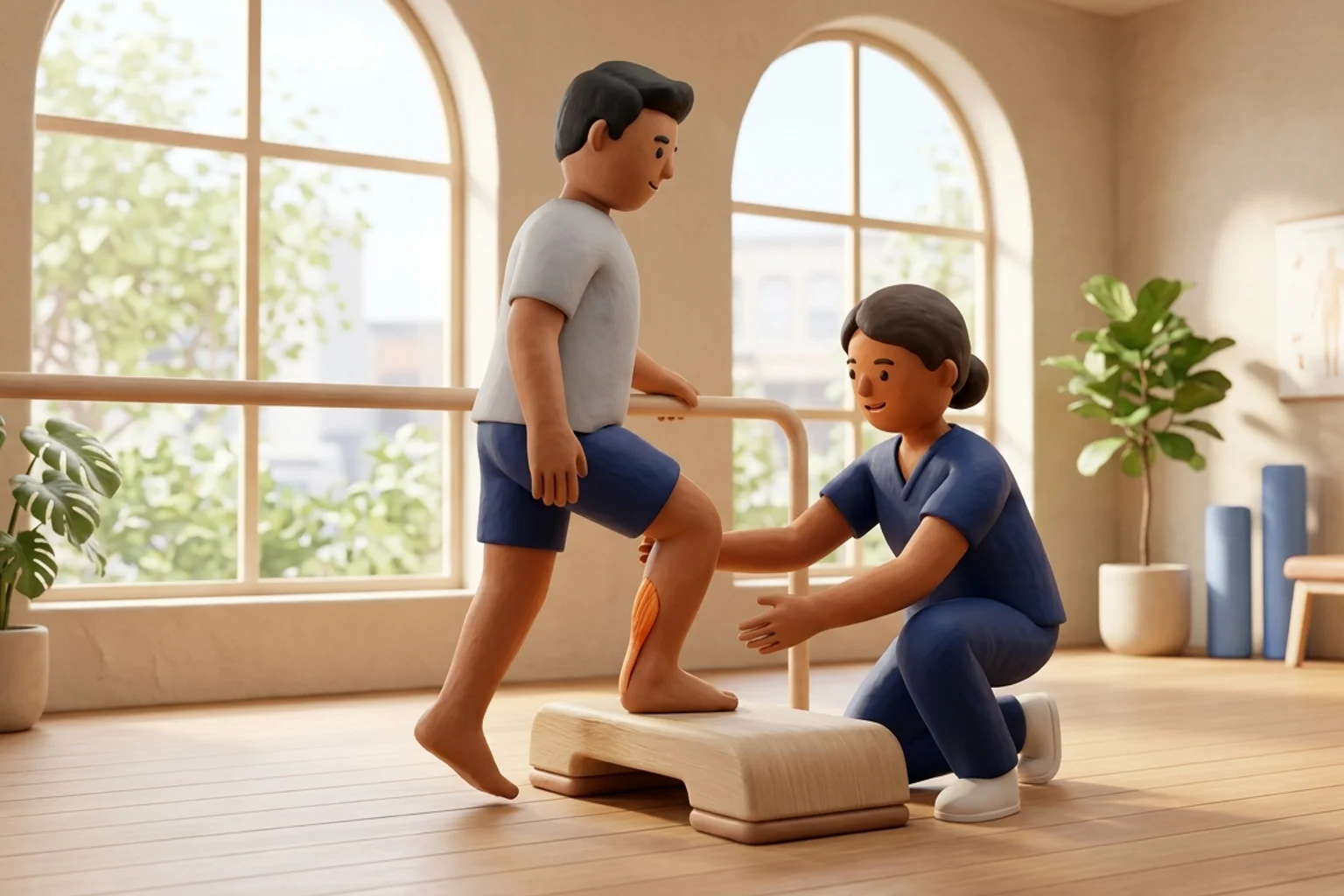
Controlled Rapid Step-Down Deceleration Drill onto Foam Block
Objective: Recondition the triceps surae to absorb sudden eccentric impact forces similar to traffic foot-down stops
- 1Stand tall on an aerobic step platform or bottom stair step wearing sturdy, lace-up athletic trainers.
- 2Hold lightly onto a banister or wall for balance, keeping your weight centered over your uninjured leg.
- 3Step your symptomatic foot forward and down onto a firm, non-slip high-density foam mat or level floor.
- 4Land smoothly on the ball of your foot and decelerate your bodyweight over one second, absorbing the shock through your calf and knee.
- 5Avoid letting your heel smash aggressively into the floor; use your calf muscle actively as a hydraulic shock absorber.
| Operational Task | Mechanical Loading Profile | Achilles Peak Force Vector | Risk Mitigation Strategy |
|---|---|---|---|
| Manual Kick-Starting | Explosive stomp with violent kickback rebound risk | Rapid eccentric dorsiflexion exceeding 8x body weight | Mandatory push-button electric start; ban manual kick |
| Sudden Traffic Foot-Down | Abrupt plantigrade impact absorbing vehicle mass | High compressive shear and sudden tensile shock | Wear rigid-shank riding boots to disperse ground shock |
| Clutch / Rear Brake Operation | Repetitive low-load isometric and concentric pulsing | Low tensile strain; potential mild muscle fatigue | Adjust foot-peg and brake pedal angle for neutral ankle |
| Pothole Impact Landing | Uncontrolled high-velocity drop into negative dorsiflexion | Catastrophic tensile failure risk in degenerated tissue | Maintain moderate speed and scan road surface vigilantly |
During an acute reactive flare of Achilles tendinopathy, operating a manual two-wheeler in dense urban traffic must be suspended for a minimum of ten to fourteen days. The unpredictable need to suddenly plant the foot to prevent vehicle drops in emergency traffic stops poses an unacceptable hazard of macroscopic tendon tearing. Patients should transition to public transit, auto-rickshaws, or carpooling until single-leg hopping is pain-free.
Frequently Asked Questions
My motorcycle battery is dead. Can I kick-start it just once to get to work?
No. Kick-starting a motorcycle when you have active Achilles tendinopathy is an extremely dangerous gamble. If the engine kicks back or if your foot slips off the wet metal lever, your ankle is violently forced into rapid dorsiflexion, creating impact forces exceeding eight times your body weight. This exact mechanism is responsible for countless acute Achilles tendon ruptures seen in Indian emergency rooms. Call a mechanic to jump-start or replace your battery, or take an auto-rickshaw to work until your vehicle electric start is fully operational.
Do I need a doctor referral to treat Achilles tendinopathy on BookPhysio.in?
BookPhysio.in does not require a doctor referral. Under the National Commission for Allied and Healthcare Professions (NCAHP) Act 2021, patients across India enjoy direct access to autonomous registered physiotherapists. Through BookPhysio.in, you connect directly with verified clinicians and pay per session with transparent fees, completely free from advance package commitments, commission markups, or platform subscription charges.
Related condition guides
Related recovery guides & articles
BookPhysio.in Editorial Team
The BookPhysio.in editorial team writes and maintains this content, checking it against reliable clinical sources. Content follows our medical review policy: general information only, and no page claims a clinical review until a named registered physiotherapist has signed it off.
Read our medical review policy