
Work-from-home neck and back pain for IT professionals in India
In short
Long software coding shifts, improvised dining table desks, and marathon video calls take a heavy toll on Indian tech professionals. Learn how physiotherapy resolves WFH spinal strain.
In this guide (6 sections)
The rapid expansion of hybrid and permanent work-from-home (WFH) models across India's technology hubs: Bengaluru, Hyderabad, Pune, Gurugram, Chennai, and Noida: has transformed daily professional routines. However, working from domestic spaces without certified corporate ergonomics has precipitated a massive surge in musculoskeletal disorders. Software developers, cloud engineers, data analysts, and IT project managers frequently endure 10 to 14 hour sedentary workdays seated on dining chairs, sofas, or beds, leading to severe postural strain, chronic headaches, and spinal disc compression.
Unlike standard physical fatigue from manual labour, IT postural strain is characterized by prolonged low-load static muscle contraction. Holding the head forward while peering into dual monitors or a compact laptop screen overloads the posterior cervical musculature, leading to ischemic myofascial trigger points, reduced spinal disc hydration, and altered scapulothoracic kinematics.
1. Common Domestic Workstation Hazards in Indian Homes
Improvised domestic workspaces create predictable physical breakdowns that compound over months of remote work:
- Un-Elevated Laptop Screen on Dining Tables: Looking down at a laptop screen forces the cervical spine into 30 to 45 degrees of flexion, increasing the effective gravitational weight of the skull on the neck from 5 kg to over 18 to 22 kg.
- Firm Wooden Dining Chairs Lacking Lumbar Curvature: Sitting on flat wooden chairs without lumbar support causes posterior pelvic tilting, flattening the lumbar lordosis and shifting intra-discal pressure upward by up to 200 percent.
- Working from Sofas or Beds: Lounging with a laptop on the lap locks the thoracic spine into severe kyphosis, strains hamstrings and piriformis muscles, and restricts deep diaphragmatic breathing.
- Unsupported Forearms and Wrist Extension: Typing on high table edges without forearm armrest support causes chronic trapezius spasm and strains the median nerve within the carpal tunnel.
| Clinical Syndrome | Key Postural Deviation | Involved Anatomical Structures | Primary Clinical Symptoms | |
|---|---|---|---|---|
| Upper Crossed Syndrome | Forward head posture, protracted rounded shoulders, increased thoracic kyphosis | Tight upper trapezius, levator scapulae, pectoralis major; weak deep neck flexors and rhomboids | Suboccipital tension headaches, burning shoulder blade pain, jaw tightness | |
| Lower Crossed Syndrome | Anterior or flattened pelvic tilt, hip flexor shortening, gluteal amnesia | Tight iliopsoas, rectus femoris, erector spinae; weak rectus abdominis and gluteus maximus | Aching lower back upon standing, morning sacral stiffness, piriformis tenderness | |
| Thoracic Outlet Irritation | Slumped shoulders, forward chest compression, shallow apical chest breathing | Scalene muscle spasm, pectoralis minor tightness compressing the brachial plexus | Numbness, tingling, or heaviness radiating down arms into the ring and little fingers |
2. Clinical Physiotherapy Evaluation for Tech Workers
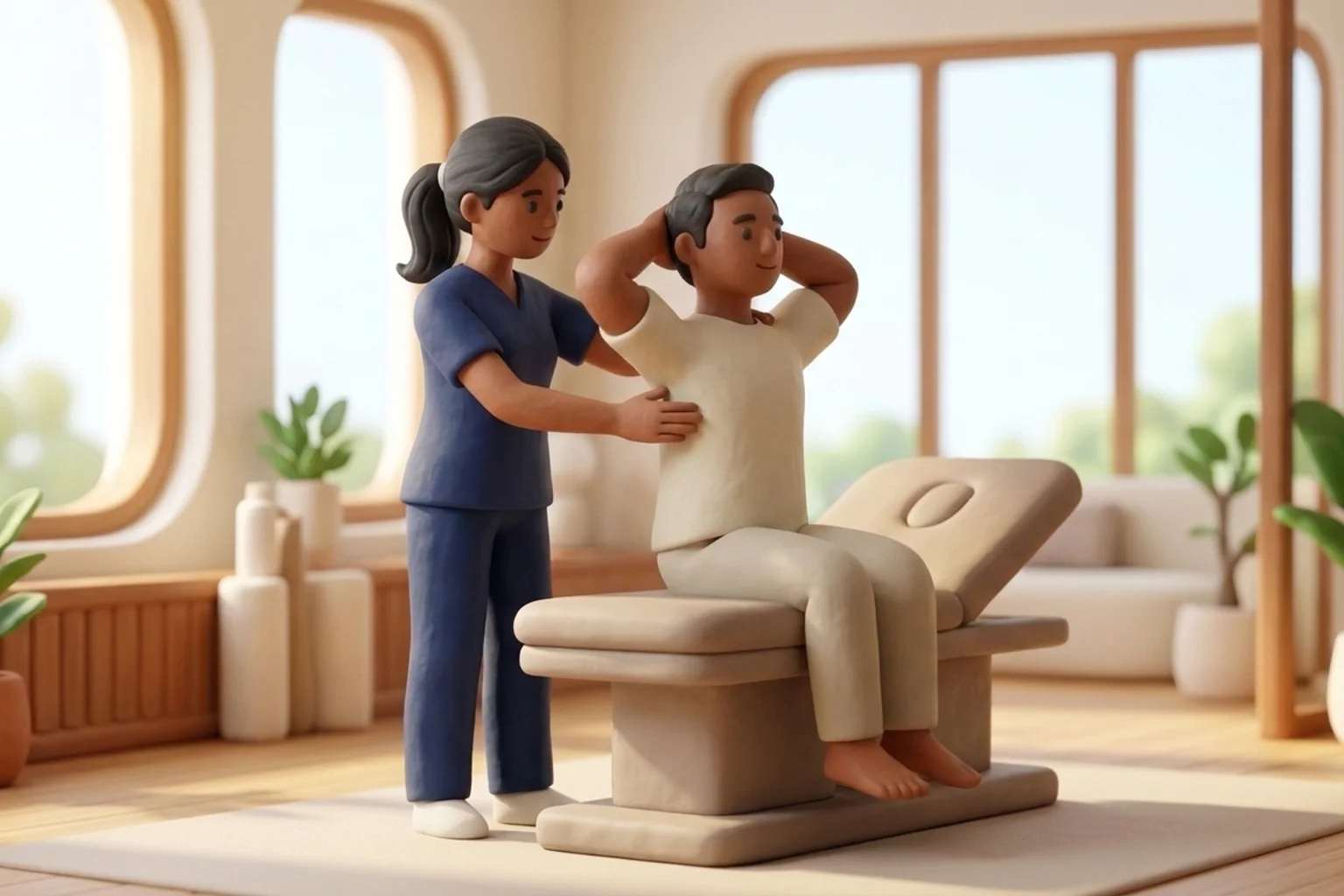
A comprehensive musculoskeletal physiotherapy assessment for remote workers evaluates both local tissue irritation and whole-body postural alignment. The physiotherapist performs:
Cervical Active and Passive Range of Motion Testing: Identifying rotational restrictions and facet joint hypomobility. Postural Ergonomic Screening: Assessing craniovertebral angle using profile alignment metrics. Neurodynamic Testing: Upper limb tension tests (ULTT) to differentiate true cervical radiculopathy from peripheral nerve tethering in the forearm or neck. Core and Scapular Endurance Testing: Evaluating the timed endurance of deep neck flexors (craniocervical flexion test) and scapular stabilizers.
3. Targeted Home Rehabilitation and Desk Exercise Regimen
Desk-Side Postural Reset for Remote IT Professionals
Objective: Activate neglected deep postural stabilizers, open tight anterior anterior muscle chains, and restore segmental spinal mobility.
- 1Brugger Postural Relief Position: Sit on the edge of your chair with knees wide. Turn palms outward, squeeze shoulder blades down and back, tuck chin gently, and take 5 deep diaphragmatic breaths.
- 2Doorway Pectoral Stretch: Stand in a doorway with forearms on doorframes at 90 degrees. Step forward gently until feeling a stretch across chest muscles. Hold for 30 seconds without arching the lower back.
- 3Thoracic Extension over Chair Backrest: Interlace fingers behind your neck to support the cervical spine. Lean back gently over the top edge of your office chair, extending the mid-back. Repeat 10 times.
- 4Prone Cobra / Floor Y-T-W Raises: Lie face down on a mat or firm bed. Lift chest slightly while raising arms in 'Y', 'T', and 'W' formations, squeezing mid-back muscles for 5 seconds per repetition across 2 sets of 10.
4. Step-by-Step Ergonomic Optimization for Indian Apartments
You do not need an expensive corporate budget to create an orthopaedically sound workspace at home. Follow these four foundational rules:
Rule 1: Elevate your screen. Use an adjustable laptop stand or a stack of books so that the top one-third of your monitor is at eye level. Always pair this with an external USB keyboard and mouse so your hands remain relaxed at elbow height. Rule 2: Support your lumbar spine. If using a standard chair, place a rolled-up bath towel or dedicated lumbar roll in the small of your lower back. Rule 3: Maintain 90-90-90 alignment. Your elbows, hips, and knees should rest at roughly 90 to 100 degrees of flexion with your feet firmly flat on the floor or on a footstool. Rule 4: Follow the 20-20-20 rule. Every 20 minutes, look at an object 20 feet away for 20 seconds and perform 3 gentle shoulder rolls.
5. Professional Physiotherapy Options and Costs in India
When home adjustments and stretches are insufficient to alleviate persistent nerve pain, muscle spasm, or cervical headaches, structured in-person physiotherapy provides targeted manual therapy, dry needling, joint mobilisations, and progressive exercise prescription. In Indian metro cities, an outpatient clinic consultation typically ranges between ₹400 and ₹1,500 per session. For professionals experiencing severe acute spasm who cannot travel through traffic, home visit physiotherapy is widely available, costing between ₹600 and ₹2,000 per session. On BookPhysio.in, every practitioner is verified against statutory state councils and patients pay their clinician directly without intermediary commission.
6. Frequently Asked Questions
Can prolonged work-from-home desk work cause permanent spinal damage?
Sustained poor posture rarely causes sudden structural damage, but it accelerates degenerative changes. Over years, uncorrected forward head posture and lumbar slumping dehydrate intervertebral discs, promote bone spur (osteophyte) formation, and cause chronic muscular imbalances. Fortunately, the human spine is remarkably adaptable. Early intervention through physiotherapy, ergonomic corrections, and targeted strength training can reverse symptoms and prevent long-term functional decline.
Is an expensive ergonomic chair necessary to eliminate back pain?
An ergonomic chair helps provide adjustable lumbar support, seat pan depth, and armrest height, but it cannot cure back pain on its own. Clinical research confirms that the best posture is your 'next posture': static sitting in even the most luxurious ₹50,000 ergonomic chair will still lead to spinal fatigue if you remain stationary for 8 hours. Modifying your existing chair with a firm lumbar roll and taking regular micro-breaks is far more effective than relying on furniture alone.
Why do I get headaches after long software coding sessions?
These are typically cervicogenic headaches or tension-type headaches triggered by forward head posture. When your chin juts forward toward a screen, the suboccipital muscles at the base of your skull stay in chronic spasm. These tight muscles compress the greater and lesser occipital nerves, sending referred pain up over the top of the skull and behind the eyes. Physiotherapy manual release of suboccipital tissues combined with deep neck flexor strengthening typically relieves these headaches rapidly.
Should I switch completely to a standing desk?
Switching abruptly to standing all day is not recommended, as it often trades upper back pain for lower back fatigue, plantar fasciitis, and varicose veins. The ideal clinical recommendation is a sit-stand ratio of approximately 30 to 45 minutes of sitting followed by 15 to 30 minutes of standing. Gradually build standing tolerance while wearing supportive cushioned footwear, rather than standing barefoot on hard tiled or marble floors.
How do I know if my arm pain is mouse-related carpal tunnel or coming from my neck?
A qualified physiotherapist differentiates these conditions through clinical cervical and peripheral nerve provocation tests. Cervical radiculopathy (pinched nerve in the neck) typically triggers pain, numbness, or tingling that worsens with neck extension or rotation (Spurling test). In contrast, carpal tunnel syndrome specifically affects the thumb, index, and middle fingers with symptoms worsening after repetitive typing and nocturnal hand numbness. Accurate diagnosis ensures treatment addresses the true anatomical source.
Related condition guides



Related recovery guides & articles
BookPhysio.in Editorial Team
The BookPhysio.in editorial team writes and maintains this content, checking it against reliable clinical sources. Content follows our medical review policy: general information only, and no page claims a clinical review until a named registered physiotherapist has signed it off.
Read our medical review policy