
ACL Reconstruction Rehabilitation Timeline: Milestone-Based Return-to-Sport Guide
In short
Recovering from ACL reconstruction requires adhering strictly to graft ligamentization biology rather than arbitrary calendar dates. Learn milestone-driven protocols from day 1 extension to return-to-sport clearance.
In this guide (5 sections)
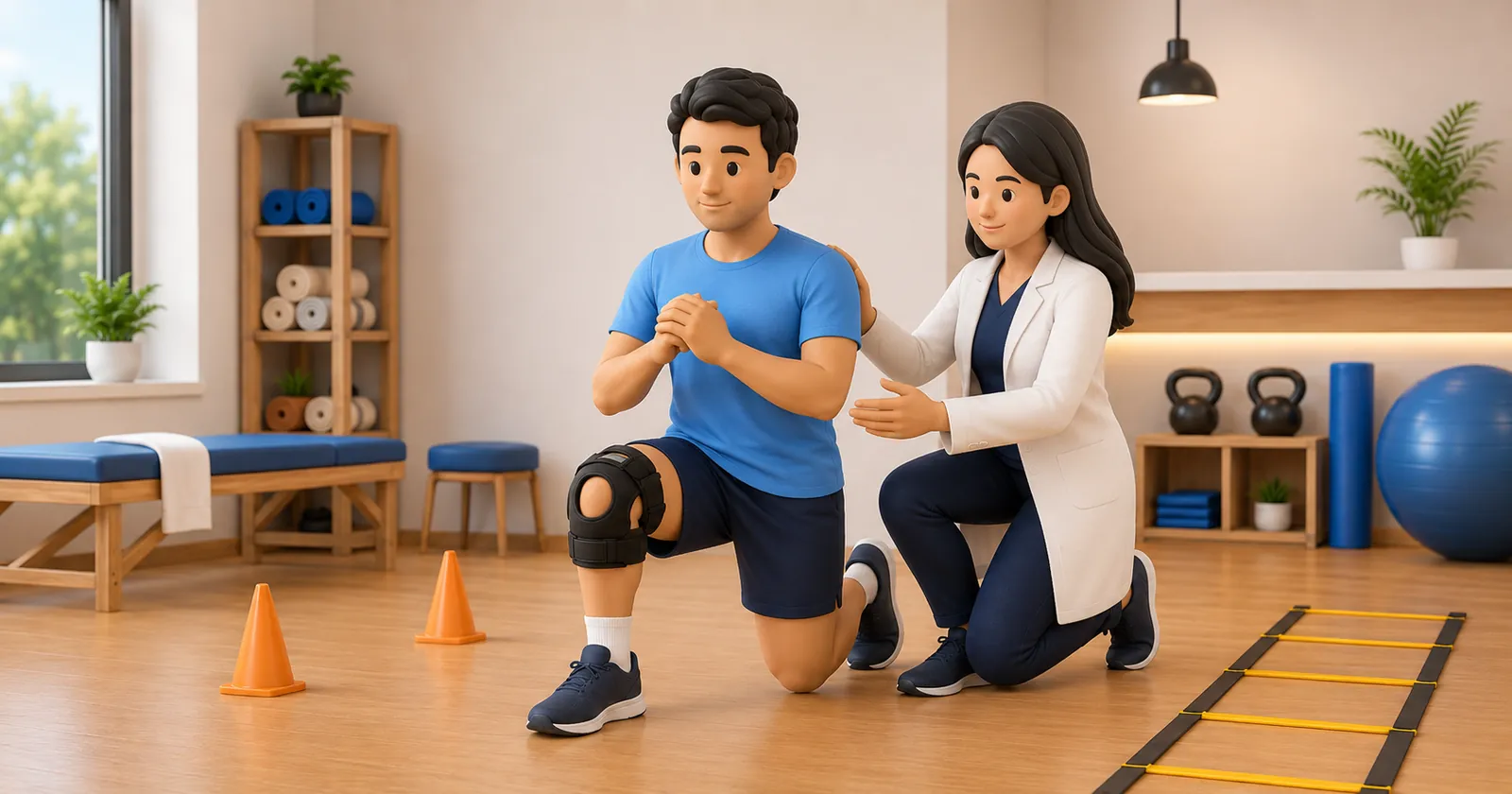
Anterior Cruciate Ligament (ACL) reconstruction is one of the most technically demanding surgical and rehabilitative journeys in modern sports medicine. In India, where competitive cricket, football, kabaddi, badminton, and running have exploded in participation, thousands of young athletes and active adults rupture their ACL annually during non-contact deceleration and pivoting maneuvers. However, orthopaedic surgery merely installs a new biological scaffold inside the knee joint: the ultimate success or failure of the procedure is determined entirely by the precision and biological discipline of the subsequent 9 to 12-month physiotherapy protocol.
Historically, rehabilitation was dictated by rigid, arbitrary calendar timelines (e.g., "start running at 12 weeks, play sports at 6 months"). Modern sports science has thoroughly disproven this dangerous approach. Today, world-class ACL rehabilitation is strictly criteria-based and milestone-driven. Every clinical phase transition is gated by objective physiological benchmarks: zero joint effusion, symmetric quadriceps strength, normal biomechanical movement quality, and psychological readiness, ensuring that athletes return to their sport with minimal risk of catastrophic graft re-tear.
1. Graft Selection and Biological Ligamentization Biology
To navigate rehabilitation safely, both clinician and patient must understand graft biology. In Indian surgical centers, surgeons primarily select one of three autograft sources: the quadrupled Hamstring Tendon autograft (semitendinosus and gracilis), the Bone-Patellar Tendon-Bone (BPTB) autograft, or the Quadriceps Tendon autograft. Each graft type dictates specific early rehabilitation precautions.
A hamstring autograft requires protecting active hamstring contraction for the first 6 weeks to prevent donor-site tendon strain, whereas a BPTB graft demands meticulous patellofemoral joint mobilization to prevent anterior knee pain and patellar tendinopathy. Crucially, regardless of graft choice, every transplanted tendon must undergo an extensive biological transformation known as Ligamentization:
- Weeks 0 to 6 (Early Incorporation & Avascular Phase): The graft is held securely by surgical fixation devices (endobuttons and interference screws), but the graft tissue itself is avascular and undergoes initial central necrosis.
- Weeks 6 to 12 (Revascularization & The Critical Weakness Window): New blood vessels infiltrate the graft tissue. Counter-intuitively, this cellular remodeling makes the graft mechanically at its weakest biological state, even though the patient knee feels remarkably pain-free. Premature running or cutting during this phase carries the highest risk of irreversible graft stretching or rupture.
- Months 3 to 12 (Ligamentous Maturation & Remodeling): The tendon gradually assumes the cellular and biomechanical properties of a native ACL, with collagen realignment and mechanoreceptor regeneration providing essential proprioceptive feedback.
2. The Five Milestone-Based Rehabilitation Phases
Progression through ACL recovery must be governed by strict objective physical testing. Never advance to the next phase until all prerequisite criteria are satisfied:
| Rehabilitation Phase | Target Timeline | Primary Clinical Goals | Prerequisite Clearance Criteria to Advance |
|---|---|---|---|
| Phase 1: Acute Protection & Early Motion | Weeks 0 to 2 | Achieve full 0° passive extension (eliminate extension deficit); control effusion; activate quads | Full passive extension matching contralateral knee; zero extensor lag on straight leg raise; minimal effusion |
| Phase 2: Early Loading & Normal Gait | Weeks 3 to 6 | Restore full knee flexion (>120°); achieve symmetrical, limp-free walking gait; initiate closed-chain quad loading | Normal unassisted gait kinematics; knee flexion >120°; quad strength >60% of uninjured limb |
| Phase 3: Hypertrophy & Neuromuscular Control | Weeks 7 to 16 | Rebuild quadriceps and hamstring muscle volume; progress double-leg to single-leg squats, deadlifts, leg press | Limb Symmetry Index (LSI) >75% on isometric quad dynamometry; Y-Balance test >90% anterior reach |
| Phase 4: Running & Plyometric Progression | Weeks 16 to 24 | Initiate straight-line jogging; train multi-planar deceleration; double-leg to single-leg landing mechanics | LSI >80% quad and hamstring strength; zero effusion flare-up after 20-minute treadmill jogging |
| Phase 5: Return to Sport (RTS) Testing | Months 6 to 12 | High-speed agility, cutting, pivoting, sports-specific drills, psychological confidence clearance | LSI >90% across all 4 single-leg hop tests; quad strength >90%; ACL-RSI psychological score >75 |
3. Core Exercise Protocol: Phase 1 Extension and Quad Reactivation
The single most critical objective in the first 14 days following ACL surgery is achieving full passive knee extension (0 degrees) matching the opposite leg. Failing to regain terminal extension in Phase 1 leads to permanent arthrofibrosis, an abnormal gait pattern, and chronic anterior knee pain.
Phase 1 Knee Extension and Quadriceps Reactivation Protocol
Objective: Achieve zero-degree passive knee extension and overcome Arthrogenic Muscle Inhibition (AMI) in the quadriceps.
- 1Prone Hang Extension: Lie face down on a bed or plinth with both lower legs hanging off the edge from mid-calf down. Let gravity gently draw the operated knee into full passive extension. Hold for 5 to 10 minutes, 3 times daily.
- 2Superior and Inferior Patellar Mobilization: Sit with your operated leg fully relaxed and extended. Use your thumb and index fingers to gently glide the kneecap upward, downward, and side-to-side for 3 minutes to prevent patellar tendon adhesions.
- 3Isometric Quadriceps Sets with Towel Roll: Place a small rolled hand towel under the operated knee. Contract your thigh muscles powerfully, pressing the back of your knee down into the towel while pulling your toes toward your nose. Hold for 6 seconds; complete 3 sets of 15 repetitions.
- 4Straight Leg Raise (SLR) with Zero Extensor Lag: Lock the knee completely straight in full extension. Slowly lift the leg 30 cm off the bed, hold for 3 seconds, and lower smoothly. If the knee bends even slightly during the lift (extensor lag), continue quad sets until full extension locking is mastered.
4. Return-to-Sport Testing Battery and Re-Tear Risk Reduction
Returning to pivoting sports (cricket batting, football, kabaddi) before 9 months post-surgery significantly multiplies graft rupture rates. Clinical research demonstrates that for every month return to sport is delayed up to 9 months, the secondary re-tear rate drops by 51%.
Before clearance, an athlete must pass the validated 4-Hop Test Battery with a Limb Symmetry Index (LSI) of at least 90% (meaning the operated leg achieves at least 90% of the distance of the healthy leg):
- Single-Leg Hop for Distance: Stand on the operated leg, jump forward as far as possible, and stick the landing cleanly on the same leg for 2 full seconds without putting the other foot down.
- Triple Hop for Distance: Perform three consecutive continuous single-leg forward hops on the operated limb, measuring total cumulative distance.
- Crossover Hop for Distance: Perform three consecutive hops, crossing back and forth across a 15-centimetre wide central line on the floor.
- 6-Metre Timed Hop: Hop forward as rapidly as possible across a 6-metre distance, recorded in fractions of a second using a digital stopwatch.
Frequently Asked Questions
Why is achieving 0-degree knee extension more critical than knee bending early on?
While knee flexion (bending) can be regained steadily over several months, knee extension is lost rapidly if not prioritized in the first 2 weeks. A persistent loss of even 3 to 5 degrees of extension alters normal gait kinematics, forces the quadriceps to work 30% harder with every step, and places abnormal compressive loads on the patellofemoral joint, leading to permanent anterior knee pain and early osteoarthritis.
When is it safe to start straight-line running after ACL reconstruction in India?
Running should never begin based strictly on a calendar date (such as 12 weeks). An athlete is cleared for running only when they satisfy strict clinical criteria: at least 16 weeks post-surgery to allow graft remodeling, zero joint effusion, full active range of motion, quadriceps and hamstring strength of at least 80% compared to the uninjured limb on dynamometry, and symmetrical movement quality during single-leg squatting.
Are open-chain knee extensions (leg extension machine) safe after ACL surgery?
Open Kinetic Chain (OKC) seated knee extensions between 45 degrees and 0 degrees (full straightening) place significant anterior shear strain on the healing ACL graft and should be avoided during the first 8 to 12 weeks. However, modern evidence supports performing seated knee extensions in the safe 90-degree to 45-degree flexion arc starting around week 6 to isolate and rebuild the quadriceps without straining the graft.
What is the risk of ACL graft re-rupture upon returning to competitive sport?
Young athletes under age 25 face an estimated 15% to 25% risk of secondary ACL injury (either re-tearing the reconstructed graft or rupturing the contralateral ACL) upon returning to competitive pivoting sports. Passing strict return-to-sport testing (LSI > 90% across hop tests), completing neuromuscular perturbation training, and delaying full return to sport until 9 to 12 months post-surgery reduces this re-tear risk substantially.
How does BookPhysio.in support athletes recovering from ACL reconstruction?
BookPhysio.in connects athletes across Indian metropolitan hubs with certified sports physiotherapists who specialize in ACL reconstruction rehabilitation, biomechanical movement screening, and return-to-sport testing. Book clinic sessions or home visits with transparent per-session pricing (₹400 to ₹1,500 clinic, ₹600 to ₹2,000 home visits) and zero platform commission.
Related condition guides

BookPhysio.in Editorial Team
The BookPhysio.in editorial team writes and maintains this content, checking it against reliable clinical sources. Content follows our medical review policy: general information only, and no page claims a clinical review until a named registered physiotherapist has signed it off.
Read our medical review policy