
Bell's Palsy: Facial Muscle Physiotherapy, Eye Protection, and Preventing Synkinesis
In short
Sudden unilateral facial paralysis requires urgent eye protection and nuanced neuromuscular re-education. Learn why aggressive electrical stimulation worsens synkinesis and how mirror biofeedback restores facial symmetry.
In this guide (5 sections)
Waking up in the morning to discover that one side of your face is completely paralyzed, your eyelid cannot close, drinking water causes spilling from the corner of your mouth, and your smile is severely distorted is a terrifying experience. Clinically diagnosed as Bell's Palsy (idiopathic acute unilateral lower motor neuron facial nerve palsy), this condition strikes individuals of all ages across India, frequently linked to reactivation of the Herpes Simplex Virus (HSV) or swelling triggered by sudden viral respiratory infections and seasonal drafts.
In the panicked rush following diagnosis, patients in India frequently receive outdated medical interventions: specifically, aggressive electrical stimulation applied to delicate facial muscles. Modern neuro-physiotherapy guidelines strongly condemn forceful electrical stimulation because it induces abnormal, disorganized motor nerve sprouting, resulting in permanent, disfiguring Synkinesis (abnormal mass muscle co-contraction, such as the eye closing involuntarily whenever smiling). Successful recovery demands immediate ophthalmic eye protection combined with gentle, nuanced mirror biofeedback and stage-matched neuromuscular re-education.
1. Anatomy of Cranial Nerve VII and the House-Brackmann Grading Scale
The seventh cranial nerve (Facial Nerve) emerges from the brainstem and navigates through a remarkably narrow bony tunnel within the temporal bone (the Fallopian Canal) before exiting the skull at the stylomastoid foramen. Once outside, it passes through the parotid gland and divides into five distinct terminal motor branches: the Temporal, Zygomatic, Buccal, Marginal Mandibular, and Cervical branches.
When viral infection triggers acute inflammation, the facial nerve swells. Trapped inside the rigid bony canal, the swollen nerve experiences acute compression ischemia, halting the transmission of electrical action potentials to the facial muscles of expression. Clinicians classify severity using the validated House-Brackmann Scale:
- Grade I (Normal Function): Completely symmetrical facial movement across all quadrants with normal tone and forehead wrinkling.
- Grade II (Mild Dysfunction): Slight facial weakness noticeable only on close inspection; normal symmetry at rest; complete effortless eye closure.
- Grade III (Moderate Dysfunction): Obvious unilateral weakness, but not disfiguring; symmetry at rest preserved; complete eye closure achieved with effort.
- Grade IV (Moderately Severe Dysfunction): Obvious disfiguring asymmetry at rest; marked weakness on smiling; inability to close the eye completely (lagophthalmos).
- Grade V to VI (Severe to Complete Paralysis): Barely perceptible movement to total absence of tone; facial drooping at rest; complete loss of taste and tearing control.
2. The Eye Protection Imperative: Preventing Corneal Blindness
The single most dangerous acute medical complication in Bell's palsy is not cosmetic asymmetry, but irreversible corneal ulceration. Because the Orbicularis Oculi muscle is paralyzed, the patient cannot blink or close their eyelid (Lagophthalmos). When attempting to shut the eye, the eyeball rolls upward and outward to protect itself (the physiological Bell's Phenomenon), but the lower cornea remains exposed to ambient air, dust, and drying.
| Time Window | Mandatory Eye Protection Action | Required Ophthalmic / Physical Tools | Risk of Non-Compliance |
|---|---|---|---|
| Daytime Hours (Every 1-2 Hours) | Instill preservative-free lubricating artificial tear drops; manually close the eyelid with clean fingers | Carboxymethylcellulose 0.5% or Sodium Hyaluronate 0.1% drops; UV-protective sunglasses | Corneal desiccation, painful keratitis, punctate epithelial erosions |
| Outdoor Exposure in Indian Traffic | Wear clear protective wrap-around moisture chamber glasses or sunglasses outdoors | Close-fitting wrap-around eyewear protecting against dust, wind, and vehicular pollution | Foreign body corneal abrasion, acute bacterial conjunctivitis |
| Nighttime Sleep Protocol | Apply thick lubricating ophthalmic ointment; tape eyelid shut using medical micropore paper tape | High-viscosity white soft paraffin eye ointment; hypoallergenic breathable micropore tape | Severe nocturnal exposure keratopathy leading to permanent corneal scarring and vision loss |
3. Why Forceful Electrical Stimulation Is Strictly Contraindicated
In many private clinics across India, patients with Bell's palsy are subjected to galvanic or faradic electrical stimulation machines. International facial nerve rehabilitation societies strongly warn against this practice.
Facial muscles are unique: they have no muscle spindles and insert directly into the superficial skin and fascia rather than bones. When high-voltage electrical stimulation is applied indiscriminately across the cheek, it excites all facial nerve branches simultaneously. As the damaged nerve axons attempt to regenerate (growing at roughly 1 millimetre per day), the electrical chaos causes misdirected axonal branching. Motor fibers meant for the mouth sprout into the eyelid, and fibers meant for the eye sprout into the cheek, locking the patient into permanent, disfiguring Synkinesis (e.g. eye shutting tightly whenever chewing food).
4. Three-Phase Neuromuscular Facial Re-education Protocol
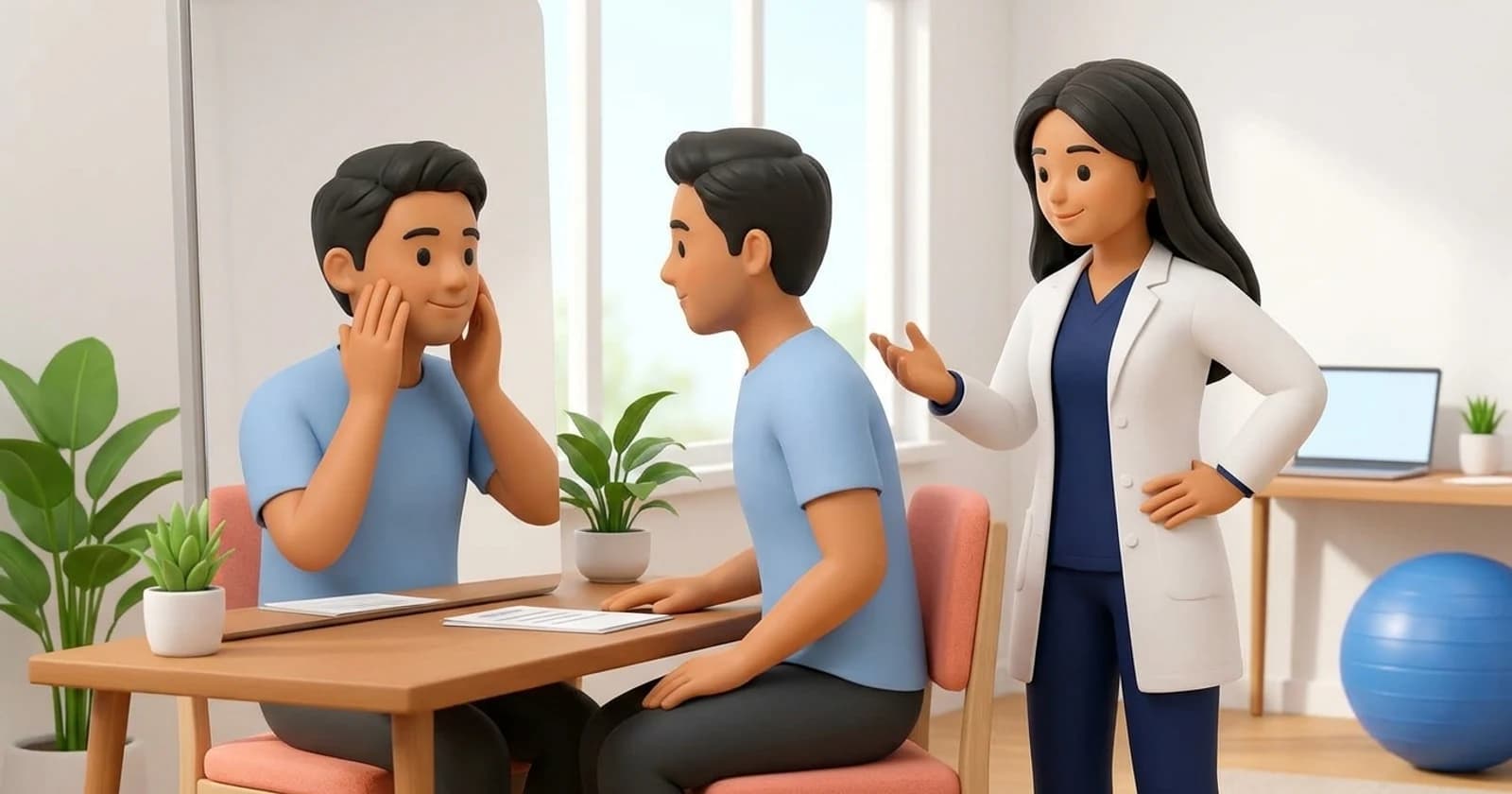
Safe facial rehabilitation utilizes mirror biofeedback, manual trophic massage, and slow, submaximal, symmetrical movement re-education.
Three-Phase Mirror Biofeedback and Neuromuscular Re-education Protocol
Objective: Maintain facial soft tissue flexibility, reactivate isolated facial expressions, and prevent synkinetic co-contractions.
- 1Phase 1 (Acute Flaccid Stage, Trophic Effleurage): Sit comfortably. Using a drop of light coconut or almond oil, use clean fingertips to perform gentle, upward effleurage strokes from the chin to the ear, cheek to temple, and eyebrow upward for 5 minutes. Gentle manual massage maintains microvascular circulation and prevents muscle contracture without stretching flaccid tissues.
- 2Phase 2 (Subacute Paresis Stage, Assisted Symmetrical Expressions): Sit in front of a mirror. Gently assist the paralyzed side using your index finger while performing small, symmetrical expressions. Gently close both eyes together lightly (never squeeze tightly); hold for 3 seconds. Practice a gentle, subtle smile showing only the upper teeth, keeping the eyes completely open and still. Complete 5 repetitions, 3 times daily.
- 3Phase 3 (Active Symmetrical Motor Control): As volitional movement returns, eliminate finger assistance. Practice isolated lip pursing (whistling position), gentle nasal flaring, and subtle eyebrow elevation. The golden rule is Submaximal Effort: never exert more than 30% to 50% effort. Forcing a maximal grimace triggers aberrant motor overflow and synkinesis.
- 4Speech and Drinking Adaptations: Drink liquids through a straw positioned slightly toward the non-affected side, and practice pronouncing bilabial consonants (P, B, M) while using your finger to support the paretic lip.
Frequently Asked Questions
How long does it take to fully recover from Bell's palsy in India?
Approximately 70% to 80% of individuals with Bell's palsy begin showing signs of spontaneous motor recovery within 2 to 3 weeks, achieving complete functional facial symmetry within 3 to 6 months, particularly when prescribed high-dose oral corticosteroids (such as Prednisolone) by an ENT or neurologist within the first 72 hours of symptom onset. Cases with severe nerve degeneration (House-Brackmann Grade V-VI) require 6 to 12 months of careful neuromuscular physiotherapy.
What is facial synkinesis and how can it be prevented in Bell's palsy?
Synkinesis is an abnormal involuntary movement of one facial muscle group occurring simultaneously with voluntary movement of another muscle group (such as the eyelid closing tightly whenever the person smiles, or the cheek twitching whenever blinking). It is caused by aberrant, misdirected axonal regeneration. It is prevented by avoiding aggressive electrical stimulation, practicing slow, submaximal facial movements in front of a mirror, and keeping the eyes relaxed during mouth movements.
Can facial exercises be started immediately on the first day of Bell's palsy?
During the first 3 to 5 days, the primary medical priorities are starting oral steroid therapy prescribed by a doctor and executing meticulous eye protection (eye drops, ointment, and nighttime eye taping). Aggressive active exercise is unnecessary during the peak inflammatory phase. Gentle manual upward facial massage and eye protection should begin immediately, with active mirror biofeedback commencing as soon as early nerve regeneration begins around week 2.
How can you tell the difference between Bell's palsy and an acute stroke?
In an acute stroke (upper motor neuron lesion), the forehead muscles are spared because the upper face receives bilateral cortical innervation from both hemispheres of the brain: the patient can still wrinkle their forehead and raise both eyebrows symmetrically, despite drooping of the lower mouth. In Bell's palsy (lower motor neuron lesion), the entire half of the face is paralyzed, including complete inability to wrinkle the forehead or raise the eyebrow.
How does BookPhysio.in assist patients recovering from Bell's palsy?
BookPhysio.in connects patients across India with specialized neurological physiotherapists trained in modern facial neuromuscular re-education, mirror biofeedback, and synkinesis prevention. Patients receive individualized, evidence-based care with transparent per-session pricing (₹400 to ₹1,500 clinic, ₹600 to ₹2,000 home visits) and zero platform commission.
Related condition guides

BookPhysio.in Editorial Team
The BookPhysio.in editorial team writes and maintains this content, checking it against reliable clinical sources. Content follows our medical review policy: general information only, and no page claims a clinical review until a named registered physiotherapist has signed it off.
Read our medical review policy